Capacity, in the context of batteries, refers to the total amount of electric charge a battery can store and deliver, typically measured per unit mass (specific capacity) or per unit volume (volumetric capacity). It is a fundamental parameter that determines how long a device can run on a single charge. Higher capacity means more energy stored in a lighter or smaller package, which is critical for portable electronics, electric vehicles, and grid storage.
History
The concept of battery capacity has been central since the development of the first practical battery by Alessandro Volta in 1800, though the modern understanding of capacity in terms of charge and energy density evolved with the advent of rechargeable batteries in the 19th century.
How it works
Battery capacity is determined by the amount of active material that can undergo electrochemical reactions. During discharge, chemical energy is converted to electrical energy as ions move from the anode to the cathode through an electrolyte, while electrons flow through an external circuit. The capacity is limited by the quantity of charge carriers available in the electrodes and the efficiency of the reactions. Improving capacity often involves finding new materials with higher energy density or optimizing the electrode structure to allow more ions to be stored.
The specific capacity of a lithium-ion battery is about 150-250 mAh/g, but a single gram of a supercapacitor material can store up to 500 F, which is why supercapacitors can charge almost instantly but hold much less energy overall.
Atomic batteries powered by plutonium decay have been running pacemakers and space probes for over sixty years. But the raw material is scarce: worldwide, only a few kilograms of plutonium-238 are produced each year, barely enough for the most critical missions.
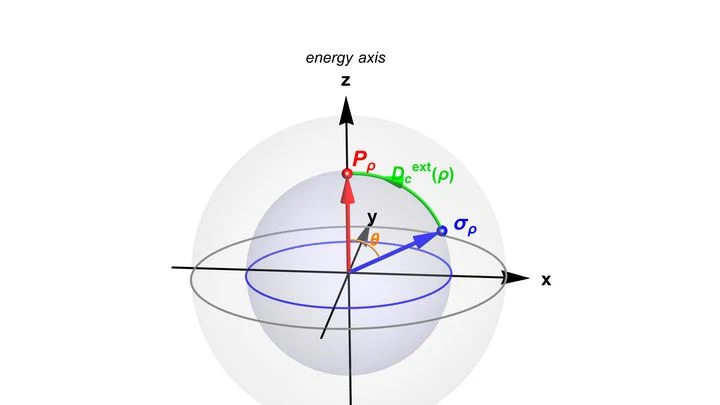
Electric charge is a slippery thing. You can measure how much there is in the entire universe or in a single particle, but try to point your finger and say, 'Right here, in this cubic centimeter, there is exactly this much charge right now,' and you hit a fundamental wall.
The issue is that total charge, which physicists denote by the letter Q, is nonlocal.
A carousel doesn't just spin you around in a circle — with each revolution, it also slightly screws itself into the ground. This corkscrew-like motion is the essence of the NUT charge, a special property of spacetime that physicists have been studying since the mid-20th century.
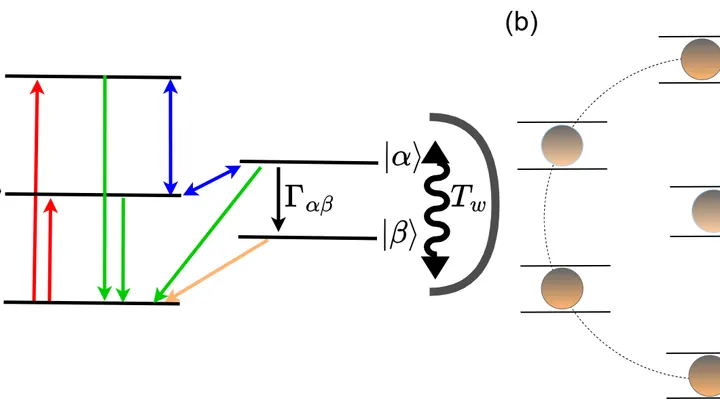
Any battery, from a AA to a quantum one, is simple in principle: there's a store of energy, and there's a way to get it out. In the quantum world, this 'way' looks like a careful switching between particle states, akin to moving a ball from a high shelf to a low one.
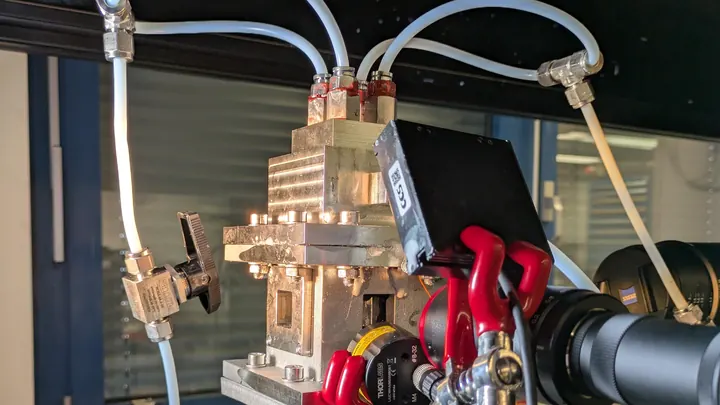
Crystals glued to the outside and inside of a metal wall act as an invisible channel. One, receiving current, starts to tremble, and these vibrations, like ripples on water, spread out in all directions through the metal. The inner crystal catches this tremor and generates electricity again.
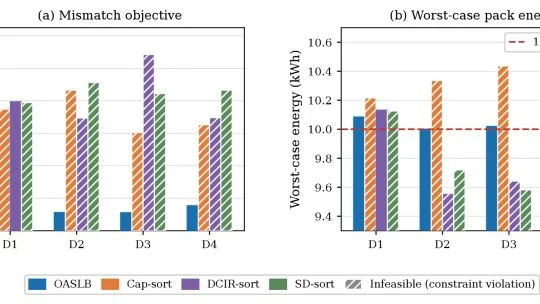
Used EV batteries behave like moody musicians: one plays too loud, another too soft, a third goes out of tune for no reason. Slapping them together randomly creates a cacophony: some cells get overloaded, others sit idle, and the system fails quickly.
Engineers turned this problem into a conductor's challenge.
Every civilization is born with a gravitational debt. The home planet's mass determines the loan amount, and the Tsiolkovsky equation is the interest rate applied to each kilogram of payload. To send a probe to the stars, you have to pay with fuel, and the debt grows exponentially.
Two pendulums hang from the same crossbar. A push, and they start swinging, gradually falling into and out of sync. In a topological qubit, Majorana particles, special excitations that can store quantum information, play the role of these pendulums.
The atomic nucleus is a natural spring of colossal power. When the protons and neutrons inside it rearrange, it enters a special long-lived state — a nuclear isomer. It stores energy like a spring compressed to its limit.
Battery aging is like metal fatigue: a crack grows inside long before the part breaks. Usually, you only learn about the problem when capacity drops below 80%—but by then, the damage is irreversible.
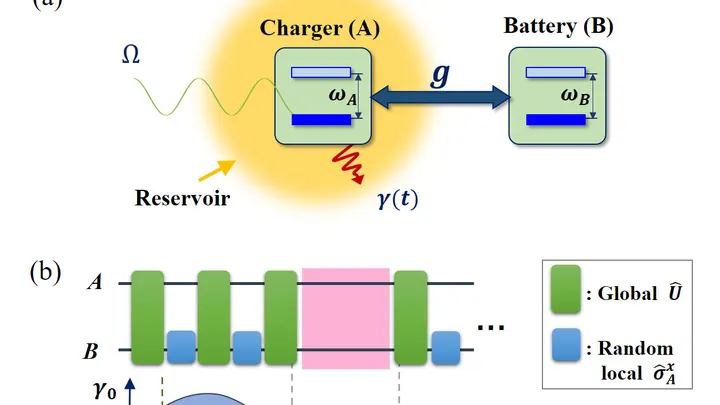
Quantum batteries harness quantum effects to circumvent the limitations of ordinary devices imposed by entropy — a measure of disorder and energy losses. Imagine a bucket under a powerful jet: filling is lightning-fast. But the bucket has holes: the environment constantly drains the energy.
Ordinary batteries lose charge like tea cools down. A quantum battery works differently: its heart is a tiny cavity with darting photons. If you illuminate it with special photon pairs, energy flows into a chain of qubit cells instantaneously — much like a swing gets a boost from strong pushes.
An ordinary battery in a phone stores energy in chemical bonds — slowly, with heat and wear. A quantum capacitor works differently: it charges not with matter but with rhythm. A swing that is pushed in time with its motion accumulates energy in the motion itself, without friction.
A quantum battery is not a box of chemicals but a chain of tiny magnets (spins) capable of storing energy. Its main trick: charge many particles at once, using their quantum entanglement. But there's a catch — not all entanglement works.
An ordinary phone battery breathes — not with air, but with contact. Inside a solid body, where there are no liquids, lithium presses against the electrolyte (the ion-conducting substance) during charging and pulls away during discharging, like a lung on inhale and exhale. This 'breathing' is not poetry but physics: each cycle creates and destroys the contact points through which current flows.
An optical tweezer is a laser beam that holds an atom in place, much like fingers holding a pea. Arrays of these tweezers form the basis of future quantum computers. But there's a catch: not every tweezer catches an atom. Typically, only half of the traps get filled, and for molecules, even fewer. Empty spots break the whole setup.
Steam rising from hot metal is a familiar sight in the kitchen. But if you use rubidium instead of water, that cloud becomes a battery. It doesn't run on chemical reactions but on the quantum coordination of atoms.
Splitting water into hydrogen and oxygen with electricity is an age-old dream of clean fuel. But tiny gas bubbles stand in the way: they cling to the electrodes like foam on the side of a soda glass, interfering with the current's work. Each bubble is a tiny plug, blocking part of the surface where the reaction should occur.
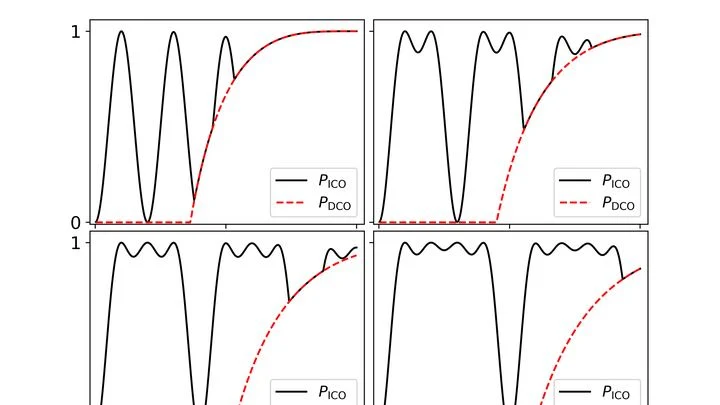
In quantum batteries, charging can be accelerated by shuffling the steps in time, like a deck of cards. Instead of a smooth energy climb, you get abrupt efficiency explosions, like microscopic supernovae inside atoms.
A conventional graphite anode in a sodium battery is like a cramped garage that barely fits a large truck. Sodium is larger than lithium and doesn't fit well between graphite layers, so batteries quickly lose capacity.
The quantum battery works like a sponge that absorbs light but won't release it without a forced squeeze. The inspiration came from bacteria's natural solar traps: capturing solar photons, they transfer energy almost losslessly, as proven by spectroscopy.
A lithium battery is like a house with a storage room: during charging, lithium goes inside; during discharging, it comes out. But if the storage room gets cluttered, some lithium stays inside forever. How much lithium returns depends on the metal the walls are made of.
The authors of the study took four metals: aluminum, magnesium, silver, and copper.
Two phones with identical batteries: one charges in a basement with a weak signal, and the process goes slower. The battery percentage here plays the role of a clock hand. Physicists applied the same logic to the quantum world. Their clock is a microscopic battery that stores energy. The charging rate depends on a hidden quantum 'mode'—like a switch.
In a regular battery, the electrolyte is liquid, and charged particles (ions) move freely. In the solid-state version, they squeeze through atomic 'corridors', like pedestrians in narrow passages. For a battery to work quickly, you need a material with high ionic conductivity.
A cell is a city where tiny motors work nonstop. They carry cargo, move cilia, and make muscles contract. All this work generates heat, just like a car engine warms up. But measuring the heat from a single motor a few nanometers in size is no easy task.
Stochastic modeling helps us peek into this world.
A quantum battery is a device that stores energy in the quantum states of particles. In the new work, the battery was modeled as a pair of qubits — the tiniest carriers of information that can be in a "zero" state, a "one" state, or a mixture of both.
Manganese is like bricks in a wall, and zinc is a guest that comes and squeezes in between them. If the guest sits awkwardly, it pushes a brick out of the masonry. That's roughly what happens in a zinc-ion battery: during discharge, zinc ions insert into the crystal lattice of manganese oxide, and manganese starts to wash out into the solution.
Since the days of Galileo, it was believed that in a vacuum all bodies fall identically. Einstein elevated this to a principle: gravity travels at the speed of light and is the curvature of spacetime.
Diamond is not just a gemstone. This crystal can conduct electricity when free charge carriers, electrons and holes, appear in it. But how fast do they move? In scientific papers, numbers vary by tens of times. One lab reports a mobility of 1000 cm²/(V·s), another 4000.
A piece of chromium exposed to air gets covered in invisible armor, an oxide film, within a minute. That film protects the metal from rust, but for a battery it's a disaster: the film blocks chromium ions, so no current flows.
Scientists mixed five metals — chromium, bismuth, copper, tin, and nickel.
After an injection under the skin, a drug doesn't just spread out like ink in water. Antibody molecules carry an electric charge, and that charge makes them interact with surrounding tissues — much like a magnet attracts or repels iron filings.
An orchestra without a conductor, where each musician hears only the hall's echo, can create a powerful melody. That's how a quantum battery works: many particles, immersed in a warm environment, don't dissipate heat but exchange it synchronously. Instead of chaos, an orderly charge emerges.
A thermometer dipped into a sample usually tells you only the temperature. But if the temperature oscillates slightly and the sample responds with a delay, that response hides more: the imaginary part of the heat capacity, which turns out to be able to hear the quantum echo of time.
A quantum battery is not a box of electrolyte but a handful of atoms or superconducting loops, with energy stored in excited states. It can be charged in fractions of a second using collective quantum effects.