A Particle on the Brink: What Holds the Mysterious X(3872) Together express
In the city of elementary particles, there is a house right on the edge — X(3872). It sits exactly on the line separating it from decaying into two lighter structures: a D meson and an anti-D meson. Give it a nudge, and it would fall apart. But the house stands.
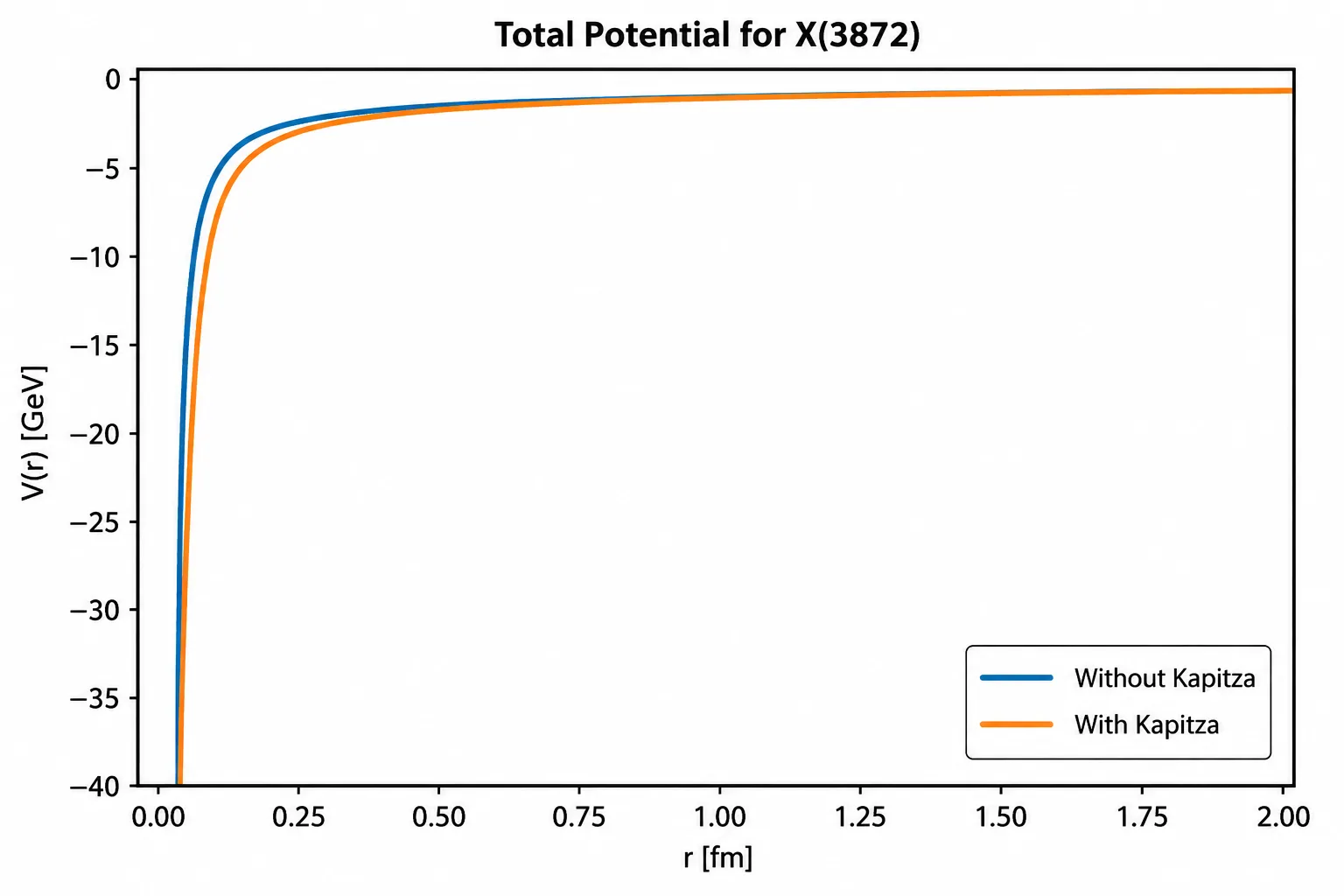
Physicists have long debated what holds it together. The usual force, the color interaction between quarks, is weak at large distances. The authors of the new study added an unusual detail to the foundation: rapid gluon fluctuations. Gluons are the carriers of the strong force; they dart between quarks. When their motion is very fast, it creates, on average, an additional attraction, like vibration driving a pile deeper into the ground. This effect is called the Kapitza-like term: a similar principle keeps a ball in a vibrating funnel.
Solving the Schrödinger equation with such a potential gives a particle mass of 3871.7 ± 0.9 MeV — a perfect match with experiment. The analysis shows that X(3872) is not just a molecule of two mesons. Inside it, there is a dense core — a compact tetraquark (four quarks in a tight bind). About 65–72% of the time, the particle behaves like a loose pair of D mesons, and 28–35% of the time, like a tight bundle of four quarks.
The model also predicts excited states of X(3872)—higher energy levels of the same quark ensemble. If they are found at colliders, it would be strong confirmation of the idea. So the house on the edge gets a blueprint: we now know not only why it stands, but also what extra floors could be added.
Original abstract
as written by the authors arXiv:2607.17402
The X(3872) remains one of the most intriguing exotic hadrons, lying extremely close to the $$D^0\bar{D}^{*0}$$ threshold. We construct an effective potential consisting of Coulomb, linear confinement and a Kapitza-inspired term representing the averaged effect of fast gluonic fluctuations. Numerical solution of the Schr\"odinger equation shows that this term provides effective attraction in the intermediate-distance region, yielding a ground-state mass of $$3871.7 \pm 0.9$$ MeV in excellent agreement with experiment. Coupled-channel analysis indicates a dominant molecular component ($$\sim 65\%-72\%$$) with a significant compact tetraquark core ($$\sim 28\%-35\%$$). We also present predictions for low-lying excited states. The model offers a physically motivated mechanism for threshold tuning.
The mass of X(3872) matches the sum of the masses of the D meson and anti-D meson to within 0.1%. It's as if a brick weighed exactly the same as its two fragments together — physicists call this situation "threshold tuning."
In Sergei Lukyanenko's novel "The Atomic Dream," intelligent quark structures are described that can change their shape — much like X(3872) oscillates between a molecule and a tetraquark.