The MeV (megaelectronvolt) is a unit of energy equal to one million electronvolts. An electronvolt is the energy an electron gains when accelerated through a potential difference of one volt, a tiny amount by everyday standards—about 1.6 × 10⁻¹⁹ joules. The MeV, however, is the natural scale for processes at the level of atomic nuclei and individual particles: nuclear decays, particle collisions, and the energies of photons in gamma-ray bursts. It is the standard currency for describing the masses of particles (via E = mc²), the binding energies of nuclei, and the thresholds for producing new particles in accelerators.
History
The electronvolt was introduced in the early 20th century as a convenient unit for single-particle energies in atomic physics. The prefix 'mega' (million) became standard in the 1930s as particle accelerators reached energies far beyond the keV scale, making the MeV a natural unit for nuclear physics.
How it works
In practice, the MeV is used to quote the kinetic energies of charged particles in accelerators and detectors, the energies of photons in nuclear transitions, and the rest masses of particles like electrons (0.511 MeV) and protons (938 MeV). When a particle with energy in the MeV range interacts with matter, it deposits that energy in a localized way—ionizing atoms and creating measurable signals in detectors. This is why the unit appears across the corpus: from neutrino experiments looking for signals at 17 MeV, to cosmic-ray studies comparing particle energies, to neutron scattering experiments probing nuclear structure.
In practice
The MeV is used to calibrate detectors in nuclear medicine (e.g., positron emission tomography), to specify the energies of therapeutic radiation beams in cancer treatment, and to report the energies of particles in high-energy physics experiments.
Fun fact
The energy released by splitting a single uranium-235 nucleus is about 200 MeV—enough to lift a grain of sand by a fraction of a millimeter, yet multiplied by billions of nuclei it powers nuclear reactors.
Systems:naturalOne million electronvolts, where one electronvolt is the energy gained by an electron accelerated through one volt; in SI, 1 eV = 1.602176634e-19 joules.
For three days straight, a laser blasted a jet of gas, and every second it produced a beam of electrons with the energy of a tiny lightning bolt. Previously, such beams could only be produced in huge halls where the accelerator takes up an entire building. Now the whole setup fits in a room and ran without a glitch for 72 hours.
A proton beam aimed at a tumor cuts through soft tissue like a knife through butter, but its range depends on the subtle properties of water, the stuff we're mostly made of. Water is the body's main component, and how quickly protons slow down in it determines exactly where they deposit their energy.
At the center of a distant galaxy, where a supermassive black hole weighing a hundred million suns spins, space is threaded with magnetic fields. They coil into tight vortices, like a drain in a sink, but instead of water, there's plasma whipped up to near-light speeds.
An old factory where instead of machines there are atomic nuclei, and neutrino radiation seethes all around. When a massive star exhausts its fuel, its core compresses a hundredfold, and the temperature skyrockets to billions of degrees.
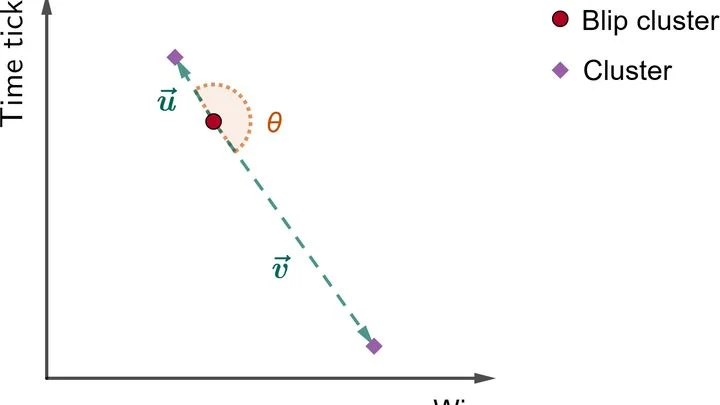
A chamber the size of a small truck is filled with liquid argon at minus 186 degrees Celsius. When a particle flies in, it knocks electrons off argon atoms, and those electrons drift toward the walls, tracing a three-dimensional picture of the event.
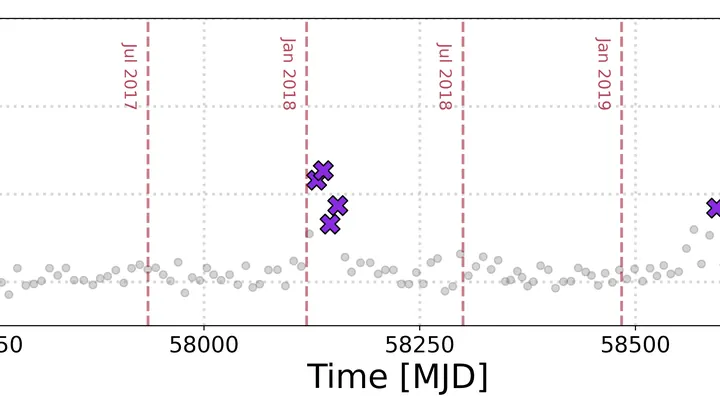
A spotlight shines ever brighter, but at some limit the bulb suddenly burns out, and no more light comes through. Astrophysicists have seen something similar in the distant blazar Markarian 421. This is an active galaxy whose jet of superheated plasma points almost straight at Earth, like the beam of a cosmic lighthouse.
A detector filled with superfluid helium-4 is like a perfectly still lake. The liquid doesn't slosh or bubble: it's frozen in a single quantum state. An invisible guest, a dark matter particle, flies through it. It doesn't shine or leave a track. But sometimes it nudges a helium nucleus.
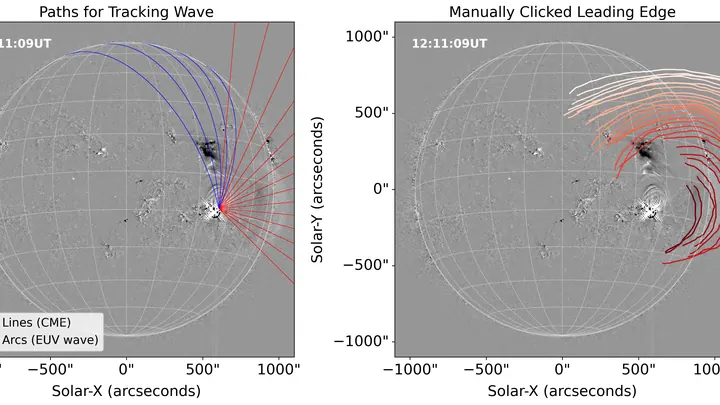
A shock wave in the Sun's corona is like the sonic boom from an airplane, except instead of air there is scorching plasma, and instead of sound there is a jump in density and magnetic field. On March 10, 2024, such a wave swept across the western part of the solar disk.
A high-speed collision knocked a neutron out of a helium-8 nucleus, and for an instant a helium-7 nucleus appeared, like an overloaded shelf shedding three books at once. This fleeting 'sound' of decay was captured for the first time: three neutrons flew apart, leaving behind an ordinary helium-4 nucleus.
Twenty-eight seconds: that's how long it took for an automated camera to lock onto a flash in a constellation whose light had traveled for more than nine billion years.
In the 19th century, James Clerk Maxwell imagined a tiny demon. It knows the speed of every gas molecule and opens a door: fast ones to the left, slow ones to the right. This creates a temperature difference without expending energy, seemingly violating the laws of physics.
A solar flare is like an explosion in the atmosphere: bright, fast, with different 'voices.' X-rays come from electrons that have been accelerated and then abruptly slowed down, losing energy. But in 2017, detectors on the Fermi satellite caught a different signal — gamma rays that didn't fit this picture.
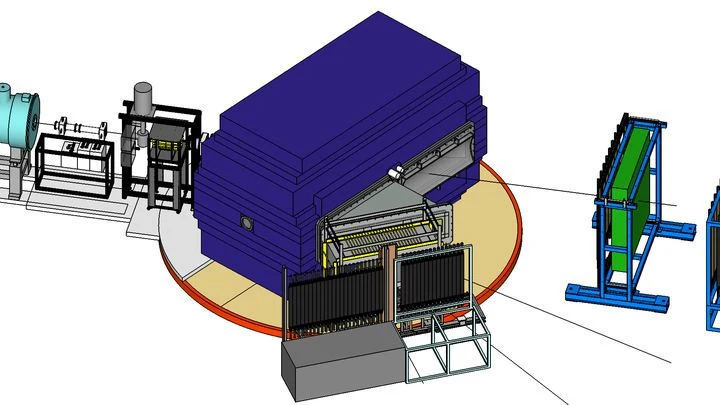
The neutron is a particle with no charge but with internal structure. Like a ball that looks smooth on the outside but has a complex filling inside. Scientists have long wanted to understand how electric and magnetic forces are distributed inside the neutron. To do this, you need to "feel" it — collide it with its antiparticle and see what happens.
In a tank of pure water, particles traveling faster than light in that medium leave bluish flashes, like a plane breaking the sound barrier creates a sonic boom. From these flashes, you can tell what kind of visitor passed through: a gamma quantum or a neutron. This is no idle task: at borders and warehouses, you need to quickly distinguish a harmless radioactive cargo from weapon-usable material.
Light hits a silicon wafer, and a single electron is born inside it. An ordinary instrument wouldn't notice — the signal is too faint. The new detector not only hears it but also determines its energy with an accuracy of 589 millielectronvolts. That's like distinguishing the footsteps of an ant at arm's length.
Inside the detector, a particle knocks an electron out of a silicon atom. This takes 0.
Measured dipole moment of tantalum-181: 3.39 × 10⁻³² e·cm — like spotting a one-atom shift across the entire Solar System. An ordinary atomic nucleus is perfectly balanced, like a spinning top. In tantalum, that balance is broken: the positive and negative charges are slightly offset from each other.