A chemical bond is the attractiveforce that holds atoms together in molecules and crystals. It arises from the electromagnetic interaction between electrons and nuclei, but its full description requires quantum mechanics. The most common types are covalent bonds (shared electron pairs), ionic bonds (electrostatic attraction between oppositely charged ions), and metallic bonds (delocalized electrons in a sea of positive ions). Chemical bonds determine the structure, stability, and reactivity of all matter, from simple diatomic molecules to complex biological polymers.
History
The concept of the chemical bond evolved over the 19th century, with key contributions from Gilbert N. Lewis, who in 1916 proposed the shared electron pair model, and Linus Pauling, who in the 1930s developed the theory of resonance and hybridization, bridging quantum mechanics and chemistry.
How it works
In a covalent bond, two atoms share a pair of electrons, which occupy a molecular orbital that spans both nuclei. The sharing lowers the system's total energy because the electrons are attracted to both nuclei, creating a net attractiveforce. In ionic bonding, one atom transfers an electron to another, creating ions that attract each other electrostatically. The strength and character of a bond depend on the electronegativity difference between the atoms and the overlap of their atomic orbitals. Quantum mechanics also explains more subtle effects, such as the directional nature of bonds and the formation of hybrid orbitals.
The strength of a carbon-carbon single bond is about 348 kJ/mol, which is roughly the energy needed to lift a 35-ton object by one meter — but on the molecular scale, this energy is what holds the backbone of all organic life together.
When an antibody meets a virus, it doesn't latch on with a single death grip. Rather, it's like two bunches of grapes tumbling in water, catching each other with dozens of short tendrils. Each tendril is weak on its own, easily torn by the thermal jitter of water molecules, but together they hold tight.
An extra electron in a molecule is like a passenger barely hanging onto the step of a departing train. Such a 'passenger' turns the particle into an anion — a negative ion. Studying it is tough: the bond is weak, the electron cloud is diffuse, and any jolt can knock the electron off.
At a concert, moving through a dense crowd is tough — the tighter the pack, the less you want to move. That's how active matter usually behaves: swarms of bacteria or robot flocks freeze in tight quarters. But one research group found the opposite effect.
Inside every cell, things are constantly meeting and parting. Some pairs hold tight, like Velcro, while others barely touch, like pollen on the wind. These fleeting touches, where the binding strength is comparable to a grain of salt dissolving in a glass of water, govern many of the cell's signals and decisions.
In the city of elementary particles, there is a house right on the edge — X(3872). It sits exactly on the line separating it from decaying into two lighter structures: a D meson and an anti-D meson. Give it a nudge, and it would fall apart. But the house stands.
Physicists have long debated what holds it together.
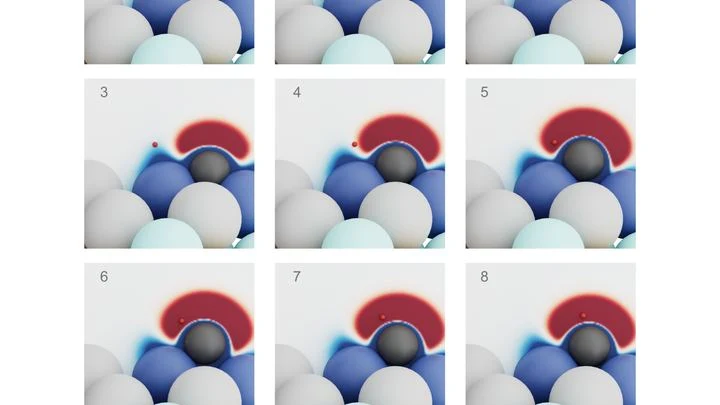
A kitchen sponge soaked in syrup: in some spots there's more syrup, and your finger sticks right away; in others, it barely touches. That's roughly how a catalyst surface works. Molecules don't react everywhere but at especially sticky points — active sites.
Run a current through a spring of organic molecules, and the electrons that come out are almost all spinning the same way. This trick is called chiral spin selectivity, and it has long puzzled physicists. In light atoms, spin (the particle's intrinsic rotation) is too weakly coupled to charge motion to achieve nearly perfect sorting.
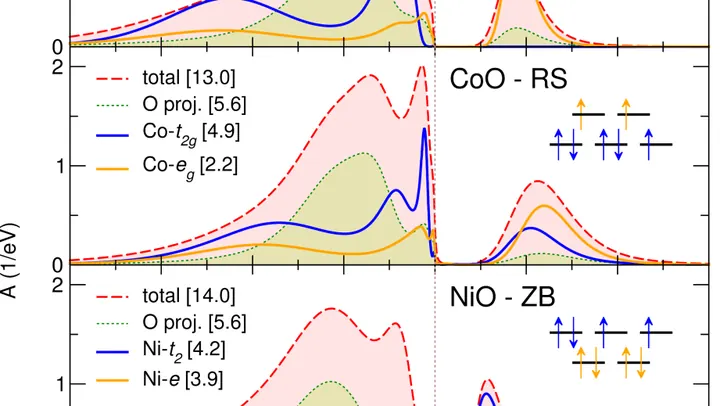
If you change not the composition but only the arrangement of atoms, you can make the same material conduct electricity or absorb light differently. That's exactly what the authors did with nickel and cobalt oxides. In one case, atoms are stacked like balls in a cubic box: each metal atom is surrounded by six oxygen atoms (rock salt structure).
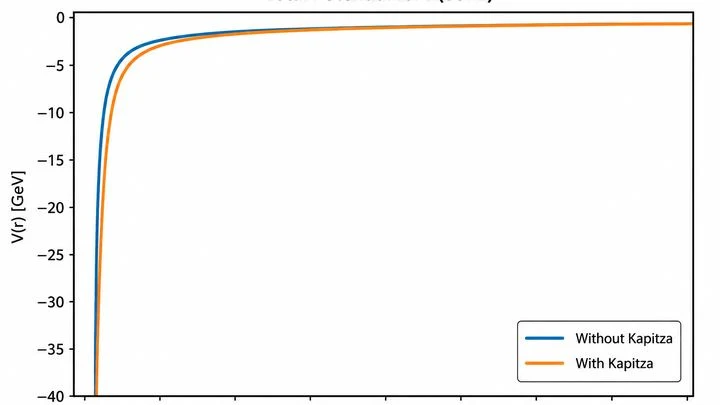
If you try to break a proton apart and pull out a quark, you're in for a surprise. Ordinary forces, like the electric force, weaken as particles fly apart. Here, it's the opposite. The farther a quark gets from its neighbors, the harder it's pulled back.
In a crystal of water and caustic cesium, oxygen and cesium atoms sit in place like beads in a rigid lattice. Hydrogen atoms behave differently: they are like passengers constantly changing seats. In this layered material, each oxygen is linked to three neighbors via hydrogen bridges, forming a honeycomb-like pattern.
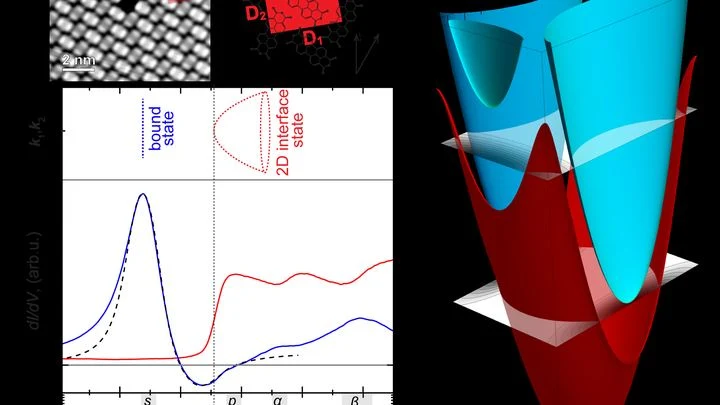
A wafer-thin film of organic molecules was grown on a silicon substrate. In this film, as if on a sheet of graph paper, tiny "pens"—artificial atoms — were laid out with the tip of a scanning tunneling microscope.
A cold cloud of atoms is like a swarm of fireflies drawn to one another. The attraction between atoms tries to pack them into a single dense ball. But quantum jitter, the unavoidable motion of particles, keeps the ball from collapsing. When the attraction is strong, the cloud breaks into separate clumps.
A water molecule, finding itself near a carbon ring, starts to vibrate, and immediately falls under the sway of an invisible conductor. The ring's electron cloud, like a maestro, dampens some vibrations while amplifying others.
A ring of magnetic atoms resembles a round dance where each participant holds hands with their neighbors. In ordinary magnets, each atom has its own permanent magnetic moment, and they interact like little arrows striving to align opposite to each other.
In a jar of oily liquid float millions of tiny magnetic grains: each about the size of a bacterium. Switch on a magnet, and the grains, like obedient little soldiers, line up into long threads. But why do they form threads rather than clumps? It turns out it's not just about magnetism.
In the quantum world, a collision between particles doesn't destroy their individuality but ties them into an inseparable knot: internal states and motions become intertwined like threads in an intricate tapestry.
An ordinary chemical reaction is like a ball rolling down a hill: it has one natural path. But if you place molecules in a tiny mirrored box, an optical microresonator, the light inside starts to interfere with the ball's motion. It can nudge it, hold it back, or even split its trajectory.
In a new study, physicists traced exactly how this happens.