Invisible Walls in Scorching Glue express
A pot of extremely thick and hot glue: that's roughly what the early Universe looked like. It wasn't ordinary glue, but a 'gluon soup': particles carrying the strong force (gluons) zipped freely through space. The temperature was so high that even quarks and gluons didn't stick together into protons and neutrons.
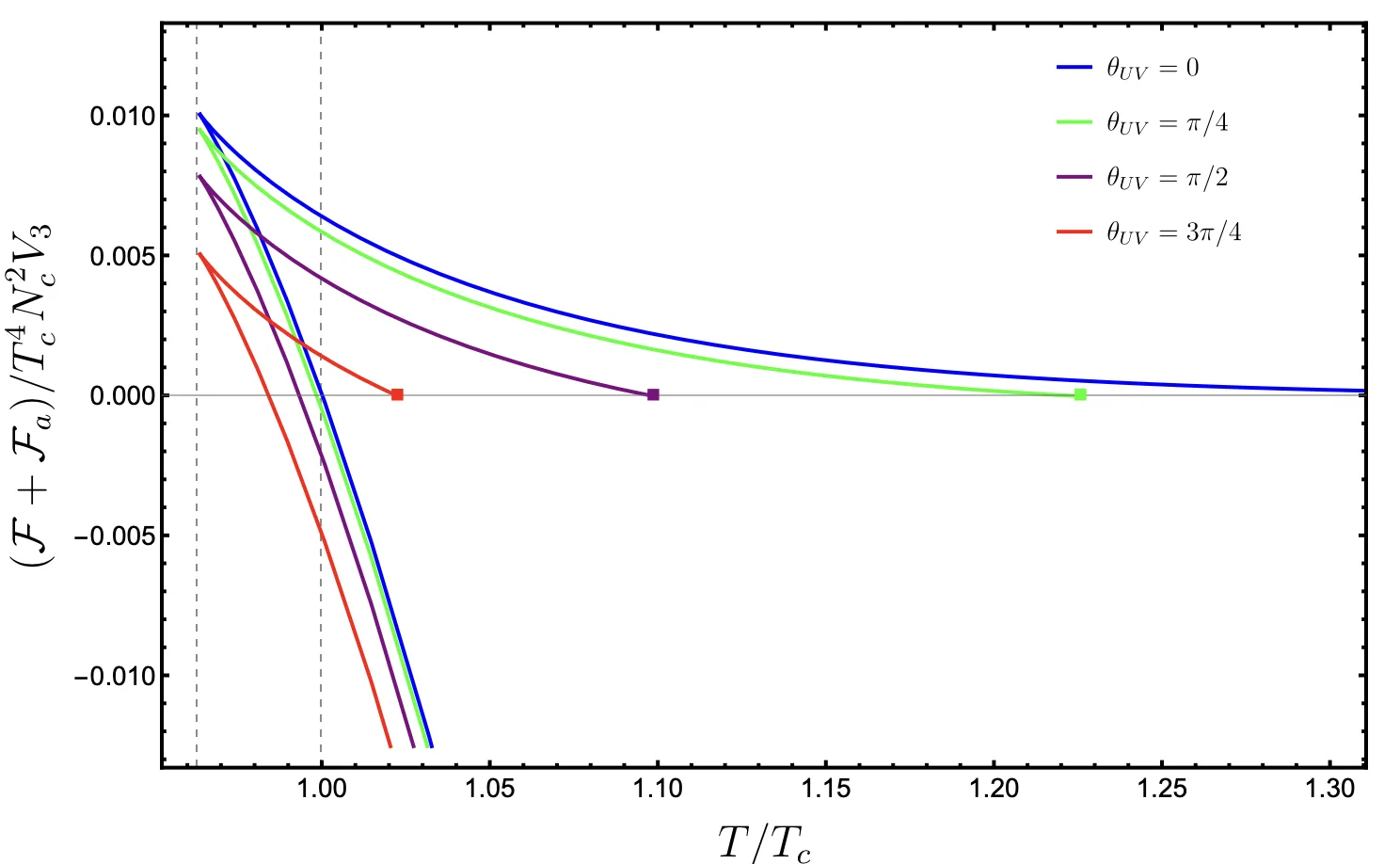
Over time, the Universe cooled. At some point, the gluon soup began to 'set'—a phase transition akin to glue hardening. This transition is called confinement: gluons and quarks became permanently trapped inside particles like protons. In a new study, physicists examined what happens when a special parameter θ (theta) is present. It turns out that the critical temperature drops — the glue sets later and more slowly than previously thought.
As the Universe cooled, glue in different spatial regions could have set differently, landing in different 'valleys' of the vacuum. At the boundaries of such regions, thin transition layers, domain walls, would have formed. They resemble boundaries between crystallites in solidifying wax. These walls are invisible but can carry enormous energy and influence the Universe's dynamics.
When bubbles of the new phase, the solidified glue, collide and merge, the walls start moving. They oscillate, interact, and eventually annihilate, emitting gravitational waves — ripples in the fabric of spacetime. The authors emphasize that the birth of walls from bubble mergers is a complex dance of hydrodynamics, local heating, and vacuum 'selection.' For these waves to leave a noticeable imprint on detectors, fine-tuning of parameters is needed, but the very possibility is intriguing.
Original abstract
as written by the authors arXiv:2607.18800
We study the confinement phase transition in SU($$N_{c}$$) pure Yang-Mills theory at finite $$\theta eq 0$$ using the Improved Holographic QCD (IHQCD) model. We show that the critical temperature, as a function of $$\theta$$ for large but fixed $$N_{c}$$, is reduced, thus decreasing the amount of supercooling in the confinement phase transition. Upon completion of the confinement phase transition, a network of domain walls can be produced, owing to the multi-branched vacuum structure of Yang-Mills theory at finite $$\theta$$. We highlight the potential interplay between the produced domain walls and the confinement phase transition dynamics. We emphasize that DW production from bubble coalescence in strongly coupled non-conformal FOPTs is a dynamical process of vacuum assignment, hydrodynamics, and local reheating effects, all potentially affecting the approach towards the scaling regime. Lastly, we demonstrate the level of tuning necessary for potentially interesting imprints from gravitational waves through domain wall annihilation and its interplay with the confinement PT.
If the θ parameter in our Universe were large enough, we might observe domain walls passing through Earth. They would be thinner than an atom but carry energy comparable to the mass of an entire mountain in every square centimeter.
In Greg Egan's novel 'Schild's Ladder', the vacuum turns out to be multi-valleyed, and transitions between false vacua generate catastrophic domain walls that destroy entire star systems.