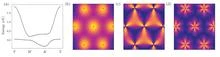
The twist angle is the relative rotation between two layers of a stacked two-dimensional material, such as graphene or a transition metal dichalcogenide. This angle is not just a geometric detail; it fundamentally alters the electronic, optical, and magnetic properties of the stack. When the twist angle is small, the moiré pattern that forms between the layers creates a new superlattice potential, which can dramatically change the band structure and lead to exotic quantum phenomena, including superconductivity and correlated insulating states.
History
The concept of twist angle as a tuning parameter for electronic properties gained prominence in 2018, when Pablo Jarillo-Herrero's group at MIT demonstrated superconductivity in twisted bilayer graphene at a magic angle of about 1.1 degrees.
How it works
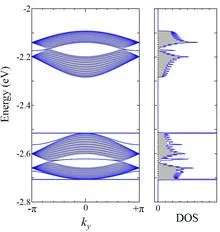
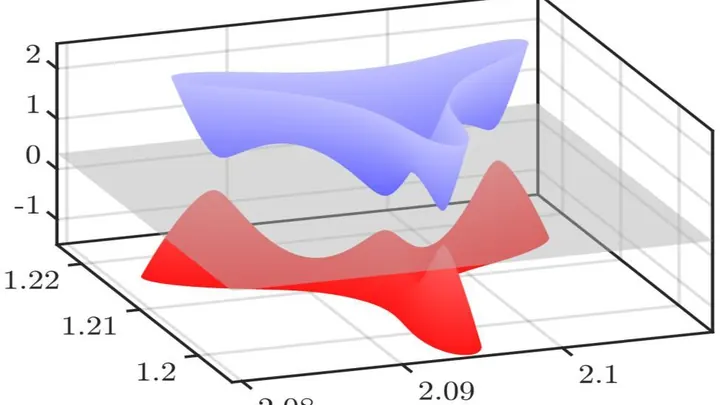
The twist angle controls the size and shape of the moiré pattern, which is the interference pattern created by the misalignment of the two crystal lattices. At specific 'magic angles', the moiré pattern becomes large enough that the electronic bands become extremely flat, meaning electrons have very low kinetic energy. In this regime, electron-electron interactions dominate, leading to strongly correlated phases such as Mott insulators, superconductors, and topologicalstates. The twist angle also affects the interlayer coupling, which determines how easily electrons can hop between layers.
In practice
Twisted materials are being explored for use in quantum computing, superconducting devices, and tunable electronic components, as well as for improving battery performance by enhancing ion transport.
It is easier to turn a jar lid by gripping its edge than its center. Layered crystals such as graphite behave similarly when one layer is twisted relative to another: the resistance arises not from the whole contact area but only from its rim.
A sheet of paper tears where tension exceeds strength. Epithelium, the cell sheet lining our organs, behaves similarly, but until recently models could not show how tears appear in it. The classical vertex model describes tissue as a network of polygons tightly packed together and forbids cells from detaching.
The triptycene molecule resembles a three-pointed star with rigid arms. When such stars are scattered on a lead surface, they spontaneously assemble into a pattern like a woven basket: triangles and hexagons alternate, and at each node sits not one star but a pair.
A door lock with two different keys: one turns easily, the other demands noticeable effort. That is how two layers of hexagonal boron nitride behave when twisted relative to each other. This material consists of boron and nitrogen atoms arranged in a hexagonal lattice, and its layers can sit in different registries, like two identical grids shifted by different angles.
A deck of cards in which each card is slightly rotated cannot lie flat: the backs and faces will never align. But if the cards are flexible, they will start to adjust, shifting by fractions of a millimeter to find the perfect match. Something similar happens inside crystals when two thick layers of MoS2 or MoS2 with WS2 are stacked with a twist of 1–2 degrees.
In a two-dimensional crystal of tungsten diselenide (WSe₂), light creates pairs — an electron and a hole that stick together. Such pairs are called excitons. Among them are "dark" ones: they barely emit, but they set the tone at low temperatures.
Two transparent sheets with circles drawn on them. If you stack them exactly, the circles align. But give one sheet a slight twist, and a new pattern emerges: in some places the circles bunch together, in others they spread apart. That's roughly how moiré works — an unexpected pattern born from rotating two periodic structures.
Two sheets of tungsten diselenide (not carbon, but a compound of tungsten and selenium) are rotated relative to each other by a tiny angle, about 5 degrees. This creates a moiré pattern: an enlarged periodic lattice where electrons behave very differently than in a regular crystal.
The book is open to the middle. Current runs along the spine, while the pages remain cool. That's roughly how a two-dimensional topological insulator works — a material where electricity flows only along the edges, while the interior stays still.
Two ultra-thin sheets, each just one atom thick, are placed on top of each other and slightly rotated. Like two sheets of colored tracing paper: while they lie flat, the picture is one thing, but give them a twist and a moiré pattern appears. Here, though, the pattern isn't visible to the eye, but it completely changes how the material handles light.
Layers of a thin material rotated relative to each other resemble stacked grids. Where the lines intersect, a new pattern emerges — a moiré. In this pattern, electrons move differently than in a regular crystal and can form unexpected states.
In the new study, researchers took two layers of molybdenum telluride and twisted them by 4.8 degrees.
Two sheets of paper stacked together start to creep ever so slightly over each other when heated. That's roughly how layers of molybdenum disulfide, a material one atom thick, behave. At room temperature, they spontaneously slide at a speed of about one meter per second.
A single-atom-thick sheet of tungsten telluride is like thin foil: electrons can't pass through because there's a band gap between their possible states, like a moat you can't jump across. Add two more layers, and the moat disappears; the material becomes a metal, and current flows. Add more layers, and the properties change again, as if someone is flipping modes with a single button.
Graphene is a carbon film exactly one atom thick. Two such sheets placed on top of each other with a slight twist behave very differently from a single sheet. At an angle of about 1.1 degrees, electrons slow down so much that the material can become a superconductor or an insulator — depending on the conditions.
A sheet of graphene one atom thick hangs in the air like a taut bedsheet. Heat waves, vibrations of atoms that physicists call phonons, ripple across it. Previously, it was thought that these waves quickly scatter due to strong interactions, and heat transfer is poor.
Think of a stack of paper: when the sheets lie perfectly aligned, light passes through them uniformly. But turn one sheet by a few degrees, and the picture changes. Something similar happens with layers in certain materials: rotate them relative to each other, and their properties change — sometimes dramatically.
Spectroscopy isn't the key here, or rather, it's not the method used.
Two sheets of graphene — carbon film one atom thick — without a twist resemble a harbor clogged with shoals: lithium ions either run aground or rush past without stopping. But a 9.43° twist lays out a perfect fairway. The ion ships dock securely to carbon 'piers' and immediately cast off without losing speed.
A sheet of graphene one atom thick is like a flexible metal mesh through which electrons zip almost unimpeded. Stack two such sheets with a slight twist, and the material's properties change dramatically: it can become an insulator that blocks current.
A thin film is like a taut sheet: the thinner it is, the harder it is to push through. Scientists have noticed that films made of very different materials (graphene, graphene oxide, polymers) resist projectile penetration surprisingly well under high-speed impact. And the thinner the film, the more energy it absorbs per unit mass.
Ordinary window glass may seem frozen forever, but inside, atoms never stay still. In amorphous germanium telluride (GeTe)—a material used in rewritable discs and non-volatile memory — physicists have for the first time directly tracked how atomic bonds stretch and bend in trillionths of a second.
Two layers of a magnetic material, rotated relative to each other by fractions of a degree, like two slightly offset screens on a window. In their normal state, they don't produce anything special, but at a certain twist angle, an unexpected effect emerges.
A stack of identical pancakes on a plate is just a stack. But if you arrange them with a certain order, something new suddenly appears: for example, a pattern that was not visible in each pancake individually. Physicists have performed a similar trick with thin layers of materials.
A pot of water heated from below is a simple example of turbulence. Hot fluid rises, cold fluid sinks, and the flow spontaneously breaks into rotating cells that look like horizontal rolls. In a new study, physicists took a wide rectangular container (ten times longer than its height) and tracked how many such rolls appear.
Twisted layers of atoms in a material form a pattern of tiny regions, domains, each of which can be electrified in one of two directions, like a compass needle pointing north or south. Previously, such materials were studied only as a whole, measuring thousands of domains at once, and their collective behavior was like a choir where individual voices are not heard.
A blunt cylinder flying at six times the speed of sound isn't the most elegant object, but it's the star of a new simulation. The surface of such a vehicle is never perfectly smooth: during atmospheric entry, the heat shield ablates, leaving bumps and pits.
A superconductor is a material where electric current flows without loss, like water through a perfectly smooth pipe. But if vortices appear, the current starts to 'stumble' over these tiny whirlpools. In graphene twisted at a special angle, such vortices can be created and studied one by one.
A glass of solidified glass may seem motionless, but inside, the atoms are frozen in random positions, never having found perfect order. A similar situation occurs in spin glasses: the magnetic moments of atoms freeze, pointing in different directions, and the material loses the ability to be simply magnetized.
A spider web is not just a sticky net but a delicate instrument that responds to the weather. When the air becomes humid, spider silk threads shorten and twist, like a wet towel being wrung from both ends. Previously, it was thought that the thread twists because the proteins inside are arranged in a spiral. But no direct evidence for such an arrangement was found.
A thin sheet of carbon, resembling an intricate mesh of triangles, hexagons, and octagons, lies on a substrate. By itself, it is not superconducting: electrons move through it haphazardly, bumping into atoms. But stretch the sheet evenly, like canvas on a frame, and the picture changes.
Electronic charge is a tumbleweed that moves camp depending on energy. In tungsten selenide (WSe₂) crystals, this is seen with utmost clarity: at a bias of −1.4 V, near the K point of the Brillouin zone, the maxima of tunneling current sit in the centers of hexagons, where there are no atoms.