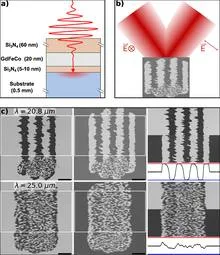
A domain wall is a thin transition region separating two areas of a magnetic material where the magnetization points in different directions. In a ferromagnet, neighboring magnetic moments tend to align, but different regions (domains) can have different orientations. The domain wall is the boundary where the magnetization smoothly rotates from one direction to another. These walls are not just static features; they can move under applied magnetic fields or electric currents, and their dynamics are central to understanding magnetism and developing magnetic memory devices.
History
The concept of magnetic domains was proposed by Pierre-Ernest Weiss in 1907 to explain ferromagnetism. The detailed structure of domain walls was later developed by Lev Landau and Evgeny Lifshitz in the 1930s.
How it works
The magnetization direction changes gradually across a domain wall over a length scale of tens to hundreds of nanometers, balancing exchange energy (which favors parallel alignment) and anisotropy energy (which favors specific directions). The wall's structure can be of different types, such as Bloch or Néel walls, depending on the material and geometry. When a magnetic field or spin-polarized current is applied, the wall can be pushed or driven, leading to its motion. This motion is governed by factors like damping, inertia, and pinning from defects.
In practice
Domain walls are exploited in racetrack memory, where data is stored as a series of walls in a nanowire and moved by current pulses, and in spintronic devices that use wall motion for logic operations.
Fun fact
In some materials, domain walls can be made to oscillate at gigahertz frequencies, which could be used for high-speed magnetic data processing.
An orchestra without a conductor can sound harmonious if the musicians feel the common rhythm. In the world of solids, phonons play that role: quanta of crystal lattice vibrations. When atoms in a substrate start moving in circles, they can transfer their rotation to a magnetic layer on top and flip its magnetization.
A frozen orchestra where musicians swap seats when the conductor, magnetism, sets a new score. In a spinel crystal, iron and magnesium atoms sit in two types of seats: some surrounded by four neighbors, others by six. At room temperature, they barely stir, but cool the material to 5 K and a mass migration begins.
Two caravans travel toward each other along a narrow road. One is wide and slow, carrying a load of density. The other, a string of light carts carrying current, slips between the first. Thus, in a magnetron discharge, two structures rotating in opposite directions coexist: the density spoke and the current filaments.
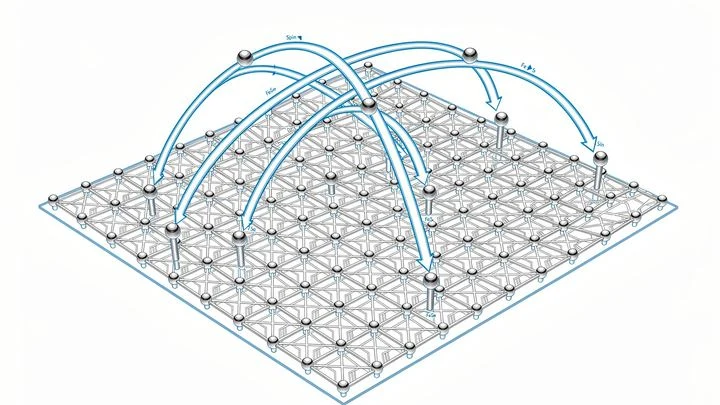
Imagine a ladder whose rungs are tiny magnets. If neighboring magnets point in opposite directions, the ladder is "calm." But if you make them all point the same way, the whole structure becomes magnetized and "stubborn."
Scientists built such a ladder from germanium atoms — a semiconductor used to make transistors.
A magnetic vortex is like a tiny whirlpool in the sea, except that instead of water, it's magnetization that swirls. Such vortices could become memory cells in future computers, but to write and read information, you need to be able to move each vortex individually. So far, this is done crudely — shifting a whole bunch at once.
In an ultracold cloud of atoms cooled to near absolute zero, regions with different spin orientations emerge, like patches with different magnetization. The boundaries between them are called domain walls. Usually they are stationary, but in this experiment the walls started moving on their own.
A highway where opposing flows are separated not just onto different sides, but onto two independent roads: each with its own entrance and exit. Something similar happens to electrons in a new type of topological insulator described by the authors of the study.
A black hole is not a vacuum cleaner. By itself, it doesn't pull everything in more strongly than an ordinary star of the same mass. But if there's a magnetic field nearby and charged particles flying around, an interesting game begins.
In a pot of boiling water, steam bubbles appear and disappear — a similar struggle takes place in two-dimensional materials. Here, electrons both create magnetism and try to extinguish it.
In the first moments of its life, the universe resembled a boiling cauldron. Matter wasn't spread evenly — clumps and voids were brewing within it, and their violent motion gave rise to a trembling of space itself: gravitational waves.
The ring was assembled from several different segments. In each segment, particles behave in their own way, like musicians playing different notes. The most interesting part begins at the junctions: here particles often get stuck, like an echo trapped in a narrow corridor. This phenomenon is called the skin effect — particles pile up at the boundary, like a crowd at an exit.
But the authors noticed something new.
Ion current through a membrane is like a queue at a turnstile. Sometimes the turnstile is free — ions pass through quickly. Sometimes it gets stuck — the flow drops. A weak magnetic field, it turns out, doesn't push ions from behind; it simply changes the number of open turnstiles.
A pot of extremely thick and hot glue: that's roughly what the early Universe looked like. It wasn't ordinary glue, but a 'gluon soup': particles carrying the strong force (gluons) zipped freely through space. The temperature was so high that even quarks and gluons didn't stick together into protons and neutrons.
Over time, the Universe cooled.
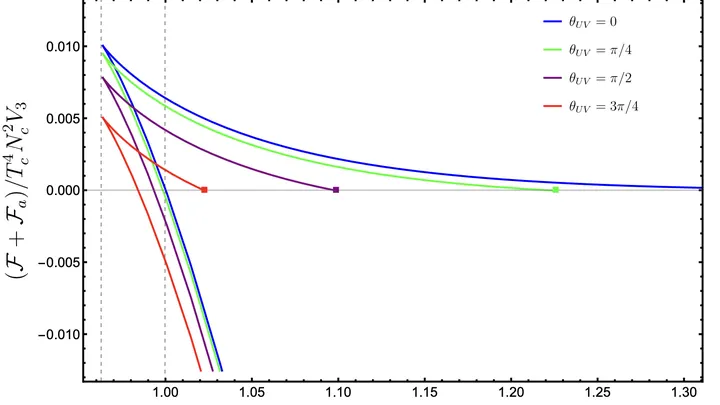
In the first moments after the Big Bang, cosmic symmetry breaking divided the hot plasma into regions with different vacuums — the lowest energy states of a field.
A parquet floor where every other plank is turned the opposite way looks symmetric. But if you run your hand over it, in one direction your fingers glide along the grain, and in the other they catch. That's roughly how the new type of magnetism studied in the crystal AgCrP2S6 works.
In the brain's white matter, the signal travels along axons — long neuronal processes wrapped in an insulating myelin sheath. Water fills the space inside axons and outside, in the narrow gaps between fibers.
A guitar string keeps vibrating even after the musician lets it go, and that vibration changes the sound the listener hears. Magnetic moments in a crystal behave much the same way: they align into a strict antiferromagnetic order (neighbors point in opposite directions), but they never completely freeze.
In the quantum world, there is its own dance. Two superconducting toroids, each comfortably holding its quantized magnetic flux, whirl in a synchronous waltz. Between them is a vacuum, not a single field line, yet they mirror each other’s moves without fail.
In the grand symphony of magnetism, a duo long reigned: boisterous ferromagnetism and silent antiferromagnetism, where spin-soloists cancel each other out. But recently, a third voice joined the ensemble — altermagnetism.
In the world of magnetism, a simple dichotomy long reigned: ferromagnets, where spins point in one direction, and antiferromagnets, where they line up in a checkerboard pattern, canceling each other out. But a recent 'third player' — altermagnets — forced a rewrite of the rules.
Some materials are internally like a Möbius strip: their electronic states are twisted in a special way. Such topological properties are usually manipulated with a powerful magnetic field, as if trying to flatten the strip with a sledgehammer. A group of researchers has found a more delicate tool.
The early universe cooled like a giant cauldron. And just like cracks can form on a freezing pond, cracks could appear in space — domain walls. These are folds in space itself, boundaries between regions with different properties. When such a wall vanished, it shook spacetime, producing gravitational waves.
A pebble drops into a pond, and ripples spread across the water. But one wave suddenly doesn't spread out: it clings to an invisible fold on the surface and runs only along it.
On May 14, 2019, LIGO detectors registered a gravitational burst that didn't fit the usual mold. Event GW190521 appeared as a collision of two black holes weighing 85 and 66 solar masses. The resulting hole of 142 solar masses landed right in the "forbidden" range — where stellar collapses leave almost no trace.
A rubber band that gets thicker the harder you pull it. In electricity, this behavior is called negative capacitance: the more charge accumulates on the plates, the lower the voltage. A regular capacitor works the opposite way — voltage rises with charge.
Two teams pull a rope with equal force in opposite directions — the rope doesn't move, and the net force is zero. That's how many antiferromagnets behave: the magnetic moments of atoms are aligned oppositely and cancel each other out.
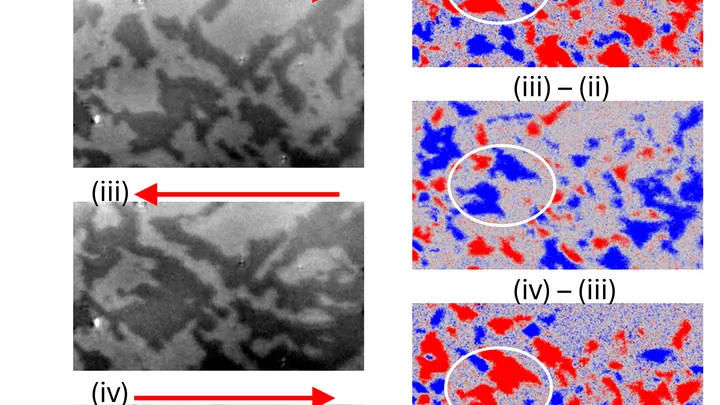
Two magnets on a table either attract or repel — depending on how their poles are oriented. Inside each piece hide tiny regions where all the magnetic arrows point in the same direction. These regions are called domains, and their arrangement determines how the material behaves in an electrical circuit.
In altermagnets, a new class of materials, domains are trickier.
A balloon doesn't deflate all at once: first, dents appear on its surface, which run, merge, and finally the balloon shrivels into a point. Domain walls behave in much the same way — thin partitions that divided space in the first moments after the Big Bang.
Imagine a huge layered cake, where the layers of dough are space and the filling is a special region resembling an invisible wall. This wall is not made of bricks but of energy, and it could be as thick as the entire universe. If such a wall exists, it should stretch the dough layers differently: those lying along it spread apart faster, while those across it spread slower.
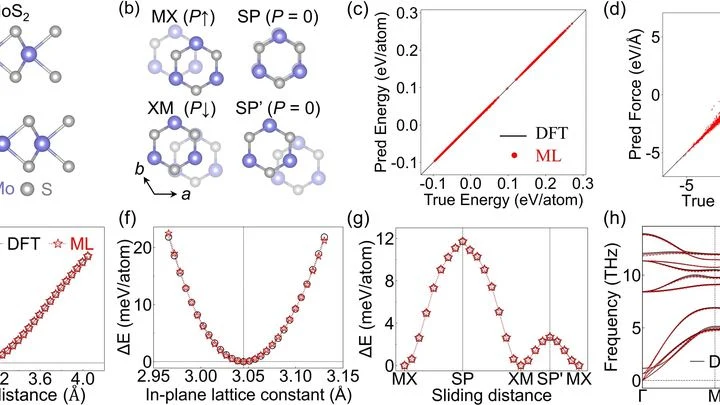
Two sheets of paper stacked together start to creep ever so slightly over each other when heated. That's roughly how layers of molybdenum disulfide, a material one atom thick, behave. At room temperature, they spontaneously slide at a speed of about one meter per second.
Imagine a line of dominoes: when the first one falls, it pushes its neighbor, and a wave rushes down the chain. The boundary between fallen and standing dominoes is a perfect image of a magnetic wall. In microscopic magnetic films, these walls separate zones with different magnetizations.
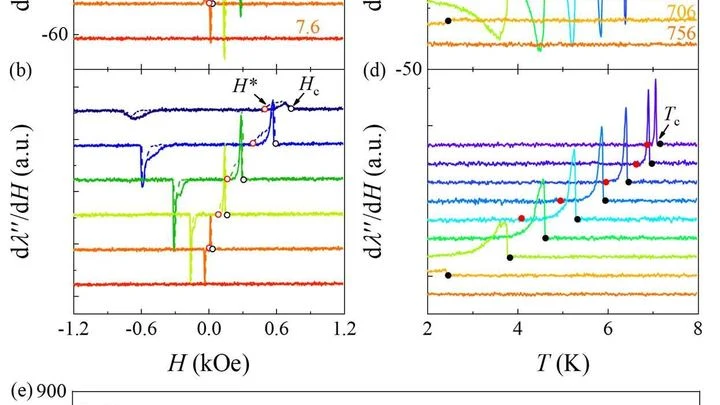
Ordinary magnetic measurements only see the surface of a superconductor, where barriers and viscous flows of magnetic field get in the way. Inside, in the so-called intermediate state, superconducting and normal domains coexist, separated by thin walls. These walls can oscillate, but hearing them directly has been difficult.
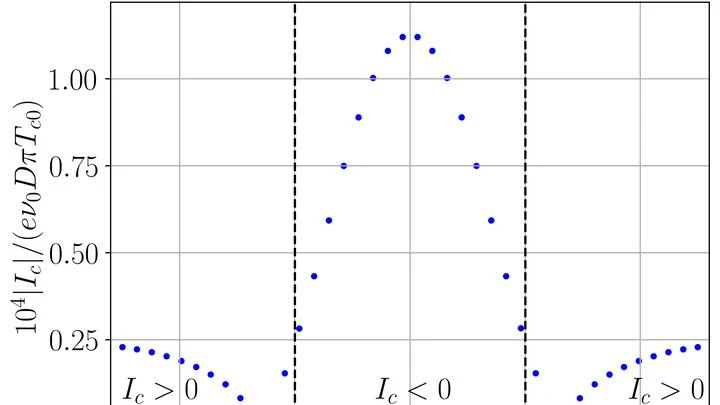
Two superconducting banks are connected by a bridge of magnetic material. Inside the bridge lies a domain wall: a narrow boundary where the magnetization rotates, like a column of soldiers changing their marching direction.
A fridge magnet stays put because the tiny atomic arrows inside it all point in the same direction. But when those arrows start to argue (some pulling left, others right, and some spinning like tops) you get magnetic frustration. That disorder gives rise to whimsical patterns: stripes, spirals, vortices.
In a large gas cloud where stars are born, the magnetic field lines are roughly aligned in one direction, like the fibers in a piece of felt. But look inside, into the dense clumps that will eventually become stars, and the picture changes: there the lines are twisted every which way, like a ball of yarn after a kitten has played with it.
In a thin nickel oxide film, magnetic regions are arranged in strict order like mosaic pieces. A single laser pulse instantly heats the material, and the mosaic falls apart: domains lose their orientation and mix.
A rug lies flat, but if you push it from the edge, wrinkles run across it. In a thin film of tantalum sulfide (1T-TaS2), wrinkles made of electrons, charge waves, freeze as if the rug were stuck to the floor. To move them, you need to apply force. Scientists have found a way to control this force using an electric field and a magnet.
In most magnetic materials, a domain wall, the boundary between regions with different magnetization, moves in one direction under current, set by the current's direction. But in ferrimagnets near a special point where the angular momenta of two sublattices cancel each other, the behavior changes.
A crystal does not grow as a single whole but like a city of neighborhoods — grains. In each neighborhood, atoms are arranged in their own way, and the boundaries between them are like streets.