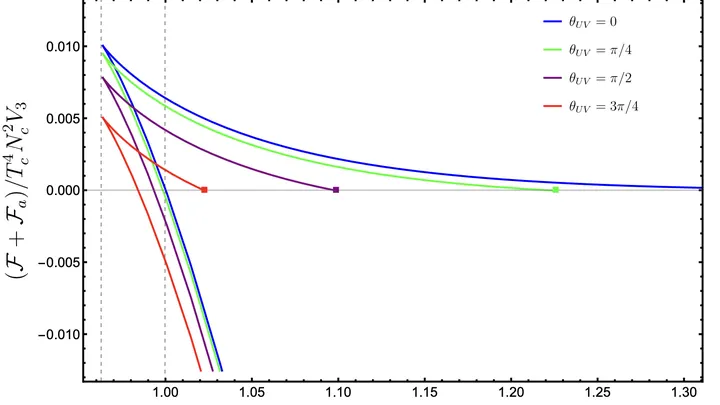
Critical temperature is the temperature at which a material or system undergoes a phase transition, such as the freezing of dark matter pairs into a quantum condensate. In the context of dark matter, this concept is central to the hypothesis that dark matter particles can form a Bose-Einstein condensate, a state where a macroscopic number of particles occupy the same quantum state, behaving as a single coherent entity. This idea is explored in the title 'Застывший танец тёмной материи: гипотеза квантового парного конденсата', which suggests that dark matter might undergo a phase transition at a specific critical temperature, potentially explaining its distribution in galaxies and its interaction with ordinary matter.
History
The concept of critical temperature in phase transitions dates back to the 19th century, with the work of Thomas Andrews on critical points of gases. The specific application to dark matter condensates is a recent theoretical development, emerging in the 21st century as part of efforts to explain dark matter's properties beyond simple cold dark matter models.
How it works
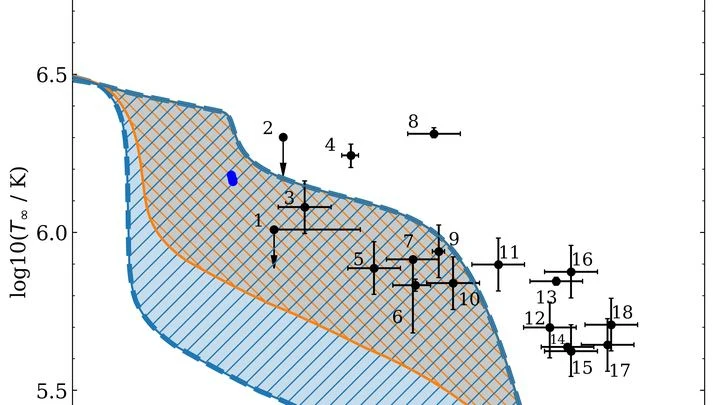
In quantum statistics, particles called bosons can occupy the same quantum state when cooled below a critical temperature, forming a condensate. For dark matter, if it consists of light bosonic particles, the critical temperature would depend on their mass and density. Below this temperature, the particles would 'freeze' into a coherent state, altering their gravitational behavior and possibly explaining phenomena like the rotation curves of galaxies. The titles also mention 'Сердце нейтронной звезды: как партнёры частиц меняют её температуру', indicating that similar pairing mechanisms (like Cooper pairs in superconductors) can affect the critical temperature in dense matter, such as in neutron stars.
In practice
In condensed matter physics, critical temperature is key to designing superconductors and superfluids, which have applications in magnetic resonance imaging, particle accelerators, and quantum computing. In astrophysics, understanding the critical temperature of dark matter could refine models of galaxy formation and evolution.
Fun fact
The critical temperature for a hypothetical dark matter condensate could be as low as a few nanokelvin, far colder than any temperature achieved in a laboratory on Earth.
Units by system: SI: kelvin · CGS: kelvin · Planck: planck temperature · natural: kelvin
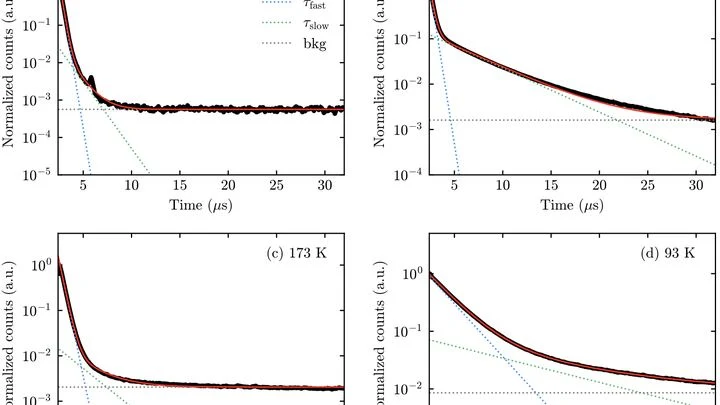
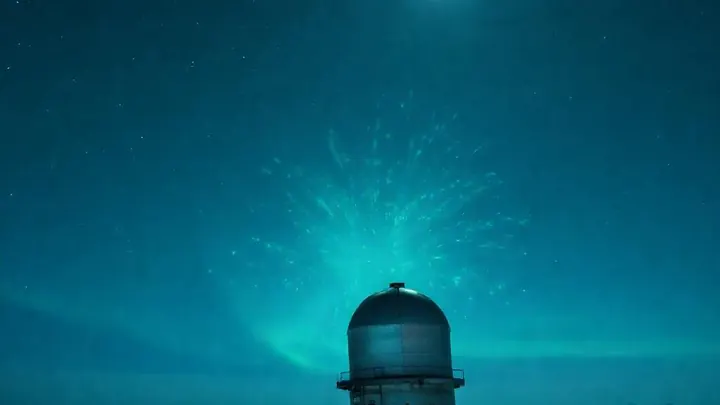
A sodium iodide crystal doped with thallium is like photographic film for invisible particles. When a gamma ray or a hypothetical dark matter particle hits it, it flashes with faint light. Two silicon photomultipliers pressed against the crystal's ends catch the flash from both sides.
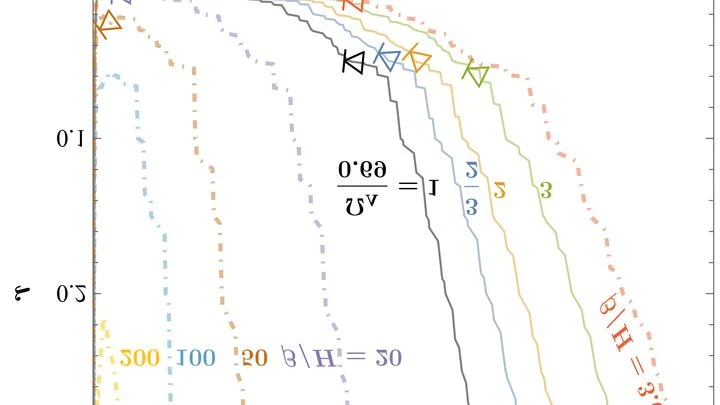
It all started with stretching. In the first fractions of a second, the universe ballooned — physicists call this inflation. Then the rapid expansion gave way to a phase where the field's energy converted into ordinary particles.
The universe is like a vast invisible scaffold. We don't see it directly, but we know it's there: galaxies and clusters hold together thanks to it. This scaffold is dark matter. The most popular version says it is "cold," made of heavy, slow-moving particles.
A pot of extremely thick and hot glue: that's roughly what the early Universe looked like. It wasn't ordinary glue, but a 'gluon soup': particles carrying the strong force (gluons) zipped freely through space. The temperature was so high that even quarks and gluons didn't stick together into protons and neutrons.
Over time, the Universe cooled.
Ever since Fritz Zwicky noticed that galaxy clusters were moving too fast, and Vera Rubin measured the rotation of spiral arms, dark matter has remained cosmology's greatest mystery.
The hot broth of the early universe cooled unevenly. At some point, bubbles of a new phase began to pop within it, like steam bubbles in boiling water. But these bubbles weren't made of steam; they were made of a new state of matter in which particles of the dark sector clumped into larger lumps. That's how dark matter could have been born.
The cosmological kitchen is full of invisible ingredients. Dark matter, like an invisible scaffold, keeps galaxies from flying apart, while dark energy, like yeast in dough, makes space expand ever faster.
At the center of many galaxies lurks an invisible halo of dark matter: it holds the stars at the edges, keeping them from flying apart. For a long time, it was described as a dilute gas of particles, but new work offers a different view: dark matter might gather into a quantum droplet.
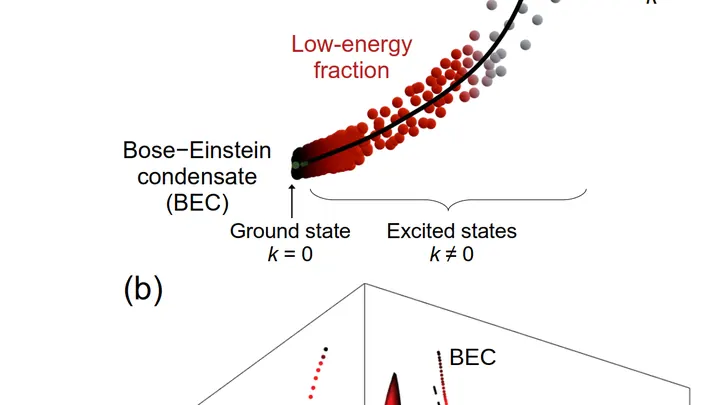
A pot of water always boils the same way: hit 100 degrees and bubbles start. Quantum fluids are different. When a cloud of atoms is cooled to near absolute zero, it can turn into a single matter wave — a Bose–Einstein condensate. But the transition itself, it turns out, can happen in three different ways.
A compressed spring can sit for years without moving. It seems frozen forever, but inside the metal, atoms slowly rearrange, and one day the spring clicks, settling into a new, more relaxed position.
When a massive star runs out of fuel, its core collapses under its own weight. A black hole forms — a region where gravity is so strong that even light can't escape. For a long time, it was thought that a point of infinite density, a singularity, lurks at the very center.
Hot tea in a freezer doesn't freeze all at once. First, tiny ice needles dart around — forming and melting until the temperature drops enough for the ice to set solid. The early universe behaved similarly as it cooled and changed its internal structure.
A neutron star is the dead core of a massive star, crushed to the size of a city. A teaspoon of its material weighs as much as a mountain. Dark matter particles fly through such a dense medium almost unimpeded, but occasionally they do hit neutrons and get stuck, like bullets bogging down in deep sand.
Water in a cup cools down in minutes. Gas in a room spreads evenly in seconds. But if you trap atoms in a tube as thin as a laser beam and give them a good kick, they will take several seconds to "cool" toward equilibrium — an eternity by atomic standards.
At the center of a black hole lies a singularity — a point where spacetime is crushed infinitely. Black holes can change state, much like water freezing or boiling. Usually, these transitions are noticed by observing the hole's surroundings.
Dark energy is usually seen as an innate property of the cosmos, at work from the very first moments. But a new model suggests it behaved like water on the verge of boiling: long unnoticed, then suddenly kicking in at a critical moment. This scenario is called 'late activation': around 5–7 billion years ago, a shift occurred, and the universe’s expansion began to accelerate.
A hot chain of atoms lined up in a row behaves like a tiny black hole. Such a chain is a series of particles, each resembling a tiny magnet. At normal temperatures, the little magnets flip randomly, but when cooled, they align in a uniform order. Physicists have discovered that when heated, this simple system reproduces the strange properties of black holes.
Water in a pot, when heated, doesn't boil: it turns into ice. That's roughly how ultracold atoms behave in an optical lattice — a light-based crystalline grid that holds atoms in place. Scientists simulated this system on a computer to understand how order changes as temperature rises.
A neutron star is the remnant of an exploded star, compressed to the size of a city. In its core, matter is packed so densely that a teaspoon of such material would weigh as much as a mountain. At such densities, as predicted by the theory of strong interactions, particles acquire 'twins'—parity partners.
In the mid-20th century, astronomer Vera Rubin discovered that stars on the outskirts of galaxies were moving too fast — held by an invisible mass. Thus the mystery of dark matter was born. It doesn’t emit light but reveals itself through gravity. The big question: why is there exactly as much as we see?
A magnetic film divided into tiny arrow-shaped cells behaves like a crowd in a square. While it's cold, all arrows point in the same direction — perfect order. Heat the film, and the arrows start darting around like pedestrians who have lost their purpose. Somewhere between these extremes, there is a moment when the system stops being uniform but hasn't yet dissolved into random noise.
Inside some materials, electric current flows with zero resistance. These are superconductors, and they only work when it's very cold. Copper oxides are special: they stay superconducting at somewhat higher temperatures, but why has been a puzzle for forty years.
Light from tiny perovskite crystals is like a choir performance, where voices sound sometimes solo, sometimes in a tight duet. Previously, such a duet could only be heard under extreme cooling, nearly to the chill of outer space. Now the choir sings at room temperature.
A cage of sixty carbon atoms, shaped like a soccer ball, lets small molecules slip inside. Carbon buckyballs, fullerenes, pack into a crystal like oranges in a crate, leaving gaps between them. At 570 degrees Celsius and 30 atmospheres of pressure, hydrogen seeped into those gaps.
Cooling usually brings order: water freezes into ice. But in the quantum world, order takes unexpected forms. Experimenters cooled polaritons — particles that are both light and matter — to near absolute zero.
In the first moments, the Universe went through a brief but turbulent period — inflation, when it expanded at a colossal speed. This idea was proposed by Alan Guth. At the same time, particles of ordinary matter were born.
Dark matter is the invisible scaffold of the cosmos, its existence betrayed by whirls of galaxies to Fritz Zwicky and Vera Rubin. What it is made of remained a mystery for half a century.
A new hypothesis paints an unusual picture.
A thermometer dipped into a sample usually tells you only the temperature. But if the temperature oscillates slightly and the sample responds with a delay, that response hides more: the imaginary part of the heat capacity, which turns out to be able to hear the quantum echo of time.
In laboratories on Earth, Bose-Einstein condensates are created by cooling a cloud of atoms to billionths of a kelvin. The atoms lose their individuality and merge into a single quantum wave that behaves as one entity. But in space, such conditions are not needed: gravity itself creates deep wells where matter compresses and cools into a state of quantum fog.
Two telescopes look at the same Universe and see different expansion rates. Local measurements from supernovae give 73.04 ± 1.04 km/s/Mpc, while cosmic microwave background data within the standard model predict 67.36 ± 0.54.