Hot overtakes warm in a quantum network express
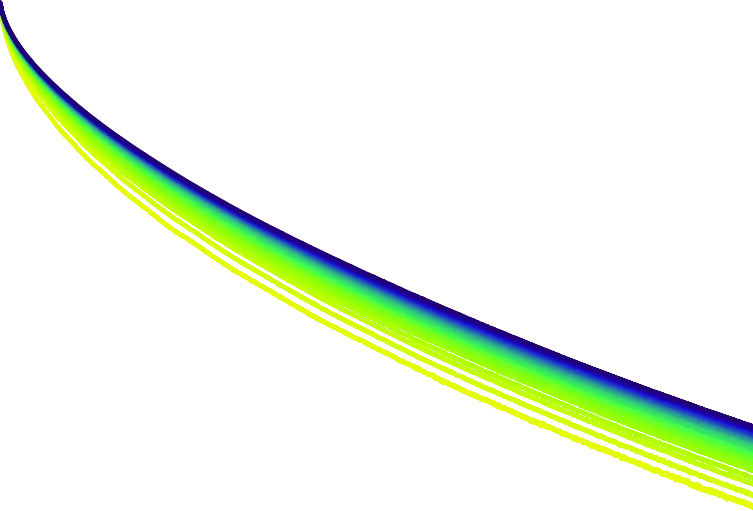
A runner trails the leader but crosses the finish line first. In the quantum world, such a trick was pulled off by a system of nuclear spins — tiny magnetic arrows of carbon-13 atoms in a diamond. This is a manifestation of the Mpemba effect: a state initially farther from equilibrium settles down faster than one closer to rest.
The authors took a diamond with disorder — paramagnetic defects (atoms with unpaired electrons that speed up the return to equilibrium) scattered randomly throughout. By switching the magnetic field, they created different magnetization patterns — some sharp, others smooth. Then they applied periodic pumping (a so-called Floquet drive) that pushed the system into a long-lived prethermal state. This is not full rest but rather a plateau on the way there. And on the approach to this plateau, the more "agitated" profile regularly overtook the calm one.
The explanation lies in the structure of the network itself. Defects create regions where spins quickly lose energy, and zones nearly devoid of defects. It is in these clean zones that the slowest collective mode resides — a kind of lazy orchestra that remembers the initial melody the longest. If the initial state strongly overlaps with this mode, it "shoots" to the finish, bypassing those that started closer. Calculations with semiclassical simulations confirmed that randomly placed defects give rise to rare regions where spins have almost nothing to latch onto. These regions conduct the anomalous race.
Original abstract
as written by the authors arXiv:2607.21669
Relaxation in an interacting system is determined not only by its initial distance from equilibrium, but also by the relaxation modes populated by the initial state. Here we experimentally observe and control the Mpemba effect, in which a state farther from equilibrium overtakes one initially closer, in an extended, disordered $$^{13}$$C nuclear-spin network in diamond. Field cycling allows us to prepare distinct spatial polarization profiles by independently controlling hyperpolarization and defect-mediated relaxation. We then track their evolution under Floquet driving, which stabilizes a long-lived prethermal regime. We observe reproducible Mpemba crossings and tune the crossing time over several orders of magnitude, from late-time thermalization into the prethermal plateau. Semiclassical simulations show that randomly positioned paramagnetic defects create fast-relaxing regions and defect-poor regions that support the slowest collective relaxation mode. The Mpemba crossings are set by the initial state overlap with this mode. Our results demonstrate anomalous relaxation within a prethermal many-body regime and identify disorder, transport, and mode-selective state preparation as resources for controlling relaxation in extended spin networks.
The Mpemba effect itself is named after Tanzanian schoolboy Erasto Mpemba, who in 1963 noticed that hot ice cream freezes faster than cold and persistently tried to prove this to his physics teacher.