The semiclassical approach is a hybrid method in physics where some parts of a system are treated with classical physics while others are treated quantum mechanically. This is often used when the quantum effects are significant only for certain degrees of freedom, while others can be approximated classically. It is a powerful tool for simplifying complex problems, such as the motion of electrons in an atom (quantum) under the influence of a classical electromagnetic field, or the behavior of a quantum particle in a classical potential.
History
The semiclassical method has roots in the old quantum theory of Niels Bohr and Arnold Sommerfeld in the 1910s, who used classical orbits with quantized angular momentum. It was later formalized in the WKB approximation by Gregor Wentzel, Hendrik Kramers, and Léon Brillouin in 1926.
How it works
In a typical semiclassical treatment, the heavy or macroscopic components of a system are described by classical equations of motion, while the light or microscopic components are described by quantum wavefunctions. For example, in the WKB approximation, the wavefunction of a particle is constructed using classical trajectories and action integrals, yielding accurate results for high-energy or slowly varying potentials. This approach often captures the essential physics while avoiding the computational cost of a full quantum treatment.
In practice
It is widely used in quantum optics to describe the interaction of atoms with laser fields, in condensed matter physics for electron transport, and in chemistry for molecular dynamics simulations.
Fun fact
The semiclassical approach can reproduce quantum phenomena like tunneling and interference patterns without solving the full Schrödinger equation, making it a favorite tool for simulating large systems where full quantum calculations are impossible.
Imagine a ladder whose rungs are tiny magnets. If neighboring magnets point in opposite directions, the ladder is "calm." But if you make them all point the same way, the whole structure becomes magnetized and "stubborn."
Scientists built such a ladder from germanium atoms — a semiconductor used to make transistors.
An ordinary random network is like a road map: to connect four cities with a complex interchange, you need to lay down many highways. In the quantum world, things are different.
A black hole that swallows matter might not just evaporate over billions of years: it could pop like a soap bubble and turn into its opposite: a white hole. This scenario emerged from numerical experiments in semiclassical gravity.
The Josephson junction is a bridge made of superconductor, separated by an ultra-thin insulating layer. Current flows through it even without voltage. But when the current becomes too large, the bridge starts to oscillate, and even steps, Shapiro steps, appear on the voltage graph. Between these steps hide invisible gaps where the system behaves strangely.
An electrical grid stuffed with power electronics resembles a huge orchestra without a conductor. Each converter, each line adds its own note, and sometimes the instruments start playing out of tune.
Usually, a black hole is described as a frozen frame: there's mass, there's charge, and it's all static. But real objects live in time. They radiate, lose energy, and change.
Searching for the global minimum in the Sherrington–Kirkpatrick spin glass model resembles climbing a glacier, where every crevasse is a treacherous local optimum, and the true bottom lies buried beneath a chaos of ice blocks. A classical climber, trudging along the gradient, would almost certainly freeze in the nearest crevice.
Photographing hummingbird wings with an ordinary camera gives a blurry smudge. For a sharp picture, you take many rapid shots from different angles and piece them together: that's how a quantum 'snapshot' is made. In the lab, scientists 'feel' the vibrations of a tiny mirror with a laser beam.
The Mpemba effect is a mystery where hot вода sometimes freezes faster than warm water. Usually this is attributed to how вода loses heat and энтропию (a measure of disorder). But in a glass of water, chaos prevents a precise model.
Physicists built a quantum model: a particle in a well with two depressions separated by a barrier.
A magnetic field holds a tiny particle in mid-air, like an invisible dance partner. A special tuning of the field creates a trap with two "positions." In the ordinary world, a dancer occupies only one, but in the quantum world — both at once. Physicists have learned to achieve this for dust grains weighing trillionths of a gram.
Once Richard Feynman saw in quantum systems a challenge for classical computers. Now we face the inverse problem: understanding what exactly the quantum processor has simulated. Among the states it births are veritable 'black boxes'—topological phases of matter.
A network of tiny magnets seeks the state with the lowest total energy: that's roughly what the quantum Max Cut problem looks like, one of the toughest in physics. Scientists have been hunting for its solution since the days of Werner Heisenberg.
Strike a tuning fork with a mallet — it vibrates, and the sound gradually fades. A black hole behaves much the same way when disturbed: it emits gravitational waves — ripples in spacetime itself — and then settles down.
You can think of a political system as a vast galaxy — a gravitationally bound system of stars, gas, and dust. In this analogy, parties are the stars, radiating the light of public activity, while their supporters are dark matter, the invisible substance that emits no electromagnetic radiation but whose mass holds the whole structure…
Gravity seems simple: it keeps us on the ground and makes planets orbit. But if it were classical (described by Einstein's equations as the curvature of spacetime, while all matter follows the quantum laws of the Standard Model) then an ordinary quantum bit (qubit) falling freely…
For almost a century, cosmologists have been grappling with the mystery: what makes the Universe expand ever faster? The standard answer — dark energy — creates a monstrous discrepancy between the theoretical vacuum density and observations. But there's another path, one that turns causality on its head.
A quantum computer is like an orchestra: each musician plays their own part, but the slightest noise from the audience can throw off the whole ensemble. The particles that store information easily lose their coherence from thermal jolts or stray magnetic fields.
The familiar metronomes placed on a movable platform eventually start to swing in sync. In the quantum world, this trick long eluded scientists. But now physicists have synchronized even the most exotic state — a Fock state, where the number of light particles is precisely defined, like in a counter.
A swing can rock strongly or barely move. Usually, if left alone, it stays in its chosen mode. But in the microworld, things are different: a tiny membrane, oscillating under the action of a laser beam, can spontaneously jump from one amplitude to another.
Gravity is a cosmic net: massive bodies stretch it, and lighter objects roll along its curves. But in the world of atoms, this net begins to tremble chaotically, producing infinite values in the equations. Spacetime curvature ceases to be smooth.
Usually, quantum corrections to gravity explode into infinities.
Two thin sheets with honeycomb patterns were stacked and slightly rotated, creating a new pattern — a moiré, like the shimmer of silk. The electrons in the experiment behaved similarly: they arranged themselves into two layers, with one layer rotated exactly 30 degrees relative to the other.
Holography is the idea that everything happening inside a volume can be encoded on its boundary, like an image on a hologram. In physics, this helps connect gravity to the quantum world. But sometimes, the holographic rules fail to assemble familiar spacetime, and scientists are looking for where exactly the mechanism breaks down.
In one model, spacetime is a smooth lake, and quantum particles are fish swimming in it. Their motion inevitably creates ripples. The math insists that the water trembles — otherwise the theory collapses. This trembling is strictly ordered and comes in two types.
A pendulum swings not in a single plane but in five dimensions at once. Its motion is described by a complex mathematical model, and the pendulum itself is an electron in a graphene sheet interacting with five different "flavors" of its environment.
The standard picture of black hole evaporation, painted by Hawking, long seemed reassuring: quantum fluctuations near the horizon produce thermal radiation, the hole slowly melts away, and the spacetime behind it remains smooth.
Quantum computers promise to solve problems that regular computers can't. But where is the line? The authors of a new study stumbled upon a surprising case: electrons paired up behave like a well-behaved orchestra. Even if you add a bit of "magic"—a special quantum resource: their behavior remains predictable.
Gravity is like a stretched trampoline: massive bodies press into it, making other bodies roll toward them. This shared curvature of space, gravity, affects everyone, but it doesn't convey secret messages.
The hot air above asphalt shimmers, betraying the heated surface. Medical thermography works in a similar way: the skin over a tumor is often slightly warmer than healthy skin — by just fractions of a degree. Computer programs try to catch this difference and determine whether it's dangerous.
A crowd of people suddenly starts moving as one. In physics, this happens with atomic spins — tiny magnetic arrows. When many spins come together and interact through a shared medium, they form one big magnet, or a macrospin. This macrospin doesn't just point in one direction; it can get stuck in several positions, like an ice cube that refuses to melt even when it's warm.
A classical computer sorts data like a person meticulously sifting through grains of sand of different colors. A quantum processor takes its cue from nature: just as a droplet of water splits sunlight into a rainbow, revealing all hues at once, this new algorithm instantly grasps the essence of vast information arrays.
Two accomplices are interrogated separately: betray or stay silent? If neither knows what the other will do, their choice breaks the classical rule of probability. It’s like riding an old bicycle over bumps — the hard seat jolts you off. The textbook rule, the classical model, fails. The authors of a new study found a simple fix: the cyclist needs a soft saddle.
According to ordinary mechanics, an electron in an atom should spiral into the nucleus and crash into it, like a surfer losing speed and falling off the board. But atoms live for billions of years. Because space isn’t empty. Even in absolute vacuum, an invisible electromagnetic sea ripples — the zero-point field. Its waves continuously nudge the electron.
IBM's Heron R3 quantum computer handled a task that made a classical method back down. The challenge was finding the ground state, the lowest energy level, of a system of 49 quantum bits.
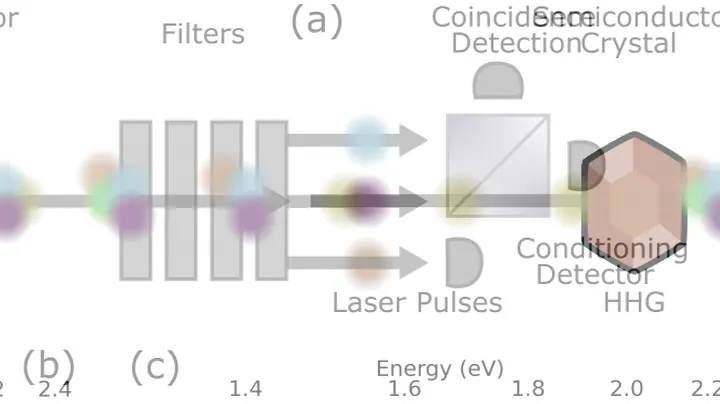
A powerful laser strikes a semiconductor, and it responds with light at many frequencies, like a string sounding a chorus of overtones. Previously, this was used in spectroscopy to observe ultrafast processes. But now physicists have noticed: the overtones are not independent; they behave as if connected by invisible threads.
Light trapped in a tiny cavity is like a pendulum that gets pushed harder and harder. At first, it swings smoothly and predictably, like an ordinary clock. But if you push it hard enough, the motion becomes strange: the pendulum seems to be in two extreme positions at once.
For a long time, physicists were certain: quantum entanglement requires direct quantum contact. A new study refutes this. Two microscopic magnetic particles, connected only by a classical spring, successfully become entangled.
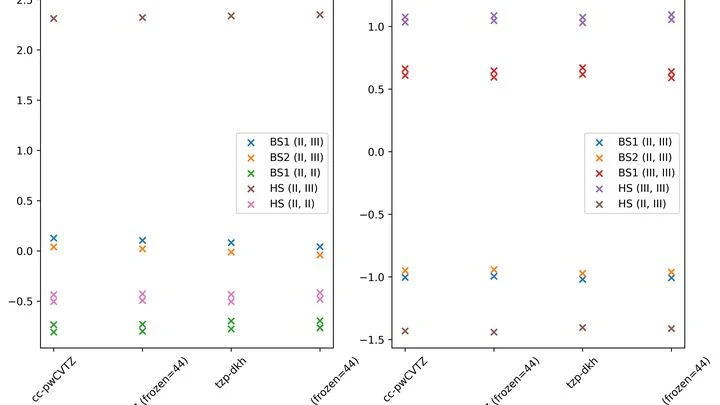
In every handful of fertile soil, there are bacteria that do something no factory can: they take nitrogen straight from the air and turn it into fertilizer. The secret lies in the enzyme nitrogenase, and its working core, a cluster of iron and molybdenum atoms, looks like a tiny factory floor.
Chemists have long tried to understand how this factory works from the inside.
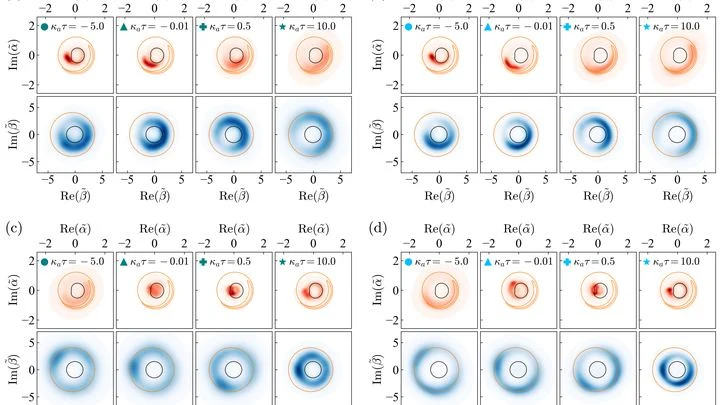
The Wigner function is a kind of topographic map of probabilities: hills correspond to regions where a particle is most likely to be found, and valleys to where its appearance is practically ruled out.
We are used to thinking that events have causes, objects exist independently, and signals cannot outpace the speed of light. Quantum mechanics, which describes the Standard Model of particles, challenges all these assumptions at once — as if a recipe couldn't use all seven ingredients.