Black Hole Rings Like a Hot Bell
Drop a pebble into a pond, and ripples spread across the water. Something similar happens when a black hole merges with another: it emits gravitational waves that resemble the fading ring of a bell.
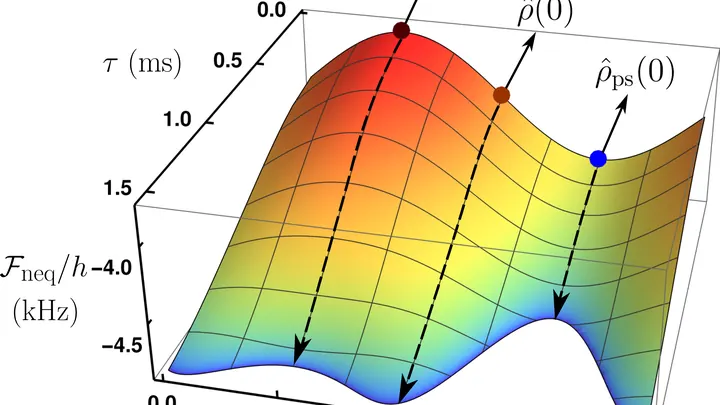
Quantum effects and symmetry formation during freezing processes in water and other substances.Quantum freezing phenomena refer to the surprising behaviors of matter during phase transitions when quantum effects dominate, particularly at extremely low temperatures. One notable example is the quantum Mpemba effect, where a hotter quantum system cools down and reaches a state of order faster than a colder one, seemingly violating intuition. These phenomena also include the formation of symmetry during freezing, such as how water molecules arrange into crystalline structures, and how quantum entanglement can influence the dynamics of cooling.
The classical Mpemba effect was observed in the 1960s by Erasto Mpemba, but the quantum version was first theoretically explored in the 2010s, with experimental confirmation in trapped-ion systems around 2022.
In classical physics, a hotter object takes longer to cool. But in quantum systems, the rate of cooling depends not just on temperature but on the initial quantum state and how it evolves. If a system starts in a highly excited state that is 'closer' in quantum state space to the final ordered state, it can transition faster. Similarly, during freezing, quantum fluctuations can seed the formation of symmetry, guiding molecules into a regular lattice. The interplay of entanglement and energy distribution determines how quickly order emerges.
Understanding quantum freezing could improve the efficiency of quantum computers by optimizing cooling protocols, and it may help design better materials for low-temperature applications where rapid ordering is beneficial.
In the quantum Mpemba effect, a system that is more entangled can actually cool faster than a less entangled one, turning the classical intuition about temperature on its head.
| T_BKT | variable | BKT transition temperature — temperature kelvin |
| ρ_s | variable | Superfluid density at zero temperature — superfluid density kilogram per metre |