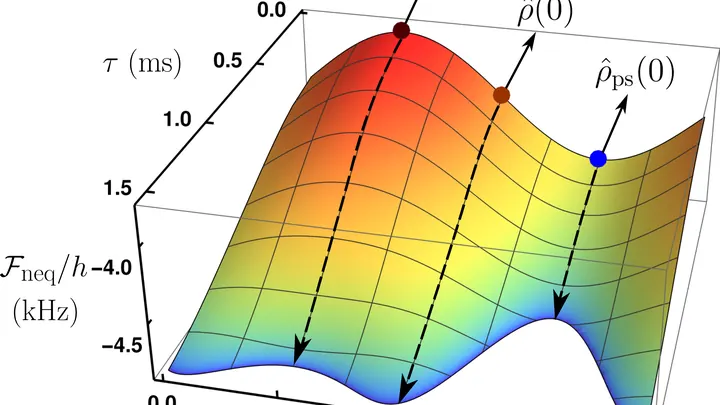
The quantum Mpemba effect is a quantum analog of the classical paradox where hot water freezes faster than cold water. In quantum systems, it manifests as a hotter (or more excited) system relaxing to equilibrium faster than a colder one, under specific conditions. This effect challenges intuitive notions of thermalization and has been observed in theoretical models and recent experiments with trapped ions and superconducting qubits. It is not a universal phenomenon but depends on the initial state's overlap with the system's slow modes: if the hotter state has less weight on slow-relaxing modes, it can thermalize quicker.
History
The quantum Mpemba effect was first predicted theoretically in 2018 by Nava and Fabrizio, and the first experimental observation was reported in 2022 using a trapped-ion quantum simulator, confirming the theoretical predictions.
How it works
The mechanism relies on the structure of the system's energy eigenstates and the concept of 'quantum memory.' A system's relaxation rate is determined by how its initial state projects onto the eigenstates of the Hamiltonian. If a hotter initial state has a smaller overlap with the slowest-decaying modes (often related to symmetries or conserved quantities), it can reach equilibrium faster than a colder state that has a larger overlap. This is often quantified using entanglement entropy or other measures of quantum correlations. The effect can be enhanced by tuning the system's parameters, such as the strength of interactions or the presence of symmetries, making it a controllable phenomenon.
In practice
The effect has potential applications in quantum thermodynamics and quantum computing, where faster thermalization could be used to speed up state preparation or cooling protocols, improving the efficiency of quantum devices.
Fun fact
In one experiment, a quantum system with higher initial energy reached thermal equilibrium in about half the time of a lower-energy system, directly demonstrating the counterintuitive effect in a controlled setting.
Hot water sometimes freezes faster than warm water: this odd fact is known as the Mpemba effect. Now something similar has been found in the quantum world: a state with weak entanglement (a special quantum connection between particles) can beat a more entangled one to the finish line.
A cup of hot coffee sometimes freezes faster than cold tap water. This paradox, known as the Mpemba effect, has long been considered a curiosity of classical physics. Now its quantum counterpart has helped test and tune quantum processors — devices that may one day power supercomputers.
Hot water sometimes freezes faster than cold. Ice forms more quickly from boiling water. This paradox, discovered by schoolboy Erasto Mpemba, long puzzled physicists. It turns out: the farther a system is from equilibrium, the faster it relaxes back to it.
The Mpemba effect remains controversial today: too many variables, hard to reproduce.
A runner trails the leader but crosses the finish line first. In the quantum world, such a trick was pulled off by a system of nuclear spins — tiny magnetic arrows of carbon-13 atoms in a diamond. This is a manifestation of the Mpemba effect: a state initially farther from equilibrium settles down faster than one closer to rest.
Imagine water as a ballroom, where each molecule is a dancer, constantly forming fleeting partnerships. These hydrogen bonds give rise to local patterns: some resemble a stiff waltz — an ordered network with cavities (low-density structure), others a wild jitterbug, where partners crowd into chaotic dense clusters.
The Mpemba effect is a mystery where hot вода sometimes freezes faster than warm water. Usually this is attributed to how вода loses heat and энтропию (a measure of disorder). But in a glass of water, chaos prevents a precise model.
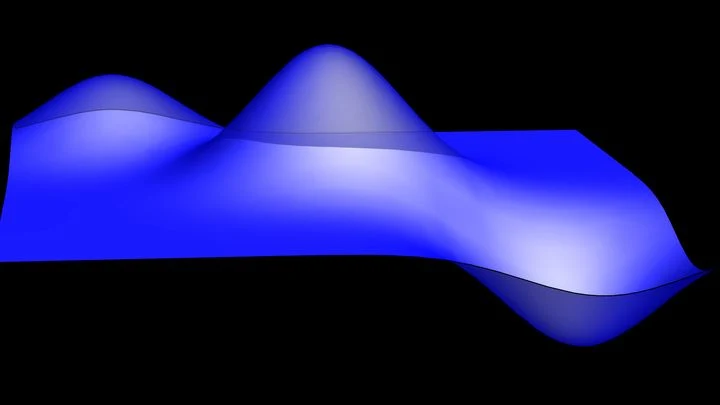
Physicists built a quantum model: a particle in a well with two depressions separated by a barrier.
The classical Mpemba paradox — hot water freezes faster than cold — has teased scientists for centuries. Only recently has nonequilibrium statistical mechanics explained it: it’s all about boundary conditions; the system seems to seek an excuse to “hit the wall” and speed up cooling.
In a hot mug, water sometimes freezes faster than in a warm one. This paradox is over half a century old and is called the Mpemba effect. It is usually attributed to fluid motion or evaporation. Now physicists have shown that a similar trick is possible without water, just through radiation of heat.
In boiling water you can see a prototype of a quantum trick: if part of the liquid turns into long-lived vapor bubbles, the main mass cools down. This is exactly what happens when you sharply jolt a system of interacting electrons: doublons flare up — pairs of particles that absorb excess energy and don’t decay for an astonishingly long time.
A glass of hot tea sometimes cools faster than a glass of warm tea. This paradox, known as the Mpemba effect, was long considered a curiosity from the world of liquids. But physicists have found it where no one expected: in the faint glow of organic films placed in a magnetic field.
Hot water sometimes freezes before cold: this is the Mpemba effect. In the quantum realm, a similar paradox appears: the more the equilibrium is disrupted, the faster it recovers. It's like fleeing from disorder (entropy) in reverse: the system rushes toward order, and a large initial imbalance only helps.
Ordinary water freezes as expected. But sometimes hot water turns to ice faster than cold — the Mpemba effect. Recently, a similar rule-breaking was found in quantum entanglement — the invisible link between particles discovered by Erwin Schrödinger.
A pot of water on the stove: the hotter the burner, the faster ice turns to water, and water to steam. Heat destroys order. But sometimes nature pulls a trick, and heating makes a liquid freeze, like a puddle turning to ice on a frosty morning.
Hot tea cools down, and its temperature is the same throughout the cup. But in many systems (for example, in the rarefied gas between stars or in plasma) temperature is not uniform: in one place particles are faster, in another slower. Physicists call such systems "superstatistical": it's as if the tea consisted of many small regions, each with its own temperature.
The void can produce particles if a strong enough field is applied. Physicists call this the Dirac–Klein paradox. Previously, explaining it required the most complex calculations of quantum field theory. But we can make do with a visual image: a tightly stretched rubber band with a knot. The knot is a particle.
Water in a cup cools down in minutes. Gas in a room spreads evenly in seconds. But if you trap atoms in a tube as thin as a laser beam and give them a good kick, they will take several seconds to "cool" toward equilibrium — an eternity by atomic standards.
The Mpemba effect is surprising: hot water sometimes freezes faster than cold. Scientists built a simple model: a bead in a thick, honey-like medium, on a landscape with two dips and a wall at the edge. The bead moves viscously, unable to hop over the central bump.
Physical systems can compute. If you build a landscape of hills and valleys so that the lowest point corresponds to the answer, the system will roll there by itself, like a ball. The problem is that the bottom is often flat, and the ball crawls around for a long time before settling.
The authors propose nudging the ball to the right place before it even starts.
In the quantum world, the path to calm sometimes resembles a paradoxical race: starting further from the finish, the system reaches equilibrium faster. This effect, a quantum analog of the Mpemba phenomenon, is due to the rapid growth of entropy — a measure of disorder.
Hot tea normally takes longer to cool than warm tea, but water sometimes breaks this rule: back in the 1960s, schoolboy Erasto Mpemba noticed that hot ice cream freezes faster than cold. This paradox has moved into the quantum world: a collection of particles can settle down faster if it was initially more excited.
The 'hot freezes faster' rule is familiar to many from water freezing outside, but in the quantum world a similar trick helps a system settle down quicker. Imagine a chain where jumps in one direction are easier than in the other. The particle gets stuck at the edge, like a car in a traffic jam on a one-way street, and energy dissipation is slow.
Picture a chef flicking water onto a sizzling skillet. The droplets instantly hiss and evaporate, giving immediate feedback on the temperature — far quicker than any thermometer. This intuitive idea underpins a new approach in quantum thermometry.
Two glasses of water: one scalding hot, the other just warm. The warm should cool first — but in the 1960s, a student from Tanzania noticed that hot ice cream freezes faster. This paradox was named the Mpemba effect. Recently, physicists found its quantum analog.
Hot water sometimes freezes faster than cold — this is the Mpemba effect. In the quantum world, it’s even more astonishing: a system bubbling with disorder (with high entropy) can settle incredibly faster than one that is almost calm.
The solution lies in islands of silence within any system — regions untouched by the destructive noise of the environment.
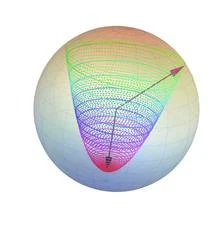
The Mpemba paradox, hot water sometimes freezes faster than cold, has gained a quantum sequel. In the microworld, a particle pushed farther from the finish line gets there first. Experimenters demonstrated this on a single spin: like a racer, they pushed it farther from equilibrium, and it reached it faster than after a weak nudge.
Hot water sometimes freezes faster than cold — that's the classic Mpemba effect. In the quantum world, its counterpart is even more astonishing: tiny particles can reach equilibrium many times faster than expected, and what helps them is not forgetfulness, but memory.
Everything tends toward equilibrium: tea cools, a pendulum swings to rest. The measure of this movement is entropy — growing disorder. But sometimes hot water freezes before warm. The Mpemba effect isn't just a curiosity: it shows up in the quantum world too. Scientists have devised a way to control this paradox.
A chain of twenty-four atoms, arranged with optical precision, begins its evolution from a state resembling a chessboard: every other atom is excited, and neighboring excitations are forbidden. After a few microseconds, the global picture becomes so entangled that the original pattern is no longer discernible.
The universe is putting on a show, and the lead role goes to dark energy. For a long time, the actor seemed unchanging: the cosmological constant (the vacuum energy that accelerates cosmic expansion) set the same tone throughout.
Two travelers head for the same destination. One starts closer but takes a winding country road. The other starts farther away but immediately hits the highway. The second arrives first. In quantum physics, this paradox is known as the quantum Mpemba effect: a state initially farther from equilibrium reaches it faster than one that starts closer.
The road to equilibrium for a quantum detector resembles a mountain route: the climb is always faster than the descent. An atom accelerated through the vacuum, sensing quantum field fluctuations, heats up to the Unruh temperature.
In 1963, a Tanzanian schoolboy named Erasto Mpemba noticed that hot ice cream freezes faster than cold. That paradox, named after him, long remained a subject of debate in classical thermodynamics. Now the quantum world offers its own version: a state with more strongly broken symmetry can recover it faster than a less broken one.
Imagine a soloist trying to blend their voice with a choir. If the choir sings in unison, the soloist's voice stands out for a long time; but if the choir scatters across a wide range — from deep basses to ringing sopranos — the soloist dissolves almost instantly. In quantum physics, the role of such a choir is played by a thermal bath — a massive environment.