Diamond is a solid form of carbon in which atoms are arranged in a crystal lattice. It is renowned for its exceptional hardness and optical properties, but in physics, it is also a material with remarkable electronic and thermal characteristics. Diamond is a wide-bandgap semiconductor, meaning it can conduct electricity under certain conditions, and it has the highest thermal conductivity of any bulk material.
History
The word 'diamond' comes from the Greek 'adamas' (invincible). The understanding of diamond as a form of carbon was established in the late 18th century by Antoine Lavoisier and others, who showed that burning diamond produces carbon dioxide. The first synthetic diamonds were produced in the 1950s.
How it works
In diamond, each carbonatom forms four strong covalent bonds with neighboring atoms in a tetrahedral arrangement. This rigid structure gives diamond its extreme hardness and high thermal conductivity. When doped with impurities like boron, diamond can become a p-type semiconductor, allowing it to conduct electricity. Its wide bandgap (about 5.5 eV) means it can withstand high voltages and temperatures without breaking down.
In practice
Diamond is used in cutting tools, high-pressureexperiments, and as a semiconductor material for high-power, high-frequency electronic devices. It is also used in quantum computing research as a host for nitrogen-vacancy centers.
Fun fact
Diamond conducts heat about five times better than copper, making it an ideal material for cooling high-power electronics.
Inside Earth, at depths from 660 to 2,900 kilometers, lies a layer known as the lower mantle. There, pressures reach 1.3 million atmospheres, and temperatures rival the surface of the Sun. Under these conditions, the mineral davemaoite exists as the third most abundant mineral in the lower mantle.
A microchip the size of a fingernail gives off as much heat as a small light bulb. Getting rid of that heat is like trying to cool a cup of hot tea with a teaspoon: the insulating material around transistors is usually a poor heat conductor.
Moiré patterns are familiar to everyone. Two combs with different spacing, placed on top of each other, show dark fringes. Something similar has emerged in time. Physicists took a cloud of Rydberg atoms, particles with unusually large electron orbits, and illuminated it with two lasers.
A crystal is like a row of soldiers on a parade ground: every atom is in its place, and electrons march through it in neat waves. An amorphous material is like a crowd at a train station, where there is no order, just a jostling throng. In such a crowd, an electron usually gets stuck quickly, like a person trying to push through a dense mass of people.
A crystal is like a city: if the streets are crooked, traffic jams. In a crystal, the streets are atomic rows, and the traffic is the flow of electrons. Any tiny imperfection, impurity, or atomic displacement makes electrons scatter. Scientists from several labs have learned to grow crystals so that the "streets" are almost perfectly straight.
The method is called horizontal vapor transport.
Diamond is the hardest natural material and usually does not conduct electricity. But if you add a few foreign atoms to its crystal lattice, it can become a semiconductor, like silicon in computer chips.
Diamond is the hardest natural material, and working with it usually feels like a sculptor using a jackhammer: rough, with cracks and chips. But electronics demands jeweler-like precision, because diamond conducts heat superbly, withstands high temperatures, and can work in quantum devices.
Turning light gases like hydrogen and nitrogen into metal is a long-standing dream of physicists. In a new experiment, nitrogen was compressed to 130–140 gigapascals (pressure equivalent to 14 million kilograms pressing on a fingernail) and heated to 3000°C.
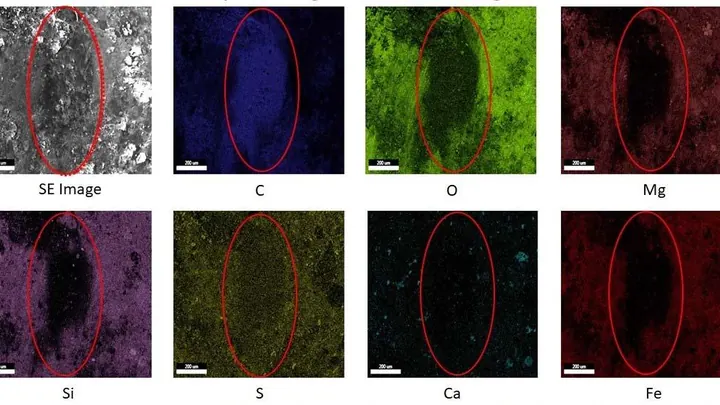
In 2017, a stone fell from the sky in the Indian village of Mukhundpura. It was a rare carbonaceous meteorite — a chunk of ancient cosmic material that preserves traces of the birth of the solar system. Locals quickly gathered the fragments, and they ended up in a laboratory.
Diamond is not just a gemstone. This crystal can conduct electricity when free charge carriers, electrons and holes, appear in it. But how fast do they move? In scientific papers, numbers vary by tens of times. One lab reports a mobility of 1000 cm²/(V·s), another 4000.
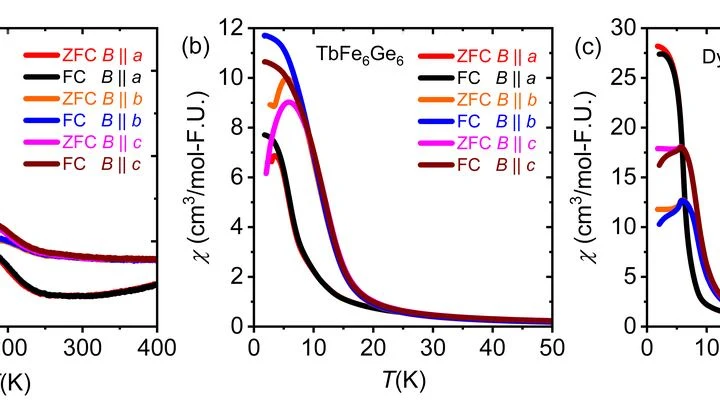
Imagine a stack of pancakes where each pancake is magnetized, but the magnetization directions in adjacent pancakes are opposite. That's exactly how this new magnetic material is arranged: in each atomic layer, all magnetic moments — the atom's 'arrows'—point in one direction, while the next layer is magnetized in the opposite direction.
A beam of visible light enters a cloud of billions of rubidium atoms cooled to near absolute zero, and emerges on the other side already in the telecom range.
Thirty nanometers is the distance over which a phonon sprinter hasn't yet had time to accelerate. In thin aluminum nitride films, thermal resistance remains almost unchanged up to this thickness: heat transport proceeds in the ballistic regime, where phonons (quanta of crystal lattice vibrations) fly…