How Movement and Sensation Loop Together express
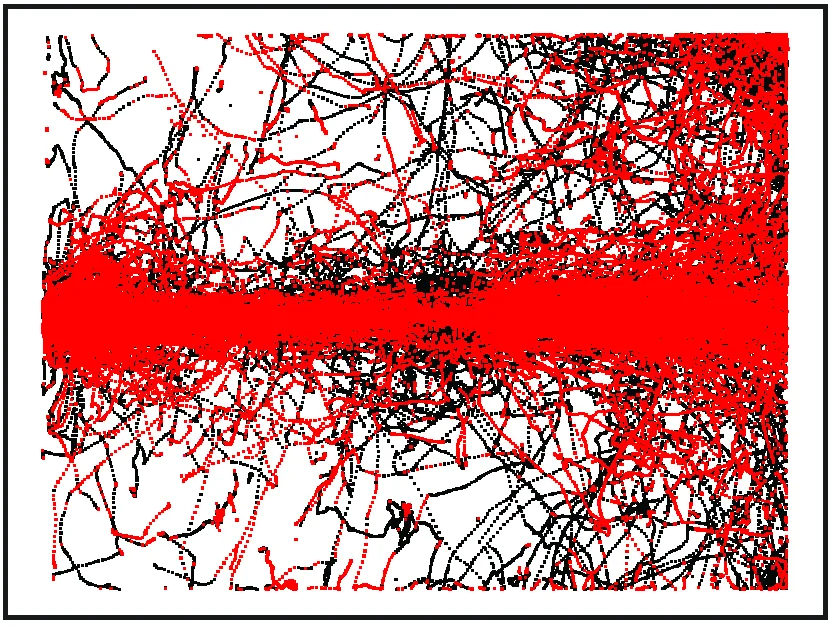
A bacterium swims toward food. A chemical signal guides it forward, but with each movement the signal changes. A loop emerges: sensation, action, new sensation. The authors turned this loop into a measurable quantity.
They applied an idea from information theory: you can calculate how many bits (units of information) flow from the senses to the motor command and back. The first stream they called reactive: this is the classic response to a stimulus. The second is active: here, the movement itself shapes future sensations, like when we turn our head to get a better look at an object.
The researchers built a simple model where these two streams can be tuned. The model showed: if the active stream is too small, the organism becomes a passive sensor and doesn't explore the environment. If it's too large, it ignores important signals. The optimum lies somewhere in between, and it differs for different tasks. In bacteria, for example, the reactive part dominates: they mostly follow the chemical gradient. In flies seeking an odor, the strategy changes depending on how close they are to the source.
The two-way exchange of information between sensation and movement is a common feature of all navigators, from the simplest to artificial ones. By measuring this exchange, you can not only predict search success but also understand what strategy an agent uses without peeking into its "brain." Thus, the loop that started with a swimming bacterium becomes a key to the behavior of any seeker.
Original abstract
as written by the authors arXiv:2607.26295
As organisms navigate the environment to locate critical resources, their behavioral actions must be tightly coupled to their sensory inputs. Here, we introduce an information-theoretic framework that quantifies this coupling using transfer entropy, which measures information flow between sensory inputs and behavioral outputs. Information flow from sensory inputs to behavior defines a "reactive" component of a navigational strategy, whereas information flow from behavior to sensory inputs defines an "active" component, whereby actions shape subsequent sensory experiences. Analyzing these bidirectional information flows enables us to both predict navigational performance and dissect navigation strategies from trajectories. Using a minimal model that captures the active and reactive components, we connect macroscopic performance to microscopic information flows. We then apply the framework to experimentally measured trajectories of bacteria, worms, and flies, as well as to machine learning agents navigating sensory landscapes. Across systems, bidirectional information flow reliably predicts navigation efficiency, revealing a common behavioral-environment feedback loop. Decomposing active and reactive information flows further exposes distinct strategies underlying bacterial chemotaxis, the spatial dependency of the navigation strategy in fly olfactory navigation, and the learned policies of a reinforcement-trained agent. Together, these results establish bidirectional information flow as a unifying principle for understanding navigation in biological and artificial systems.
E. coli "deliberates" about 10 bits of information per second when deciding where to swim. That's roughly the same amount needed to choose one out of a thousand possible trajectories.