Life at the Pencil's Tip: How Simple Rules Give Rise to Cells express
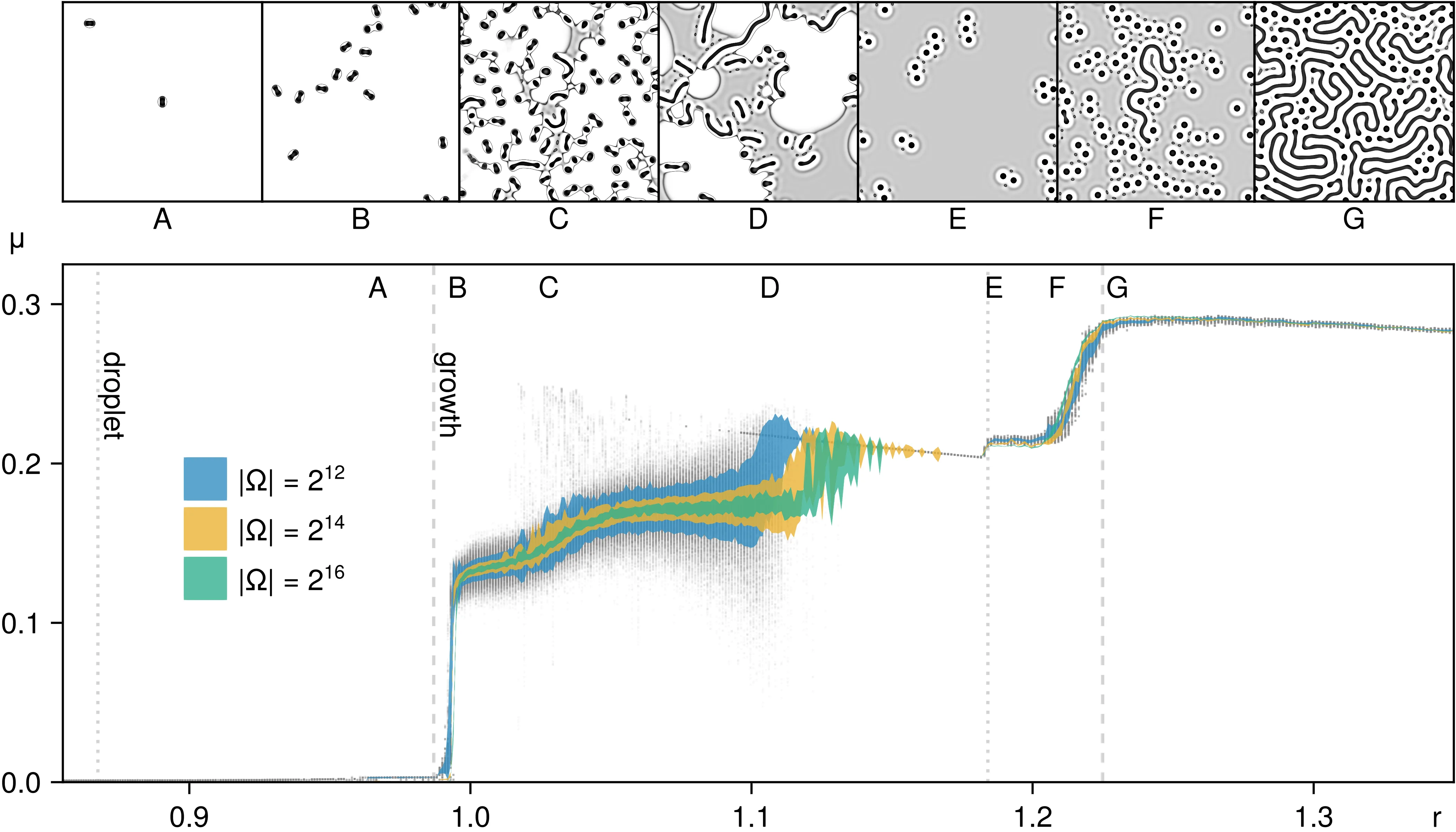
In 1970, mathematician John Conway invented the Game of Life — a cellular field where just three rules generate surprisingly complex patterns. Forty years later, SmoothLife appeared: a version where space is no longer cellular but smooth, like a blurred patch. The authors of the new study took an even simpler variant of this continuous game: now everything changes smoothly in time as well. The result was unexpected — structures resembling living cells spontaneously emerged on the field.
Each such 'cell' (actually just a clump of activity) lives its own life: it can crawl, split in two, or dissolve without a trace. It all depends on how much 'resource'—a kind of substance distributed across the field — surrounds it. When resources are scarce, the patterns freeze; when abundant, they start multiplying uncontrollably. The most interesting things happen at the boundary where pattern density is moderate. The authors call this zone the 'edge of growth'—it is here that all the diversity of forms is born.
If you add a conservation law, limiting the total amount of resource across the field, the system naturally settles onto this edge of growth. Self-organization emerges: patterns don't spread chaotically but gather into a mobile, ever-changing community. This resembles a bacterial colony, where each individual seeks food, but the overall balance keeps everyone together.
Such a simple sandbox needs no genes or membranes — only mathematics. Yet within it, we already see the rudiments of division, movement, and death. The continuous Game of Life becomes a bridge between abstract rules and real biology, allowing us to glimpse the very beginnings of self-organization.
Original abstract
as written by the authors arXiv:2607.27402
Conway's Game of Life shows that simple rules can generate a rich diversity of emerging structures. This cellular automaton has been translated to continuous space by Rafler (2011) in a simulation called SmoothLife. The isotropic rule of this continuous Game of Life generates patterns whose beauty has attracted the attention of a growing community at the intersection of science and computer art. We study a minimal variant of this model, continuous in space and time, that generates cell-like patterns capable of self-replicating, gliding and disappearing. The phenomenology of these unit patterns is reported and related to homogeneous-state bifurcations, symmetry breaking, observed shape instabilities, finite-amplitude morphological changes, and a dilute-to-dense transition associated with cell proliferation. Its mapping onto a large reaction--diffusion system is interpreted in terms of homeostatic concentrations of morphogens, regulated by the nonlinear survival rule and generated through a cell-sourced cascade of auxiliary reactions. Introducing a global conservation law that limits resource availability causes the system to self-organize at this dilute-to-dense transition, which we call the edge of growth. A further exploration of parameter space reveals a variety of phases and the richness of life-like morphologies organized around this edge. Resemblance to biological processes such as division, motility, and death, together with a concise formulation and numerical implementation, makes the continuous Game of Life an appealing model system for investigating the emergence and self-organization of life-like patterns.
In Conway's classic Game of Life, there is a 'glider' pattern that flies endlessly across the field. In the continuous version, such gliding clumps also exist: they resemble single-celled organisms swimming in a drop of water.