nlin.PS nlin.PS

17 articles

articles

General Relativity2025-11-221 minarXiv:2511.18110express
A Chain Reaction of Black Holes Generates Gravitational Waves
Right after the Big Bang, primordial black holes floated in the hot plasma — clumps of mass the size of a mountain squeezed into the volume of an atom. According to Hawking's prediction, they slowly evaporated, emitting radiation like tiny stoves.

Quantum Gases2026-02-211 minarXiv:2602.18876express
Sharp Corners Break Superfluidity
A superfluid flows without friction, like water in a perfectly smooth pipe, but the moment it hits an obstacle, the picture changes. In a new study, researchers looked at how a superfluid stream flows around rectangular walls and pits with sharp corners.
Applied Physics2026-03-021 minarXiv:2603.02433express
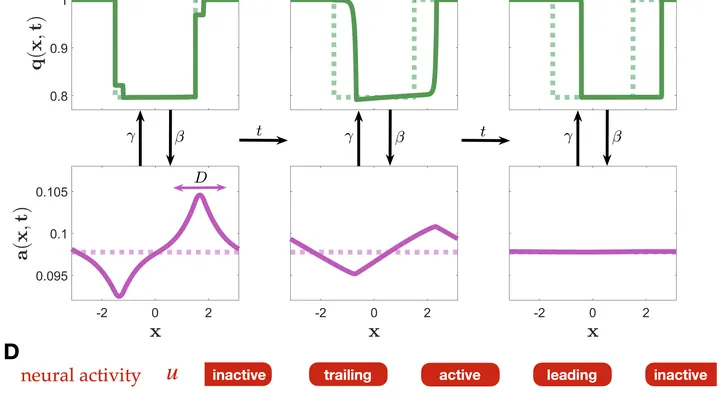
Mechanical Memory: How to Make a Wave Get Stuck and Move On
If you compress a plate with accordion-like cells, a kink wave runs through it, like a wrinkle in a rug when you push it with your foot. Such waves can switch the material between two stable shapes, and this is the basis of mechanical memory. But if a table leg gets in the way of the wrinkle, it gets stuck. In a new study, researchers showed how to nudge it loose without brute force.
Quantum Gases2026-03-101 minarXiv:2603.09357express
Solitons on a Magnetic Rope
Magnetic waves in an ultracold gas behave like elastic cords. Two or three such cords can twist into a single knot that breathes: it contracts and expands, but never unravels. For the first time, scientists assembled such knots in the lab and confirmed that their breathing matches calculations exactly. The gas consisted of two atomic species that do not mix, like oil and water.
Fluid Dynamics2026-03-151 minarXiv:2603.14237express
How a sharp jolt flips a system over
A quiet tube with a heated grid inside. The voltage on the grid is suddenly raised, and the tube starts to hum, sustaining itself. This is not a malfunction but a transition to another stable state, like a ball rolling over a hill into a neighboring hollow.
Optics2026-03-281 minarXiv:2603.27219express
A Light Vortex That Keeps Its Shape
A laser beam twisted into a spiral looks like a drain vortex in a sink: light moves not only forward but also in circles. Such vortex beams already help move tiny particles and transmit more data. But once they pass through an inhomogeneous medium, the vortex falls apart, like water from a leaky bucket.
How Helper Cells Keep a Thought in Mind
Holding a phone number in your head while you dial it: that's working memory. In the brain, a group of cells is responsible for this, sending signals to each other like people passing a bucket along a chain. But every transfer has a cost: it requires messenger substances that get used up.
Medical Physics2026-04-162 minarXiv:2604.15478express
Tissue as a Maze: Why FLASH Radiation Acts Unevenly
Imagine a city where streets are not straight but winding, with dead ends and hidden passages. A bike courier will take much longer to deliver a package than in a city with a regular grid of roads. Similarly, molecules inside living tissue: their path depends on how "tangled" the tissue structure is. Scientists built a model that describes the movement of molecules in such a "tangled" environment.
q-bio.PE2026-04-231 minarXiv:2604.22122express
How a Desert Remembers Its History
Drylands are like skin cracking from dehydration. When rainfall decreases, plants don't vanish overnight: they rearrange, leaving bare patches of soil between them. These patterns are visible even from space. Scientists compared satellite images of eight arid regions, from the Sahel in Africa to Australian deserts.
HEP Theory2026-06-212 minarXiv:2606.22680express
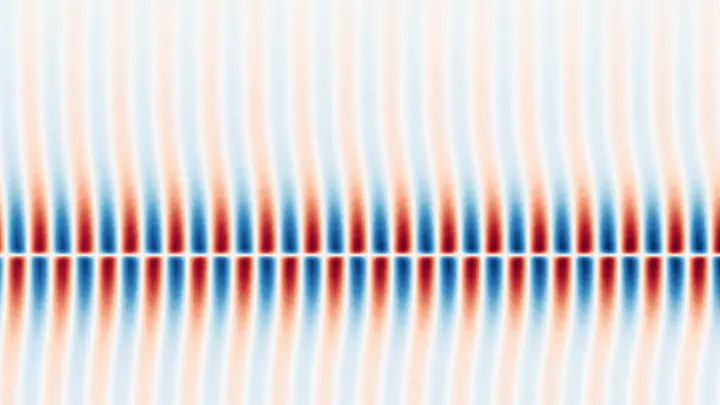
How a trembling bubble clings to a fold
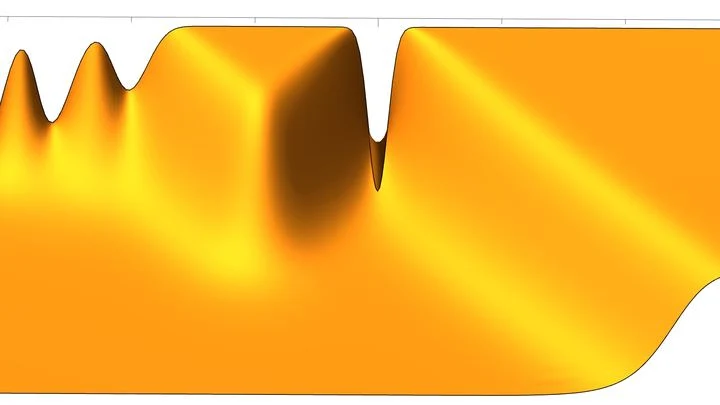
A lone fold runs across a taut sheet — a sharp drop in height that doesn't spread out but moves as a whole. Physicists call such a fold a 'kink'. If you give the sheet a sharp tug in one spot, ripples will travel across it. But in some media, these ripples don't disperse; instead, they gather into a clump and tremble in place for dozens or hundreds of cycles. Such a clump is an oscillon.
HEP Theory2026-07-262 minarXiv:2607.23616express
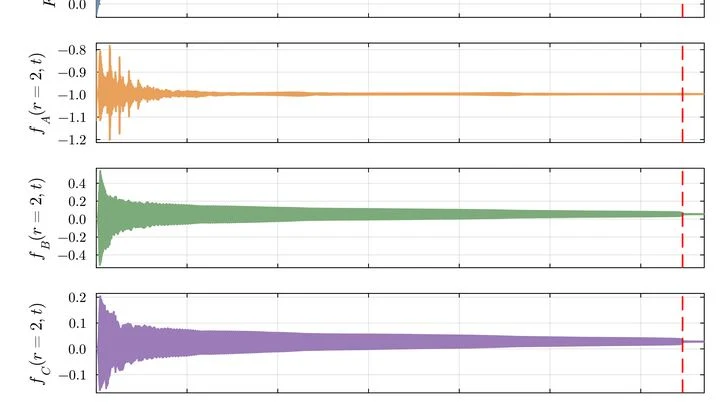
How a Tiny Addition to the Higgs Field Extends the Life of Energy Clumps
A tightly stretched string keeps vibrating after being plucked. In particle physics, there is a similar object — the oscillon. It is a clump of energy that pulses like a heart without spreading out in space. Such structures arise in the Higgs field — the very field responsible for particle masses.
Biological Physics2026-07-292 minarXiv:2607.27402express
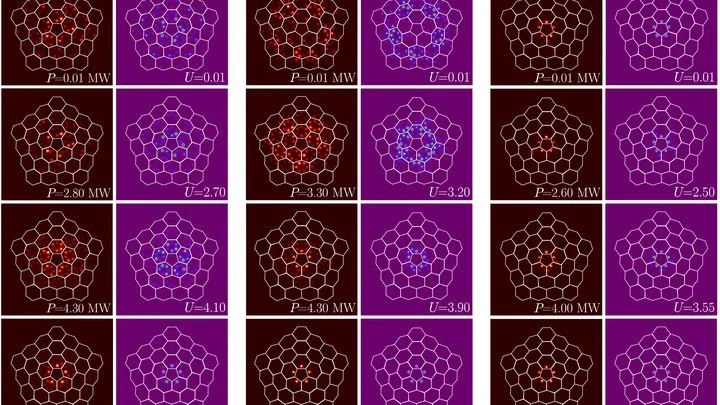
Life at the Pencil's Tip: How Simple Rules Give Rise to Cells
In 1970, mathematician John Conway invented the Game of Life — a cellular field where just three rules generate surprisingly complex patterns. Forty years later, SmoothLife appeared: a version where space is no longer cellular but smooth, like a blurred patch. The authors of the new study took an even simpler variant of this continuous game: now everything changes smoothly in time as well.
nlin.PS2026-08-011 minarXiv:2608.00579express
Quantum Shadow of a Classical Marvel
The Josephson junction is a bridge made of superconductor, separated by an ultra-thin insulating layer. Current flows through it even without voltage. But when the current becomes too large, the bridge starts to oscillate, and even steps, Shapiro steps, appear on the voltage graph. Between these steps hide invisible gaps where the system behaves strangely.
nlin.PS2026-09-032 minarXiv:2609.03259
A Gaussian Packet on Water: Three Fates of One Wave
A wave packet is like a traveler who either loses steam and spreads out along the way, holds a steady pace, or gathers into a fist. In a 50-meter flume with water 5 meters deep, scientists tracked how a bell-shaped group of waves behaves when its height is changed but not its width.
Optics2026-09-072 minarXiv:2609.07934
Light as a Score: Photonic Chip Conducts Wave Packets
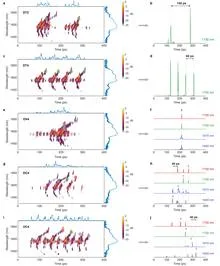
A conductor raises the baton, and the orchestra produces not just sound but a complex score: each note sounds at its own moment, at its own pitch, with the right volume. Light can also be a score, if you control its spectrum and timing. Previously, this required bulky setups that could not be reconfigured after assembly.
Cracks Learn from Their Mistakes
A drying puddle of mud becomes covered with cracks, like an old painting with craquelure. At first the cracks meet at nearly right angles, forming a rough grid. But if the mud is wetted again and allowed to dry, the pattern changes: cracks begin to meet in threes, at an angle of 120 degrees, like a honeycomb. Why this happens remained a mystery for a long time.