nlin.AO nlin.AO

29 articles

articles

Depth as a Measure of Natural Complexity
A team assembling a jigsaw puzzle from random pieces: how many simultaneous moves does it take to complete the picture? If the pieces are independent, they all go down at once. If each piece depends on the previous one, you have to work one at a time. So it is with systems: some states assemble instantly, others require a long sequential effort.
Noise That Works for Us
An old aviation instrument sometimes sticks: the needle catches on the scale and doesn't move, even though the plane is already changing altitude. Engineers found a simple solution: add a slight vibration. The shaking doesn't hinder; on the contrary, it helps the needle break free and show the truth.
The Forest That Sometimes Falls Silent, Sometimes Sings: The Dynamics of the Drake Equation
The Galaxy is a forest where birds don't start singing right away. First, trees must grow — stars, around which planets eventually appear. The Drake equation counts how many birds might be singing in this forest right now, but it implicitly assumes that their number doesn't change: as many as there are, that's how many there have always been.
The Climate Pendulum: How Extreme El Niño Events Are Born
Every few years, the Pacific Ocean off the coast of Peru warms up, and then fields dry out in Australia while deserts in Chile get drenched. This phenomenon is called El Niño.
nlin.AO2021-07-023 minarXiv:2107.00843
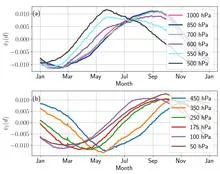
Ozone Sings in Many Voices: How Climate Stratifies by Altitude
In the vast concert hall of the atmosphere, ozone plays a part that changes from tier to tier. Near the surface, its notes sound alarming, for there it is a pollutant that irritates lungs and leaves. At 25 kilometers up, the same gas becomes a protective shield that absorbs harsh ultraviolet radiation.
Life from a Test Tube: How a Simple Mixture Assembled Itself into a Cell
Dissolve a few salts and formaldehyde in a glass of water. After a while, the liquid spontaneously separates: droplets with membranes appear, like tiny bubbles. Inside each droplet, chemical transformations occur, and the droplet itself grows, absorbing material from the surrounding solution. These droplets are not just bubbles.
Statistical Mech2026-02-162 minarXiv:2602.15185express
Complexity on the Edge of Order and Chaos
A magnetic film divided into tiny arrow-shaped cells behaves like a crowd in a square. While it's cold, all arrows point in the same direction — perfect order. Heat the film, and the arrows start darting around like pedestrians who have lost their purpose. Somewhere between these extremes, there is a moment when the system stops being uniform but hasn't yet dissolved into random noise.
q-bio.PE2026-02-281 minarXiv:2603.00457express
How Deceiver Ants Strengthen Their Shared Home
In an anthill, some ants carry food and build, while others just eat and reproduce. This isn't just laziness: it's two distinct types of ants. Workers are smaller, while freeloaders are larger. If freeloaders become too numerous, the colony falls apart, like a communal kitchen where nobody washes the dishes.
Statistical Mech2026-03-231 minarXiv:2603.22089express
A Network That Decides When to Stop
A Network That Decides When to Stop A crowd grows: each new person joins the group with a probability that depends on how large the group already is. If the group is small, joining is easy; if it is huge, people start to hesitate, and growth slows down. This mechanism, called feedback, changes the entire behavior of the network.
Biological Physics2026-03-271 minarXiv:2603.26226express
The Ant Trap: When the Shortest Path Becomes a Roadblock
In urban planning, Braess's paradox is well known: adding a new road to a transport network can worsen traffic rather than ease it. For a long time, it was explained by the selfish behavior of drivers, each seeking personal gain. However, ant colonies, acting as a single coordinated superorganism without personal interests, exhibit the same trap.
High Energy2026-04-061 minarXiv:2604.04659express
Why Power Laws Are Everywhere
Toss a handful of sand on the floor: there are few large grains, many medium ones, and even more tiny ones. This skew, where small events are common and large ones are rare, is described by a power law. It shows up in city sizes, earthquake magnitudes, and citation counts of scientific papers.
q-bio.PE2026-04-111 minarXiv:2604.09966express
The Landscape Ratchet: How Fragmentation Boosts Biodiversity
A landscape cut by roads or rivers into isolated patches resembles a shared apartment after partitions are installed: residents no longer bump into each other in the common hallway. Species that once competed for the same food or space now live apart. Competition weakens, and those that would have lost to pushier neighbors in a continuous landscape now survive.
High Energy2026-04-231 minarXiv:2604.21390express
The Magnetic Dance of a Black Hole
Gas falling into a black hole spirals inward like water down a drain. In this flow, magnetic loops constantly form and pop — somewhat like solar flares, but far more powerful. Each loop is a tiny magnet living its own life. When many of them are present, they start to influence each other: their north and south poles attract and repel in turn.
nlin.AO2026-05-063 minarXiv:2605.04508
The efficiency of chaos: how nonequilibrium systems save energy on self-organization
The engine of order runs right at the edge of chaos: push it a little harder and instead of neat structures you get a whirlwind of randomness. Physicists have long suspected that living systems, from flocks of birds to bacterial colonies, choose exactly this edge, but they could not measure how worthwhile it is to spend energy maintaining order far from equilibrium.
How the Brain and Heart Drift Apart in the Final Minutes
When the conductor leaves the orchestra, the musicians keep playing from memory for a while. But without a unified rhythm, each one starts to speed up or slow down on their own, and the harmonious symphony turns into disjointed noise. According to new research, the brain and heart behave much the same way in the last hours of a person's life.
How the Brain Learns to Predict Without Cues
A neural network, like a sheet of graph paper, receives homogeneous signals at its input, and draws its own coordinate grid. Initially, connections between inputs and network cells form a gentle hill: the response is strongest at the center and fades toward the edges.
Biological Physics2026-06-172 minarXiv:2606.19066express
The Fire That Kindled Our Minds
A living organism is a machine that constantly channels energy through itself and converts it into heat. This internal cycle is called internal entropy production (a measure of energy dissipation). But about 2.5 million years ago, our ancestors switched on a second loop — an external one. They picked up a sharpened stone, and then a burning branch.
q-bio.MN2026-07-033 minarXiv:2607.03545
The Cellular Orchestra: How Genes Learn to Play in Tune with Chaos
In embryonic development, a cell resembles a musician in a vast orchestra: it must play its part, following a conductor — the gradient of signaling molecules. But the conductor is unreliable: morphogen concentrations constantly fluctuate. How then does a cellist not veer into a violin melody?
Theater in the Fog: The Quantum Landscape that Gives Birth to Thought
Imagine an old theater in the damp fog. On the stage, a scattering of actors, but only one is caught by the spotlight beam, made to freeze in the bright patch. The rest billow in the dim light, ready to dissolve at any moment.
nlin.AO2026-07-161 minarXiv:2607.14914express
How Spite Replenishes Resources
Two gardeners haggle over water from a magical well. One proposes how many buckets to take, the other can agree or refuse. If the deal goes through, the water decreases; if not, the well gradually refills. This haggling repeats hundreds of times, and the gardeners' habits sometimes change randomly, as if they're trying new tactics.
Biological Physics2026-07-292 minarXiv:2607.27402express
Life at the Pencil's Tip: How Simple Rules Give Rise to Cells
In 1970, mathematician John Conway invented the Game of Life — a cellular field where just three rules generate surprisingly complex patterns. Forty years later, SmoothLife appeared: a version where space is no longer cellular but smooth, like a blurred patch. The authors of the new study took an even simpler variant of this continuous game: now everything changes smoothly in time as well.
Statistical Mech2026-07-301 minarXiv:2607.28172express
Avalanche of Cells: The Critical Edge
On a steep mountain slope, a single falling rock sometimes triggers an avalanche, and sometimes gets stuck. It all depends on the state of the slope.
Entropy as a computer's compass
Picture a swarm of 200 particles that keep jostling, aligning their velocities, and pushing toward a common goal. This swarm isn't just darting around in space: it's learning to predict chaos. An external signal, something like the unpredictable behavior of weather, is fed in through a single driver particle, and the rest have to guess where it will move next.
Biological Physics2026-07-311 minarXiv:2608.00314express
A Swarm of Insects Holds Together by Noise
A mosquito swarm resembles a living cloud — hundreds of bodies circle together, but no one lines up or mimics a neighbor's movements like starlings or fish. For a long time, it was unclear what held such unity together. The authors of a new study suggested that the insects communicate by sound.
Biological Physics2026-08-012 minarXiv:2608.00662express
Gut Rhythms Without a Clock
In any complex community, whether an orchestra or a colony of microbes, you can notice a rhythm. In the mouse gut, bacteria change their abundance every day, and for a long time it seemed they were syncing their internal clocks with the host's. But when researchers looked closely at hourly measurements, the familiar picture fell apart.
q-bio.CB2026-08-011 minarXiv:2608.00846express
How a Cell Chooses Its Path: A View Through the Noise
A Dictyostelium amoeba crawls across glass. Its path is recorded — a chain of points on a plane. But what forces are pushing it? Inside the cell, a molecular motor works: proteins pull, the membrane springs, water presses.
Physics and Society2026-08-021 minarXiv:2608.00939express
AI Freezes in the Heat
In an oven, as temperature rises, molecules move faster and disorder increases. With language models like ChatGPT, it's the opposite. When developers increase the 'temperature' parameter, the model gets access to a wider choice of words, but its long texts suddenly start looping. A team of researchers tested 11 different AIs by generating 12,000 text continuations.
nlin.AO2026-08-141 minarXiv:2608.14081express
Ecosystems in Nature's Rhythm
A forest does not live in a static world. Between winter and summer, day and night, conditions shift, and each fluctuation is like a rhythm that all its inhabitants must keep pace with. Yet until now, ecologists have mostly studied how communities of living beings persist in an unchanging environment, like testing a bridge's strength only in calm weather.
A Greedy Flock: How Foraging Gives Rise to Collective Behavior
Picture a flock of birds gathering around a feeder that no one built. Each bird searches for food on its own, yet they all end up together. Usually, such behavior is explained by social instinct: birds want to be near their kin. But what if the flock is simply a side effect of greed?