Flat Bands: Magnetism Without Motion express
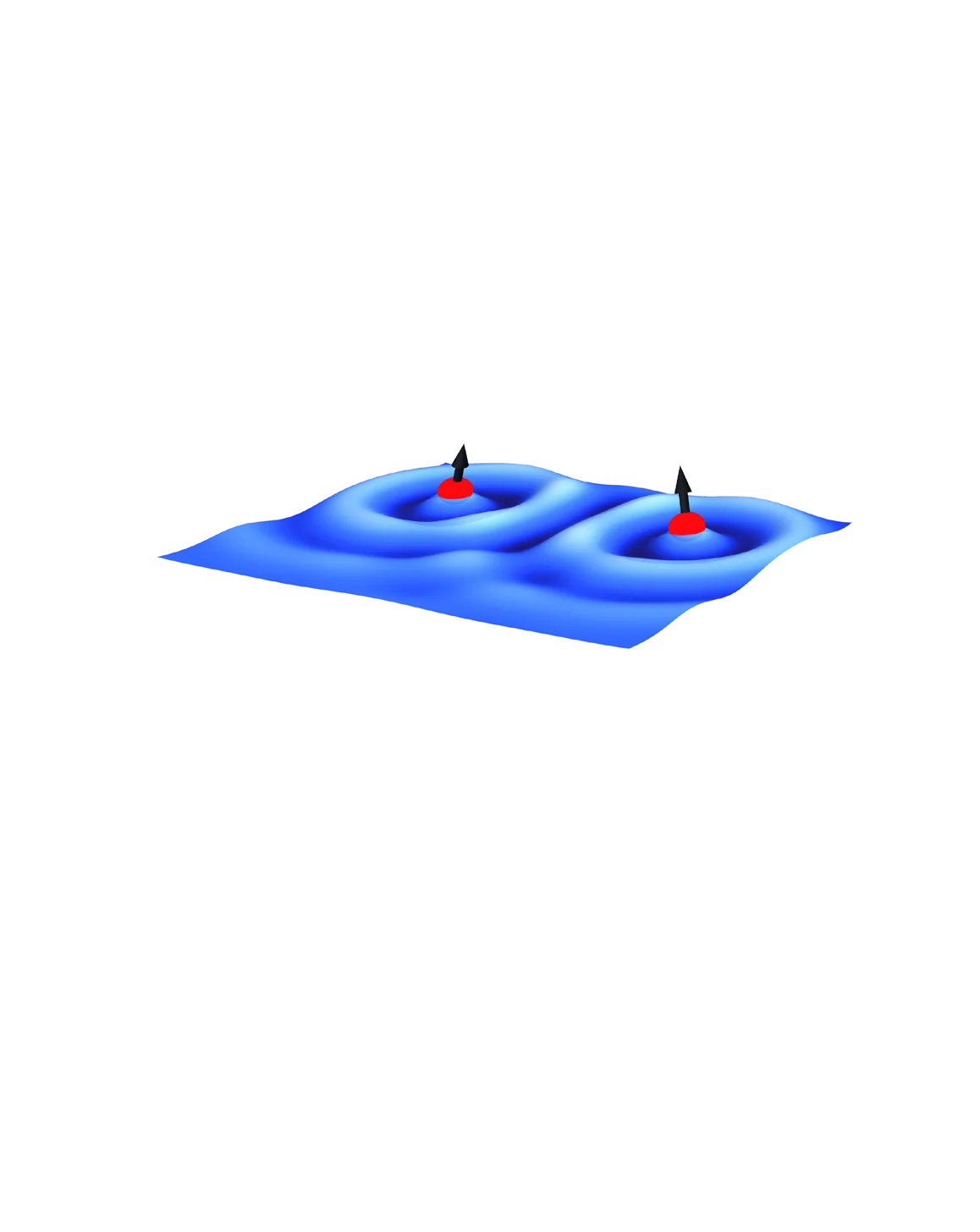
Imagine a postal service where couriers suddenly stop moving. It would seem that letters would stop arriving and communication between cities would break down. But what if the envelopes themselves suddenly gained the ability to change shape and transmit messages through a shared web without moving an inch? That's exactly the kind of unexpected mechanism physicists have discovered in the world of quantum materials.
In ordinary metals, the magnetic moments of atoms communicate via mobile conduction electrons, like exchanging letters through speedy couriers. This interaction is known as RKKY interaction. But in some crystals, electrons find themselves in so-called flat bands, where their group velocity (the speed at which an electron moves as a particle) drops to nearly zero. The couriers are frozen. Logic suggests that magnetic coupling should vanish. Yet nature has found a loophole.
It turns out that in flat bands, the baton is passed to the quantum metric — a quantity that measures the 'distance' between quantum states of electrons in the Brillouin zone (the full set of possible momenta). It determines how far magnetic order extends and how robust it is. The larger the quantum metric, the stronger the magnetic coupling and the higher the temperature at which the material can become magnetic. This effect is especially pronounced in small samples, where the usual constraints on magnetism no longer apply.
Thus, immobility turns into a new type of coupling. The couriers stand still, but the letters get through — thanks to the geometry of the very fabric from which the crystal is woven.
The quantum metric is not an abstract concept. It can be measured experimentally by observing how electrons in a crystal respond to external fields, and it is closely related to the real geometry of electron orbitals.
In Greg Egan's novel 'Distress', a universe is described where the laws of physics are so strongly determined by the geometry of spacetime that familiar causality disappears — much like here, where magnetism is determined not by motion but by pure geometry of quantum states.