The Brillouin zone is the fundamental cell in reciprocal space (also called momentum space) that captures the periodicity of a crystal lattice. Just as a crystal is periodic in real space, its electronic properties are periodic in momentum space, and the Brillouin zone is the smallest repeating unit that contains all unique information about the electron states. It is constructed from the Wigner-Seitz cell of the reciprocal lattice, which is defined by the crystal's lattice vectors.
History
The concept was introduced by Léon Brillouin in the 1930s, building on earlier work by Felix Bloch on electron waves in periodic potentials. It became a cornerstone of solid-state physics, particularly in the theory of electronic band structure.
How it works
Electrons in a crystal are described by Bloch waves, which are plane waves modulated by a function with the same periodicity as the lattice. The wavevector k of these waves is defined only up to addition of a reciprocal lattice vector, so all distinct states lie within the first Brillouin zone. The energy bands—the allowed energy levels for electrons—are plotted as functions of k within this zone. The shape of the zone depends on the crystal structure: for a simple cubic lattice, it is a cube; for a face-centered cubic lattice, it is a truncated octahedron. The zone boundaries often correspond to energy gaps, where electrons cannot propagate.
In practice
The Brillouin zone is used to calculate and interpret the electronic, optical, and vibrational properties of materials, such as band gaps in semiconductors, which are crucial for designing transistors, LEDs, and solar cells.
Fun fact
The shape of the Brillouin zone can be highly complex; for example, the zone for a quasicrystal is fractal-like, reflecting the non-periodic but ordered structure of the material.
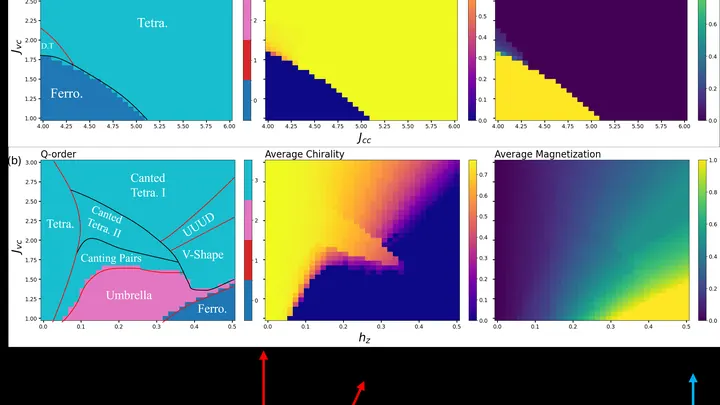
Imagine a triangular grid with tiny magnetic arrows at each node. Electrons, the charge carriers, run across this grid. Usually, the arrows align simply: all pointing the same way (ferromagnet) or alternating in the plane.
A crystal without inversion symmetry is like a room where one wall is mirrored and the other is frosted: the reflection doesn't match the original. Such materials often behave unusually because electrons feel the lattice distortion.
In two-dimensional crystals, electrons and holes, quasiparticles corresponding to the absence of an electron and carrying positive charge, attract each other, forming bound pairs called excitons. When cooled strongly, as thermal fluctuations die down, the motions of many excitons can synchronize, like a coordinated dance.
An electron inside a crystal is like a traveler walking through a city with winding streets. Its direction of motion constantly changes depending on where it is. Physicists call this feature the geometric Berry phase, and it determines how a material conducts electricity or responds to a magnetic field.
A sheet of graphene is a lattice of carbon atoms arranged like a honeycomb. Electrons in it zip around so fast they seem to have no mass, just like light. When a powerful laser pulse hits such a sheet, the electrons get a kick and start accelerating. Their path can be compared to a road with occasional barriers — the forbidden zones.
Cells in our bodies are not rigid bricks but rather squishy sponges soaked in water. Their softness or stiffness matters: cancer cells are often softer than healthy ones, and cartilage must withstand pressure with every step. To measure this stiffness without touching the tissue, scientists use light.