The Boltzmann constant (symbol: k or kB) is a fundamental physical constant that connects the microscopic world of atoms and molecules to the macroscopic world of everyday temperatures and energies. It is the proportionality factor between the average kinetic energy of particles in a gas and the absolute temperature of that gas. More deeply, it appears in the statistical definition of entropy, S = k ln W, where W is the number of microscopic configurations consistent with a macroscopic state. This makes it the bridge between thermodynamics and statistical mechanics, giving a quantitative meaning to the idea that temperature is a measure of the average random motion of particles.
History
The constant was introduced by Max Planck in 1900 while deriving the blackbody radiation law, and he named it after Ludwig Boltzmann, who had pioneered statistical mechanics but never explicitly used the constant in its modern form. The value was first measured accurately by Planck using radiation data.
How it works
In kinetic theory, the average translational kinetic energy of a particle in an ideal gas is (3/2)kT, so the constant converts temperature (in kelvin) into energy (in joules). In statistical mechanics, the Boltzmann factor exp(-E/kT) gives the relative probability of a system being in a state of energy E at temperature T. The constant sets the energy scale for thermal fluctuations: at room temperature, kT is about 1/40 of an electronvolt, which is why chemical reactions and biological processes operate at that energy scale.
In practice
It is used in every calculation involving thermal noise, from the Johnson–Nyquist noise in electronic circuits to the design of infrared detectors and the calibration of thermometers. It also defines the kelvin itself, since 2019 the kelvin is defined by fixing the value of k exactly.
Fun fact
The Boltzmann constant is the only fundamental constant that has a dedicated unit (joules per kelvin) named after a person, and its value was chosen in 2019 so that the kelvin is defined by setting k = 1.380649 × 10⁻²³ J/K exactly.
A numerical factor that depends on the frequency integration limits and the specific definition of 'average' (e.g., over the full spectrum). — proportionality constant = 2.701
k_B
constant
Fundamental constant converting temperature to energy scale — boltzmann constant= 1.380649e-23joule per kelvin
⟨ ⟩
operator
Statistical average over the photon distribution — ensemble average
$$T = \frac{\hbar c^3}{8\pi G M k_B}$$
Black hole temperature is inversely proportional to its mass.
What is in the formula
T
variable
Hawking temperature of the black hole — temperaturekelvin
A handful of coins drops onto a table — heads and tails land wherever they please. The same goes for an instantaneous snapshot of a quantum chain: in some places a particle is present, in others it is not. But behind the disorder lurks a precise angle.
In this work, a chain of particles closed into a ring was considered. It was divided into four arcs: two were measured, two were left untouched.
A black hole has three laws, just like an ideal gas. The first: energy is conserved. The second: the horizon area never decreases. And the third, the most finicky, demands that at zero temperature the entropy (a measure of disorder) tend to zero or a universal constant.
Imagine a postal service where couriers suddenly stop moving. It would seem that letters would stop arriving and communication between cities would break down. But what if the envelopes themselves suddenly gained the ability to change shape and transmit messages through a shared web without moving an inch?
Textbooks divide particles into two camps: bosons love to crowd into the same state, fermions absolutely refuse. But nature allows a third option. Anyons are quasiparticles whose behavior lies somewhere in between. They can 'remember' how they were exchanged and obey a nonstandard exclusion principle.
The early universe expanded at an unimaginable rate — faster than light could cross it. In this boiling cauldron, any region of space resembled an open can of paint: its boundaries continuously captured new 'vapor' from outside, while some of its own contents irrevocably escaped.
A pot of water always boils the same way: hit 100 degrees and bubbles start. Quantum fluids are different. When a cloud of atoms is cooled to near absolute zero, it can turn into a single matter wave — a Bose–Einstein condensate. But the transition itself, it turns out, can happen in three different ways.
Every quantum system (whether an atom, a crystal, or the entire Universe) has its own set of allowed energies, like the steps of a ladder. The hotter the system, the more readily particles climb to higher rungs.
An ultracold cloud of atoms trapped in laser light can 'breathe': it rhythmically contracts and expands, much like lungs. Physicists have long been able to observe this breathing, but only now have they realized that its amplitude is not just a pretty picture: it is a precise measure of hidden energy jitters inside the cloud.
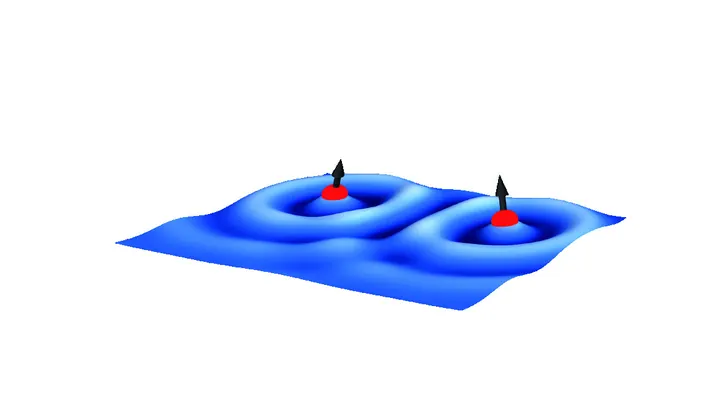
In a container the size of a coin, light behaves like water: it gathers into a single quantum fluid. When energy is added, whirlpools, quantum vortices, spin up on their own. Each vortex is like a tiny whirlpool that cannot simply disappear.
Physicists illuminated this fluid with a laser and took snapshots.
At the hilltop of classical physics, a particle is frozen in unstable equilibrium. The slightest nudge — and it rolls down with increasing speed. In the quantum universe, no nudge is needed: the uncertainty principle itself acts as an all-pervading wind, blowing the particle off the peak.