Hairy Black Holes and Strings express
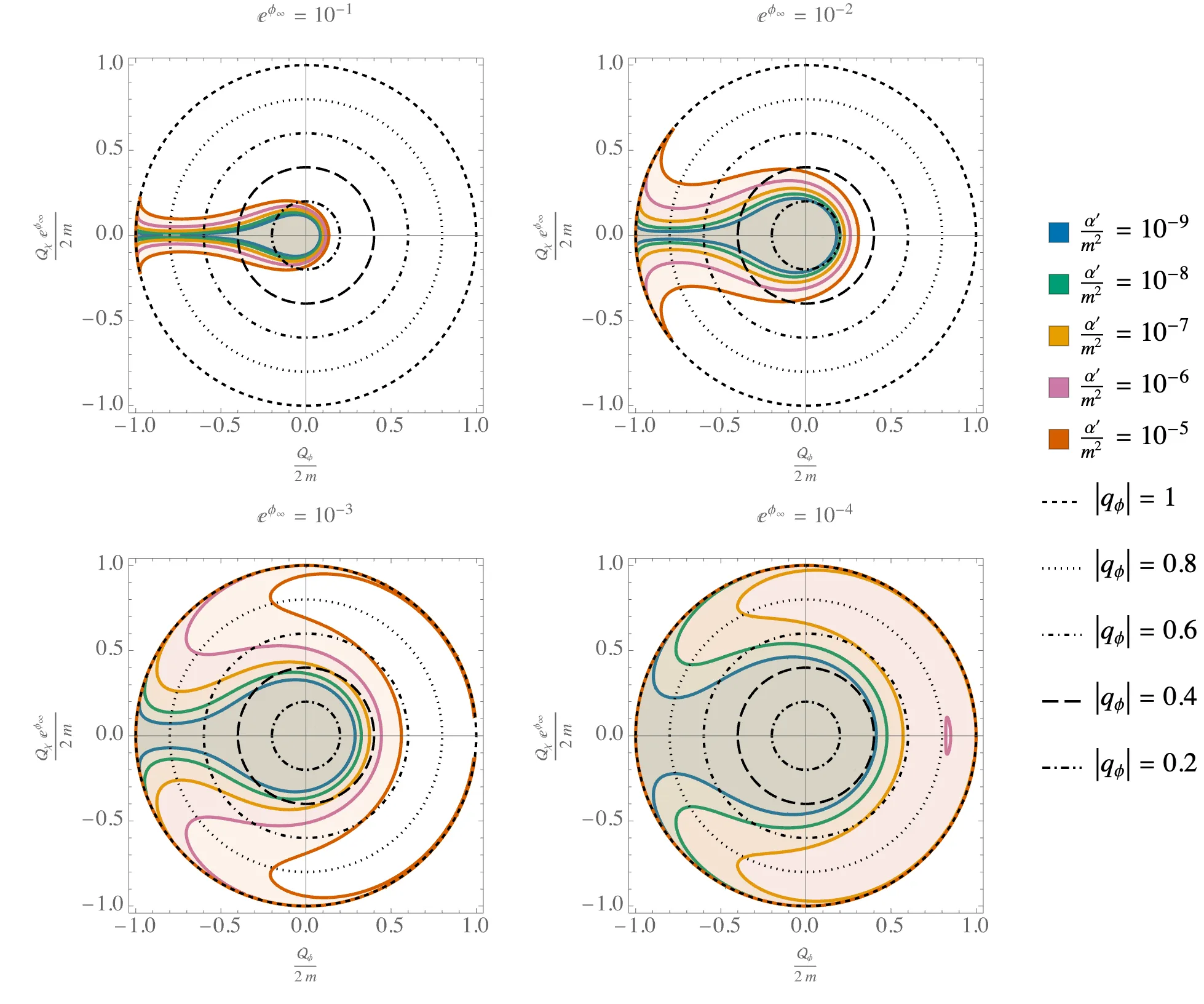
A black hole is not just a dark sphere. In string theory, it can grow 'hair'—extra scalar fields such as the axion and the dilaton. These fields gently alter the geometry of space around the hole. The authors started from the classical solution for a 'bald' black hole, the so-called Fisher–Janis–Newman–Winicour solution, and showed that all possible 'hairy' variants arise from it via a simple symmetry transformation. It's like rotating a shape in charge space: the same form, but from a new angle.
Then the physicists tested how robust these solutions are when quantum corrections come into play. They compared two types of corrections: those from spacetime curvature (so-called α'-corrections) and those from string interactions (loop corrections). It turned out that for weak fields, the curvature corrections kick in earlier. This means that even a slightly 'hairy' hole senses quantum effects more sharply than a completely bald one. In the regime where the black hole's size is comparable to an excited string, hairy solutions always have greater curvature than the classical Schwarzschild hole.
This result is important for the hypothesis of a correspondence between black holes and strings. It turns out that even a small 'mane' makes the hole a more sensitive probe for testing the theory. Far from this correspondence, in weak gravity, hairy solutions remain under control and can describe fields from highly excited strings — provided the string coupling also stays weak.
The term 'hair' for black holes was introduced by physicist John Wheeler in the 1960s, joking that 'black holes have no hair'—meaning they are described only by mass, charge, and rotation. But in theories with extra fields, hair does appear.