The dilaton is a hypothetical scalar field that emerges in various extensions of general relativity, particularly in string theory and Kaluza-Klein theory. It couples to matter and modifies the strength of gravity and electromagnetic forces, effectively acting as a dynamic 'constant' that can vary across space and time. In cosmology, the dilaton has been proposed as a candidate for dark energy or as a mediator for dark matter interactions.
History
The dilaton was first introduced in the 1920s by Theodor Kaluza and Oskar Klein as a component of a five-dimensional theory unifying gravity and electromagnetism. It was later revived in string theory in the 1970s and 1980s as a fundamental scalar field.
How it works
In theories with a dilaton, the field's value determines the coupling constants of fundamental forces. As the field evolves, it can change the effective gravitational constant or the fine-structure constant. This is often modeled by adding a scalar field term to the Einstein-Hilbert action, which then influences the spacetime geometry and the motion of particles. The dilaton can also produce long-range forces if it is very light.
In practice
The dilaton is studied in theoretical cosmology as a possible driver of cosmic acceleration, and in particle physics as a candidate for a light scalar particle that could mediate new forces.
Fun fact
In string theory, the dilaton's vacuum expectation value determines the string coupling constant, meaning the strength of all interactions in the theory is set by this single field.
A stone drops into a pond, and ripples spread across the water. In the same way, massive bodies generate gravitational waves, except it's space itself that ripples. So far, these waves have been caught by giant detectors that barely flinch as a wave passes through. But what happens on the microscopic scale, inside a tiny piece of matter?
In the far reaches of space, there exists a hypothetical object: an ultracold black hole. It is charged and resides in an expanding universe (de Sitter space). Its temperature hovers just above absolute zero — about one trillionth of a degree above it.
A black hole spun up almost to its limit is like an athlete balancing on the edge of a record. The most interesting action isn't inside the hole itself, but in the thinnest film of spacetime at its horizon. It's there that tiny corrections to Einstein's gravity can suddenly swell to gigantic proportions.
Light freezes at the edge of the abyss: that's what the event horizon of an ordinary black hole looks like. But at the center of this abyss lurks a singularity, a point where the laws of physics break down. What if, instead of a point, there were a hard shell?
A gravastar is not a black hole.
In the first moments, the Universe expanded at an enormous rate. This process is called inflation, and its driving force is the inflaton field. Its energy pushed space apart, like yeast raising dough. But physicists suspect that the dough might have left 'bubbles'—superheavy particles born from the expansion itself.
In 1929, Edwin Hubble pointed his telescope at distant galaxies and discovered they were receding. Ninety years later, two measurements of this recession rate, from ancient light and from nearby stars, stubbornly disagree. A 9% discrepancy cannot be chalked up to error. It is as if the Universe in its youth and in its maturity runs on different clocks.
Right after the Big Bang, space cooled unevenly. In some places, folds could have formed — threads of energy as thin as a hair but incredibly dense. Physicists call them cosmic strings. They oscillate, collide, and emit gravitational waves — ripples in the fabric of space itself.
In the first 10⁻³⁵ seconds after the big bang, the most rapid part unfolded. Space expanded faster than light — that's expansion of the universe (inflation). Almost the entire score was performed by a single field, the inflaton, conducting the tempo and key.
The Standard Model of particle physics is a catalog of all known building blocks of the universe: electrons, quarks, and others. But it is silent about dark matter and doesn't get along with gravity.
10⁻¹²⁰. That's not just a small number: it's a chasm. That's the ratio of dark energy density to the Planck density, the natural scale of quantum gravity. The colossal difference of 120 orders of magnitude has long seemed an unsolvable puzzle. But the answer might lie in a drama played out at the dawn of time.
The world around us is three-dimensional, but perhaps that's just an illusion. Some theories allow for extra dimensions of space, curled up or stretched in special ways. One such model depicts a five-dimensional universe with a "diluted" dimension (called a linear dilaton).
The space we live in appears three-dimensional. But when physicists try to reconcile gravity with quantum mechanics, familiar dimensions start behaving strangely. In a new study, scientists showed that to describe a massive particle while accounting for quantum gravitational effects, it is natural to add two more dimensions.
A large underground tank of liquid xenon waits for a rare event — a nudge from a dark matter particle. Normally, gravity is too weak to notice such a nudge. But if space has hidden dimensions, everything changes: at tiny distances, gravity suddenly strengthens, and the chance of catching an elusive particle grows.
Spacetime is not empty: it shivers. After the Big Bang, the universe was filled with a hum of gravitational waves, like the low rumble of a giant bell. In this ripple, as it turns out, particles of dark matter, the invisible substance that holds galaxies together, can be born.
But the previous idea had a snag.
The focus is on a black hole, but not an ordinary one. It carries a magnetic monopole and is surrounded by a dilaton — a field that blurs the familiar boundaries of space. The authors tested how stable such a system is to thermal jolts.
A magnetic monopole is a hypothetical particle with a single magnetic pole.
In the early 20th century, Einstein showed that gravity is the curvature of space and time. A bit earlier, Maxwell had unified electricity and magnetism into a single theory.
A black hole is a place where gravity is so strong that even light cannot escape. But around it there is a glowing ring of gas, and in the center a dark void known as the shadow. The size of this shadow depends on how spacetime is curved.
The universe is expanding faster and faster thanks to dark energy. But measurements of the rate give contradictory results. A new explanation: in the past, dark energy acted as a brake, slowing the galaxies' recession, and then switched to acceleration. Like a car that first rolls backward and then lunges forward.
The oldest light in the universe has been traveling toward us for nearly 14 billion years. It was born when the cosmos first became transparent, and since then its plane of oscillation has been rotating ever so slightly. The cause is an invisible ocean permeating all of space: the dark energy field that makes the universe expand faster and faster.
On one side of the scale lies all the matter in the Universe; on the other, all the antimatter. According to the laws of physics, at the moment of the Universe's birth, the pans should have been balanced. But we see one pan tipping: around us are stars, planets, people, and almost no antimatter. This imbalance is one of the greatest mysteries.
A stone thrown into water leaves ripples. A satellite orbiting Earth also leaves a trace — not on water, but in the laws of physics. Its orbit is not a frozen line: it slowly rotates, like the hand of a giant clock.
Inside the proton, life is boiling. Quarks don't just sit there: they're glued together by carrier particles called gluons (from the word glue). Usually, this glue is spread evenly, like butter on a skillet. But when energies become enormous, gluons start clumping together. This is the gluon condensate — an ultra-dense state of the gluon field.
The universe is expanding, and its history features two puzzling episodes that don't fit into a simple picture. The first is a brief period in its youth when everything flew apart faster than expected, as if someone had floored the gas pedal. The second is today's acceleration, as if the same pedal were pressed again, but more gently.
An inflating balloon starts out slowly, then suddenly expands faster and faster, as if someone is pumping it up from inside. That's roughly how our universe behaves: galaxies are receding with acceleration. The culprit behind this acceleration is called dark energy.
The Universe is a vast city. In it, dark matter is the invisible framework of buildings, and dark energy is the force stretching the streets. For a long time they were considered independent, but new research has caught them in secret communication.
Right after the Big Bang, space swelled at an unimaginable speed — that's inflation. Now expansion has slowed, but galaxies are moving apart faster and faster. The culprit behind the acceleration has been named dark energy.
Back in the 1930s, Fritz Zwicky noticed that the speeds of galaxies in clusters were too high for the visible mass. Later, Vera Rubin confirmed this for individual galaxies.
Quantum objects live in a world of superpositions — being here and there at the same time, with one spin and another. But as soon as they gain enough mass, this magic fades. Roger Penrose suggested that gravity itself is to blame.
For a long time, dark energy, the mysterious force prodding the expansion of the Universe, was considered eternal and unchanging, like yeast that never loses its activity. But explaining such constancy through the laws of the microcosm proved impossible, and scientists began to suspect that the “leaven” might be going flat.
A galaxy is like a cosmic highway where stars, like cars, race along circular orbits. Their speed is set by the invisible "cargo" of mass enclosed within the orbit: the more massive the central region, the faster the stars at the periphery.
An ordinary kettle: you heat it up — temperature rises, molecular chaos grows, and steam shoots out. But in the lab, they've created a peculiar "kettle"—an analog black hole made from superconducting circuits cooled to the extreme.
You can poke a pencil through a folded sheet of paper, and the path between two points becomes shorter. That's roughly how the idea of a wormhole works: a tunnel in space connecting distant regions.
A balloon in your hand springs back equally in all directions. But a bottle of soda behaves differently: along the neck it is stiff, while across it is easily squeezed. This is roughly how pressure works inside some stars: it can be unequal in different directions. Such stars are called anisotropic, and their behavior has so far been described by disparate methods.
A stone thrown into a pond creates ripples that spread far. But if you throw it into thick jelly, the waves die out almost immediately. That's roughly how an additional gravity field behaves under different mathematical descriptions.
The authors built a unified approach to calculate how such a field manifests itself in the Solar System.
No one has ever seen dark matter, but every galaxy feels its pull. Usually, it's pictured as a sea of identical, silent particles. The new work paints a livelier picture: two kinds of particles, heavy and light, constantly exchanging between them.
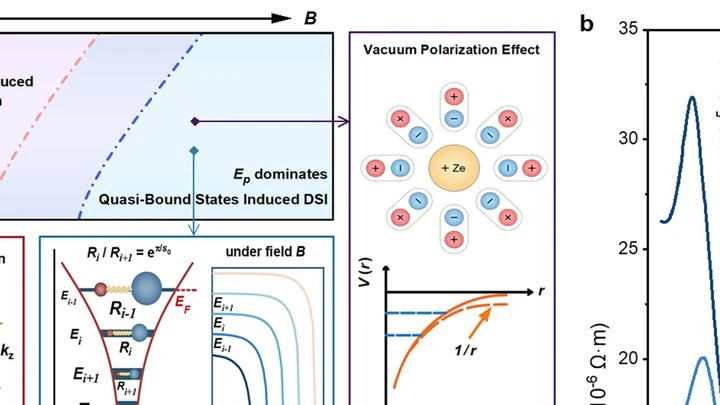
In the crystal HfTe5, electrons behave almost like light: their mass is so small that they obey the laws of relativity. If you place such a crystal in a strong magnetic field, the electrons start to circle in tiny orbits. Their energy then changes not smoothly but in steps, like floors in a building.
A tiny superconductor, levitating above a magnet, is like a cork on the surface of an invisible ocean. The slightest breath of dark matter makes it shudder. Scientists examined two kinds of such 'wind'. The first – gravitational waves, which stretch and squeeze space itself, like ripples on the fabric of the cosmos.
Picture a black hole as a funnel in a taut sheet — the classic analogy for spacetime curvature caused by a massive body. But if a fifth dimension exists, this simple picture gets complicated: the sheet gains hidden springs.