In classical general relativity, black holes are famously 'bald': their external appearance is completely determined by just three parameters — mass, electric charge, and angular momentum. This is the no-hair theorem. However, when additional fields (like scalar fields) are present, certain black hole solutions acquire extra 'hair' — observable parameters beyond the standard trio. These hairy black holes challenge the simplicity of the bald picture and open a rich landscape of exotic solutions.
History
The no-hair theorem was conjectured in the 1960s by Werner Israel and others, with rigorous proofs for electrovacuum solutions. Hairy black holes were discovered in the 1990s in theories with non-minimally coupled scalar fields, notably by Bekenstein and others.
How it works
The no-hair theorem holds under specific assumptions, such as the absence of matter fields or certain energy conditions. When a scalar field is coupled to gravity in a non-minimal way, or when the field has a mass or self-interaction, stable configurations can exist where the scalar field is non-trivial outside the horizon. This scalar 'hair' modifies the spacetime geometry and can affect phenomena like gravitational wave emission, black hole shadows, and orbital dynamics of nearby stars.
In practice
Hairy black holes are studied in the context of modified gravity theories and as potential observational targets for gravitational wave detectors and black hole imaging, where deviations from the bald solution could reveal new physics.
Fun fact
Some hairy black hole solutions are unstable and can 'burst' like soap bubbles, transitioning to a bald state or another configuration.
Speed of light in vacuum, a fundamental constant of nature. — speed of light= 299792458metre per second
G
constant
Newtonian constant of gravitation, determining the strength of gravity. — gravitational constant= 6.67430e-11cubic metre per kilogram per second squared
Drop two stones of different shapes into a pond — the ripples will tell you which one was smooth and which was jagged. Gravitational waves work the same way: when two ultra-dense objects merge, the trembling of spacetime carries details about their inner workings.
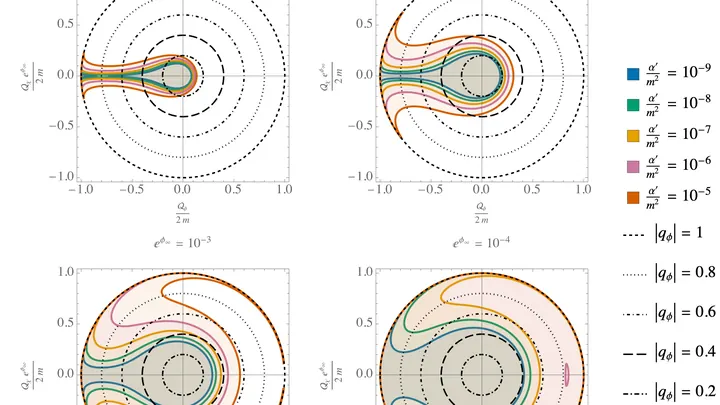
A black hole is not just a dark sphere. In string theory, it can grow 'hair'—extra scalar fields such as the axion and the dilaton. These fields gently alter the geometry of space around the hole.
A black hole is like a perfectly smooth sphere. It has no features — only mass, charge, and spin. This rule is called "no-hair." But nature loves to complicate things: sometimes a cloud of a scalar field (a special field described by a single number at each point) spontaneously appears around a black hole.
A pot of boiling water is covered with two lids — an inner and an outer one. The thermometer under each shows its own temperature, but their harmonic mean (a special averaging method where you add the reciprocals) always remains unchanged. Heat seems to obey an invisible rule.
A black hole sitting on a thin cosmic membrane (brane) resembles a heavy ball stretching an elastic sheet. In classical physics, it is bald — only mass, charge, and rotation. But add a scalar field (an invisible substance like temperature), and the hole can spontaneously grow 'fur' from this field.
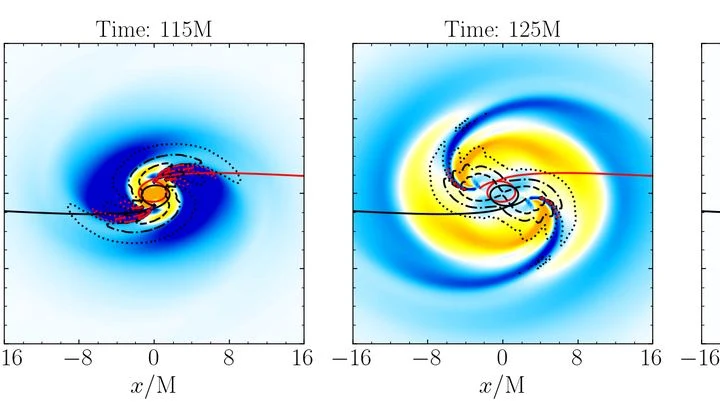
Two black holes race past each other like Formula 1 cars on opposite lanes. In standard general relativity, they remain 'bald'—no extra fields appear around them. But if you add a scalar field to the equations (something like an invisible fog permeating space), the rules change.
The focus is on a black hole, but not an ordinary one. It carries a magnetic monopole and is surrounded by a dilaton — a field that blurs the familiar boundaries of space. The authors tested how stable such a system is to thermal jolts.
A magnetic monopole is a hypothetical particle with a single magnetic pole.
Two magnets collide in a dark room, stick together into a clump, and a dull thud echoes. Black holes behave much the same way, except instead of magnets they carry electric charge, and instead of a thud, there's a burst of gravitational waves. But there's a third player in this story — an invisible field that physicists call scalar.
Drop a stone into a pond — ripples spread across the water. The most visible ripple comes from the strongest splash. That's roughly how physicists picture the growth of perturbations around a black hole: if a system has an instability, its 'loudest' component, the one that grows fastest, should show up first.
Imagine a soap bubble with electricity trapped inside and walls made of an invisible field: that's roughly what a black hole with 'resonant hair' looks like. This isn't real hair, but a cloud of scalar field held around the hole by its own interactions.
An ordinary black hole resembles a funnel, at whose center spacetime plunges into a point — a singularity. There, density becomes infinite and the laws of physics break down. But what if, instead of a plunge, there were a smooth bottom inside?
The authors of the study constructed exactly such a model.
Classical black holes, regions of spacetime with gravity so strong that even light cannot escape, according to general relativity, hide a singularity at their center: a point of infinite density and curvature where the known laws of physics break down.