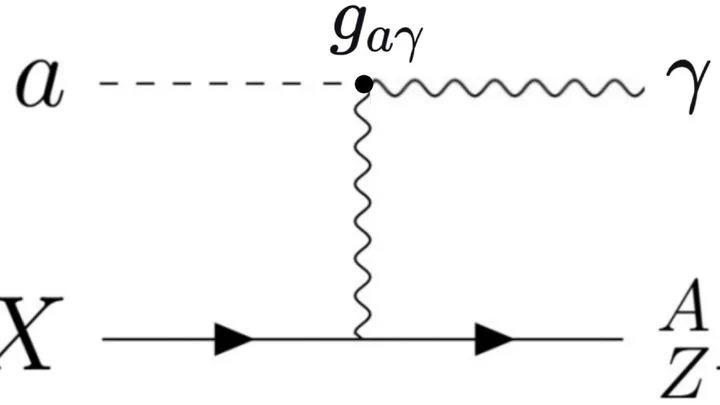
The axion is a light particle predicted to solve the problem of CP violation in the strong interaction (why quarks behave symmetrically under mirror reflection). It hardly interacts with matter and could constitute cold dark matter. The search is conducted by attempting to convert an axion into a photon under the influence of a strong magnetic field.
History
The Peccei-Quinn mechanism was published in 1977, and soon Frank Wilczek and Steven Weinberg independently predicted a light boson. Wilczek named it the axion, by analogy with a cleaning agent that 'cleans up' QCD from the strong CP problem. In the 1980s, the first experiments were proposed, including a 'magnetic sequester.' In the 21st century, axion searches have become one of the main directions of particle physics, intertwined with astrophysics and cosmology.
How it works
The axion field a(x) interacts with electromagnetism through the term (g_{aγγ}/4) a F_{μν} ilde{F}^{μν} in the Lagrangian. In an external magnetic field, this leads to the conversion of axions into photons. Cosmologically, axions are born at the spontaneous breaking of symmetry, and their field is frozen until the moment when the mass becomes comparable to the Hubble rate; then it begins to oscillate, behaving as cold dark matter. For detection, resonance in microwave cavities is used (frequency is related to the axion mass) with sensitivity g_{aγγ} ~ 10^{-16} GeV^{-1}.
In practice
The search for axions is underway in dozens of laboratories using sensitive detectors and powerful magnets; their discovery will decipher the nature of dark matter and open the way to new physics.
Fun fact
An axion could shine through a solid lead wall a light-year thick without even noticing it.
Picture a radio receiver with a single tuning knob that moves all of its internal coils at once, like one living organism. That is exactly how a new instrument for the search for the axion works, a particle that may fill galaxies with invisible mass. Inside a copper cylinder the height of a coffee can sit rods of aluminum oxide.
The orchestra plays, though no one sees the conductor. The musicians are charged particles in the pulsar's magnetosphere, and the score is the electric and magnetic fields generated by the spinning superdense star.
The orchestra plays, though no one sees the conductor. The musicians are charged particles in the pulsar's magnetosphere, and the score is the electric and magnetic fields generated by the spinning superdense star.
In the basement of the laboratory, an 8 tesla magnet hums. Inside it, like a bell in a bell tower, hangs a hollow copper cylinder tuned to a single note. If an axion, a dark matter particle, flies by, the cylinder responds with a faint ring. The trouble is that ordinary copper muffles this ring: at high frequencies, current flows only through a thin skin of the metal, and losses grow.
In a tank holding three tons of liquid xenon, buried deep underground, something stirred one day. Not the xenon itself, but one of its atomic nuclei: it received a kick with an energy of 248 thousand electronvolts and recoiled like a billiard ball struck by an invisible cue ball.
The neutron is a particle that usually sits in the atomic nucleus and doesn't disappear. But some theories suggest that occasionally it might transform into its invisible twin — a particle that ordinary detectors can't catch.
Inside the Sun, reactions can produce light, almost undetectable particles called axions. One such reaction yields axions with an energy of 5.49 MeV, as if each one carried the energy of a tennis ball moving at 100 km/h. These particles pass freely through Earth, but occasionally they might collide with a xenon atom.
Imagine a huge stadium packed with people dressed in black. You're standing outside, trying to figure out what's happening inside, even though you can't see a single person. But if two people bump into each other and exchange bright T-shirts, you'd spot a flash of color.
In the first moments after the Big Bang, the universe resembled a boiling cauldron. According to one hypothesis, dark matter, the invisible substance that holds galaxies together, could have been born there.
In the first moments after the Big Bang, the universe resembled a boiling cauldron. According to one hypothesis, dark matter, the invisible substance that holds galaxies together, could have been born there.
The quantum world is like a kitchen where particles suddenly appear out of "nothing." But you need a chef — a classical field acting as an external source. Glauber's theorem, long known in optics, has now been generalized: it shows exactly how the field "cooks up" particles, be they photons or gravitons.
The early Universe resembles a boiling cauldron, where particles and antiparticles are born and die in equal numbers. But today, all around us is only matter — stars, planets, ourselves. How did a tiny excess of one part in a billion emerge from the initial equality? One answer hides in the oscillations of a heavy field, like a rock that the tide alternately submerges and exposes.
A red giant in a globular cluster is a star in retirement. It has burned up the hydrogen in its core and now lives off fusion in a thin shell around a helium ash core.
An extra electron in a molecule is like a passenger barely hanging onto the step of a departing train. Such a 'passenger' turns the particle into an anion — a negative ion. Studying it is tough: the bond is weak, the electron cloud is diffuse, and any jolt can knock the electron off.
The early Universe resembles a boiling cauldron, where particles and antiparticles are born and die in equal numbers. But today, all around us is only matter — stars, planets, ourselves. How did a tiny excess of one part in a billion emerge from the initial equality? One answer hides in the oscillations of a heavy field, like a rock that the tide alternately submerges and exposes.
Buried in Antarctic ice, there's a detector the size of a cubic kilometer. It doesn't catch light but ghostly particles — neutrinos. Yet sometimes, a different beast might flash through: a pair of muons born together and flying apart in a wide fan. No known particle of ordinary matter can paint that pattern.
Dark matter is the invisible scaffolding of the universe. It's there, we know from the motion of stars and galaxies, but what this scaffolding is made of remains unknown. One guess is ultra-light particles similar to axions. They barely interact with ordinary matter, yet occasionally they do get involved.
In the scorching plasma of the solar interior, particles are born that barely interact with matter. One hypothesis suggests these are axion-like particles — light and elusive.
In the galaxy NGC 1052 DF2, stars move at only 8 kilometers per second, as if there were no invisible mass around. For comparison: in our Milky Way, outlying stars accelerate to 200 kilometers per second, held by a massive dark matter halo.
Some 123 parsecs from Earth, in the constellation Corona Australis, drifts the neutron star RX J1856.5-3754. Its diameter is about 12 kilometers, smaller than Moscow's Ring Road, but its surface temperature reaches 460 000 kelvin. The star emits a slow, almost inaudible exhalation.
In the first fractions of a second after the Big Bang, the Universe underwent inflation — a monstrously rapid expansion that smoothed out all irregularities. But amid this cosmic smoothness, one "wrong" note could have been hidden: quantum fluctuations of the axion field.
Deep underground, in the silence of a cryostat (a cooled container), lie crystals of lead that once belonged to an ancient Roman ship. This material barely emits background radiation — over two thousand years, unstable isotopes have decayed, leaving it perfectly clean for hunting the rarest events.
A lighthouse at sea doesn't just rotate: its lamp itself dims and brightens on its own. Magnetic white dwarfs, the ultra-dense remnants of stars like our Sun, behave in much the same way. Their powerful magnetic fields can convert light into axions — hypothetical particles that could explain the Universe's hidden mass.
A billiard ball clicks against another in complete darkness. The sound of the impact and the clatter of balls dropping into pockets: that's all you hear. This is roughly how physicists study the interactions of elementary particles at energies that no terrestrial accelerator can reproduce.
Light from distant quasars, breaking through billions of years, leaves a pattern of dark absorption lines on the cosmic film — the spectroscopic Lyman-alpha forest. Each line is like a note in a grand score, written by the hydrogen of the intergalactic medium.
Imagine a green beam that, passing through an ingenious optical setup, twists into a three-dimensional funnel of light — an optical vortex. At its heart, like in the eye of a hurricane, the intensity drops to zero. It is there that photons disappear.
The universe sounds with silence. The lion's share of matter — about 85%—remains invisible, manifesting only through gravity. Back when Vera Rubin Vera Rubin showed that galaxies spin as if wrapped in unseen mass.
The world around us is three-dimensional, but perhaps that's just an illusion. Some theories allow for extra dimensions of space, curled up or stretched in special ways. One such model depicts a five-dimensional universe with a "diluted" dimension (called a linear dilaton).
Since Saul Perlmutter and his colleagues discovered the accelerated expansion of the universe, physicists have been scratching their heads over the nature of dark energy.
In a close binary system, the hot star, like a searchlight, illuminates its cooler companion. Some of the light scatters off free electrons in its atmosphere — this is Thomson scattering — and acquires linear polarization. As the stars orbit each other, this polarization rotates, like the hand of a peculiar cosmic metronome.
In a close binary system, the hot star, like a searchlight, illuminates its cooler companion. Some of the light scatters off free electrons in its atmosphere — this is Thomson scattering — and acquires linear polarization. As the stars orbit each other, this polarization rotates, like the hand of a peculiar cosmic metronome.
Dark matter remains one of the greatest mysteries of modern physics. Back when Vera Rubin observed galaxy rotation, she proved that visible matter is insufficient to keep stars from flying apart.
In the pitch darkness of a vacuum chamber, a tiny magnet floats. It touches no walls and loses almost no energy — an ideal sentinel, ready to catch the faintest nudge. Such a sentinel is exactly what you need for axion hunting. These particles are prime suspects in the case of the Universe's hidden mass, which we call dark matter.
A large underground tank of liquid xenon waits for a rare event — a nudge from a dark matter particle. Normally, gravity is too weak to notice such a nudge. But if space has hidden dimensions, everything changes: at tiny distances, gravity suddenly strengthens, and the chance of catching an elusive particle grows.
The universe is like a vast warehouse where a strict inventory was taken long ago. The cosmic microwave background is an ancient record of everything in stock 380,000 years after the big bang. According to it, the fraction of matter in the cosmic 'budget' (the parameter Omega_m) is known with high precision.
In the early Universe, tiny black holes could have been born — mountain-mass but atomic-nucleus-sized. Today they could serve as factories for dark matter. There are two mechanisms: the familiar evaporation (Hawking radiation) and the lesser-known superradiance.
The universe is permeated by invisible mass, dark matter, whose existence was first proposed by Fritz Zwicky in the 1930s, based on his observations of galaxies moving in clusters.
Imagine a perfectly tuned orchestra, where every instrument is adjusted with flawless precision, trying to play in a noisy hall. That noise is quantum gravity — the microscopic ripples of spacetime. It constantly threatens to throw the musicians off.
An ocean permeates all of space, yet remains invisible to us. This ocean is dark matter, and the waves on its surface are particles called axions. They are so light and elusive that they pass through Earth without noticing it. But if these waves crash against a shore made of a special material, they might leave a trace — a tiny electric current.