A Bias That Needs No Teacher express
In a warehouse, there are boxes of apples and pears. There are many apples and few pears. But when the stock clerk says "a fruit with smooth skin," we are somehow more likely to recall the rare pear than the common apple. This is the inverse base-rate effect — a persistent glitch in how the brain resolves ambiguity between categories.
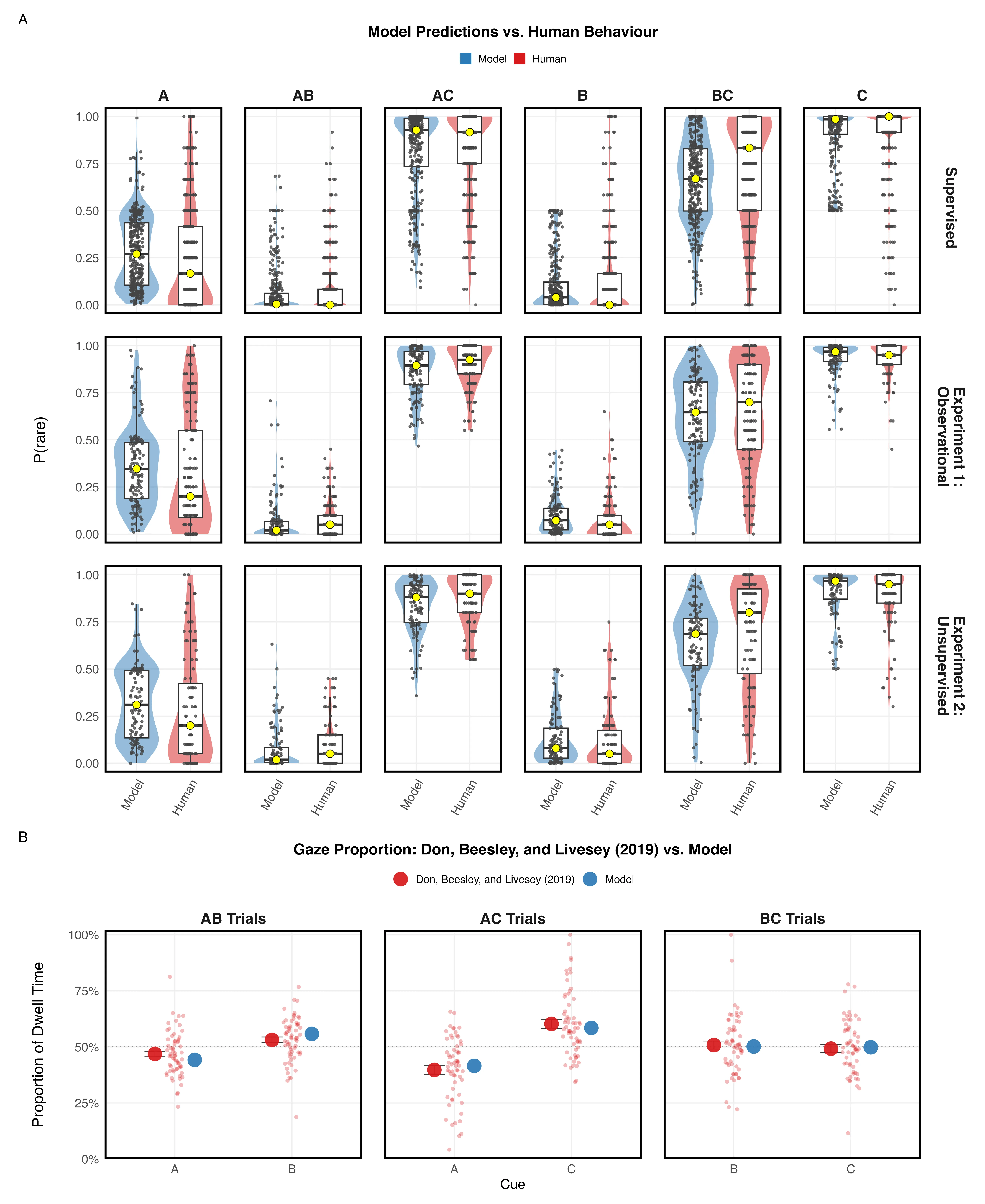
For a long time, it was thought that prediction error was to blame: the brain makes a mistake, receives a mismatch signal, and recalibrates expectations. But the authors of this study went further: they removed the very possibility of such an error from their experiments. First, they switched to observational learning (participants simply watched without making predictions), and then they removed category labels altogether. The effect did not disappear.
Thus the OSCAR model was born. It operates on self-generated feedback — something like internal pattern completion. Upon seeing partial features, the system fills in the whole and learns from this internal response. The model not only replicated results on old data but also predicted individual differences among people and, for the first time, explained previously puzzling eye movements recorded in experiments.
Original abstract
as written by the authors arXiv:2608.06149v1
The inverse base-rate effect is a robust bias in how people resolve ambiguity between competing categories, and the most prominent theories explain it through prediction error. Across two experiments we progressively removed the elements of the predictive-learning design that supply such error signals: first by moving to observational learning, then to an unsupervised procedure in which category labels were not presented. The effect persisted--the irrational bias is independent of supervised learning procedures. We propose a new theory, OSCAR, that integrates core computational principles of the best-validated models and operates on self-generated feedback akin to pattern completion. OSCAR extends the learning dynamics underlying the response bias to observational and unsupervised procedures. Evaluated on a large preexisting supervised dataset in addition to the two new experiments reported here, OSCAR performs competitively against alternatives, and is the first model that reproduces the pattern of individual differences seen in humans across all three procedures. The model provides an explanation of hitherto unexplained eye-tracking data, something none of the alternative accounts provide.
The inverse base-rate effect is so robust that it appears even in preverbal infants — suggesting it is a deep feature of brain function, not a byproduct of learning.
In the novel Flowers for Algernon, the protagonist experiences shifts in his perception of the world after his intelligence is enhanced — distortions of categories and biases, similar to the inverse base-rate effect, could explain why "smart" and "dumb" decisions sometimes intertwine so curiously.