How Sleeping Galaxies Suddenly Switch On Cosmic Floodlights ✎ express
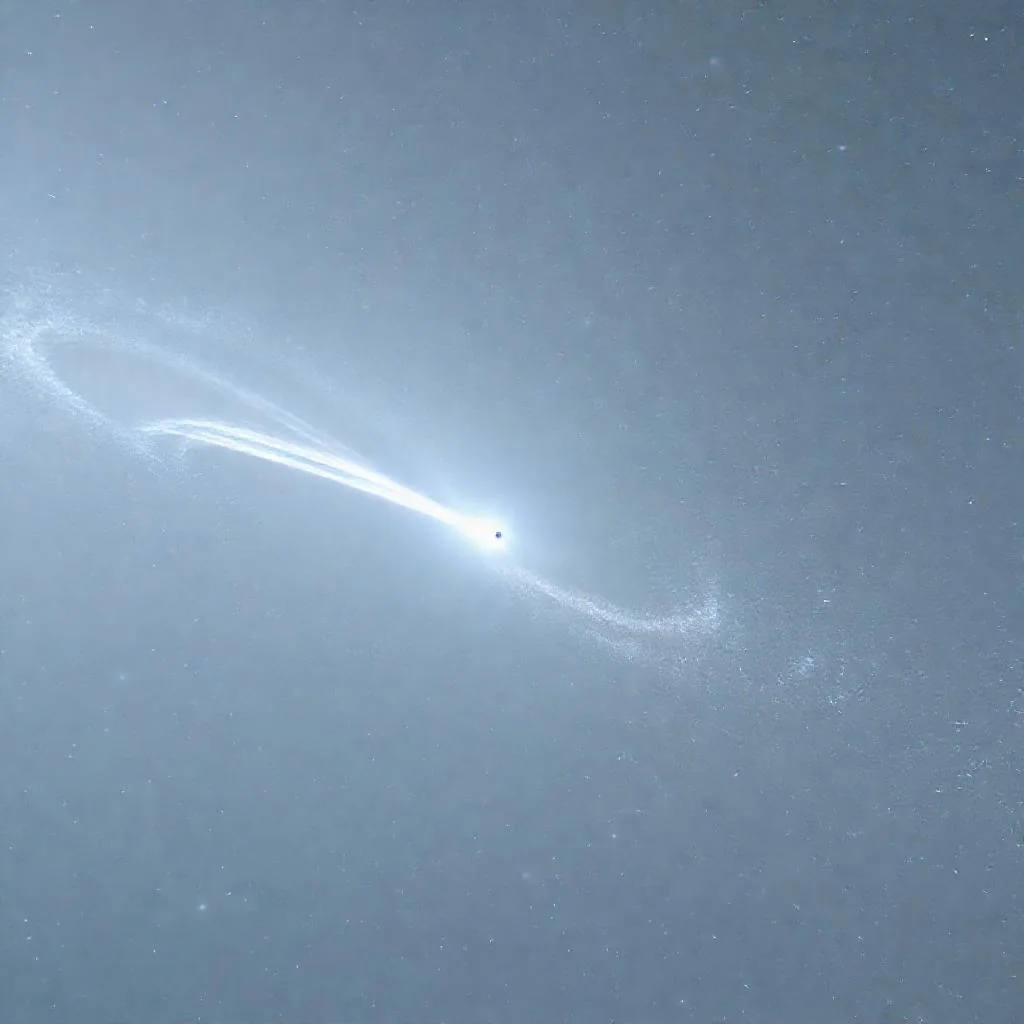
At the heart of nearly every large galaxy sits a supermassive black hole. Usually it behaves quietly, but sometimes, like a waking volcano, it spits out narrow plasma jets. These jets glow in the radio band, making the galaxy 'radio-loud.' Astronomers have long known this happens, but they couldn't catch the very moment of switching on.
Now they have. In a sky survey at 887.5 MHz (that's very long, meter-wavelength radio waves), scientists spotted 101 compact radio sources inside distant galaxies. Over 1–6 years, their brightness jumped by 80–1800%. It's like a light bulb in a distant window suddenly flaring from a dim glow to a searchlight. For 41 sources, the cause turned out to be internal: 26 of them brightened continuously, and two even went from 'radio-quiet' to 'radio-loud.'
Follow-up observations confirmed: for 14 sources, the spectrum was initially 'humpy' (peaking at a certain frequency), then became flat or steep — exactly what you'd expect from an expanding jet. For 12 others, the spectrum didn't change, meaning their jets are growing more slowly. Meanwhile, several previously found 'newborn' radio-loud galaxies dimmed over this period. It seems their radio-loudness was temporary, like a short flash rather than the start of long-term activity.
So astronomers have for the first time seen a sleeping black hole turn into a cosmic radio beacon within a few years. And it's not rare: such events could happen in many galaxies; we just weren't looking often enough before.
Plasma jets from supermassive black holes can be longer than the galaxy itself — up to millions of light-years. If such a jet struck a neighboring galaxy, it could 'blow away' its gas and halt the birth of new stars.
In Stanislaw Lem's novel 'Fiasco,' humans try to make contact with a civilization hidden behind powerful energy outbursts from its star — loosely reminiscent of radio flares from black holes.