A Pendulum Clock in a Distant Galaxy
Far away in the constellation Cancer, 3.5 billion light-years from Earth, a pendulum clock is ticking. The pendulum is a secondary black hole orbiting a much more massive primary.
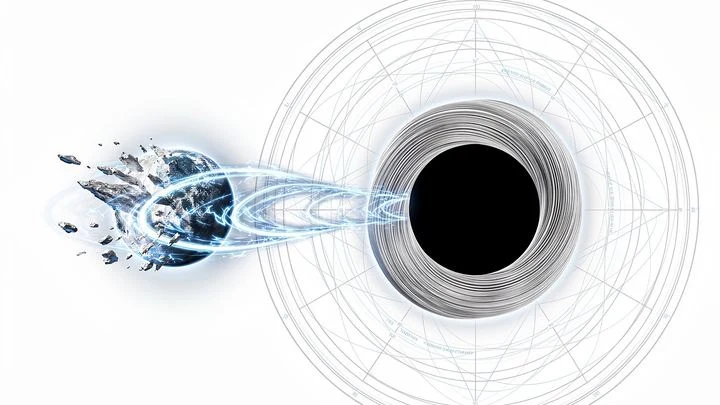
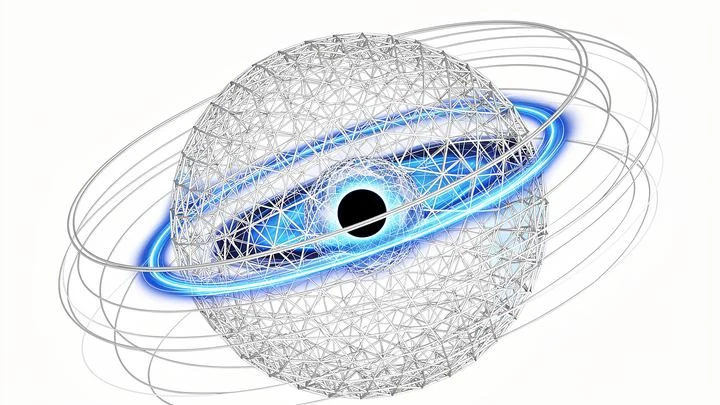
A tidal disruption event occurs when a star is torn apart by a black hole's gravitational forces.A tidal disruption event (TDE) is an astrophysical transient that occurs when a star passes too close to a supermassive black hole. When the tidal radius (the distance where the star's self-gravity balances the tidal force) becomes smaller than the pericenter (closest orbital point), the star is disrupted. About half of the mass falls onto the black hole, forming an accretion disk with a characteristic fallback rate ∝ t^{−5/3}. The disk emits in soft X-rays and ultraviolet, reaching a peak luminosity of ~10⁴⁴ erg/s, then fading over months to years.
The concept of tidal disruption was detailed in the works of Martin Rees (1988), although tidal forces near black holes were considered as early as the 1970s. The first observational confirmation came with the ROSAT mission in the 1990s, detecting soft X-ray flares from inactive galaxies. Modern surveys, such as ASAS-SN and ZTF, find dozens of candidates in the optical, while Swift and XMM-Newton study them in X-rays. Significant contributions came from accretion disk theory and hydrodynamic simulations of disruption.
A tidal disruption is initiated when the tidal radius R_t ≈ R_* (M_BH/M_*)^{1/3} exceeds the pericenter distance. The star is disrupted, and its material is distributed along orbits with different eccentricities, forming an elliptical stream. The gas, losing energy via shock waves and self-gravity, accumulates, and its return rate to the black hole follows Ṁ ∝ (t/t_fall)^{−5/3}, where t_fall is the fallback time of the most bound material. Accretion may be super-Eddington, generating powerful winds and, in some cases, relativistic jets, explaining radio-loud TDEs. Spectroscopy reveals broad hydrogen and helium lines, as well as blue-shifted absorption lines indicating outflows.
Tidal disruption events help detect dormant black holes, study their population, and accretion processes in extreme gravity.
One of the brightest recorded TDE flares, ASASSN-15lh, was initially thought to be a record supernova, but later turned out to be a star torn apart by a rapidly spinning black hole.
| r_t | variable | Tidal disruption radius — radius metre |
| R_* | variable | Radius of the star — radius metre |
| M_\bullet | variable | Mass of the black hole — mass kilogram |
| M_* | variable | Mass of the star — mass kilogram |
| M_{\text{Hill}} | variable | Hill mass limit — mass kilogram |
| R_p | variable | Planet radius — radius metre |
| M_p | variable | Planet mass — mass kilogram |
| t_peak | variable | Time from disruption to peak accretion rate — time second |
| M | variable | Mass of the black hole — mass kilogram |
| M_p | variable | Mass of the disrupted star — mass kilogram |
| R_p | variable | Radius of the disrupted star — radius metre |
| d | variable | Roche limit distance — Roche limit metre |
| R_m | variable | Radius of the secondary body — radius metre |
| M | variable | Mass of the primary body — mass kilogram |
| m | variable | Mass of the secondary body — mass kilogram |