A sky survey is a systematic and comprehensive mapping of the celestial sphere, aimed at cataloging astronomical objects and phenomena. Unlike targeted observations of individual objects, surveys cover large areas of the sky, often repeatedly, to detect everything from stars and galaxies to transient events like supernovae and gamma-ray bursts. Sky surveys are foundational to modern astrophysics, providing the data for statistical studies of the universe's structure, the discovery of new objects, and the monitoring of variable sources.
History
The first systematic sky survey was the Palomar Observatory Sky Survey, completed in 1958, which photographed the northern sky on photographic plates. The advent of digital detectors in the 1990s revolutionized surveys, enabling deeper and more automated observations.
How it works
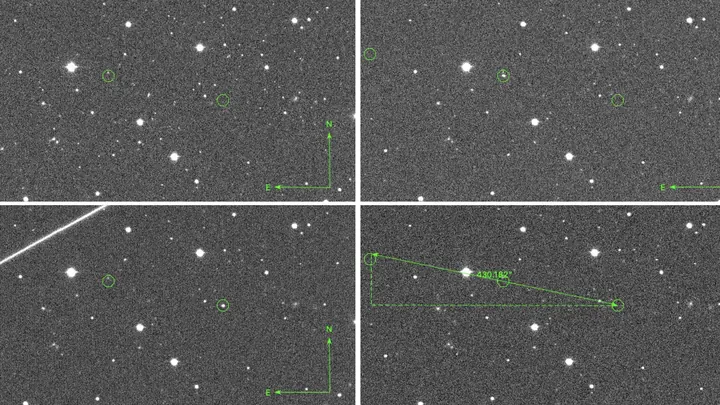
Sky surveys use telescopes equipped with wide-field cameras to capture images of large sky patches. These images are then processed and compared across epochs to identify moving objects (like asteroids), variable sources (like pulsating stars), and transient events (like supernovae). Modern surveys, such as the Sloan Digital Sky Survey or the upcoming Vera C. Rubin Observatory, employ automated pipelines that detect, classify, and archive millions of objects, producing publicly accessible catalogs that astronomers worldwide use for research.
In practice
Sky surveys are used to map the distribution of galaxies, discover near-Earth asteroids, study dark energy through supernova measurements, and search for exoplanets via transit photometry.
Fun fact
The Sloan Digital Sky Survey, one of the most ambitious surveys, has mapped over 500 million celestial objects, and its data is freely available online, used in thousands of scientific papers.
A storm in the upper atmosphere lasts a few millionths of a second. A cosmic ray, a proton or a helium nucleus, strikes air molecules, sending a swarm of particles downward. Most of them stay together, but occasionally one particle gains so much energy that it surges ahead.
A census by body shape: that's one way to describe what astronomers did with 6348 massive galaxies. Instead of height and weight, they measured how concentrated the light is toward the center, how flattened the galaxy is, and how asymmetric its shape is. Then they ran the same measurements on galaxies from three computer models of the universe and compared the results.
The universe sounds with silence. The lion's share of matter — about 85%—remains invisible, manifesting only through gravity. Back when Vera Rubin Vera Rubin showed that galaxies spin as if wrapped in unseen mass.
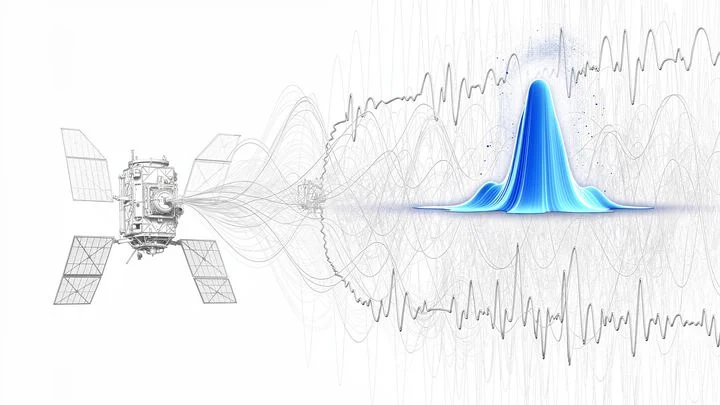
The gamma sky, captured by the Fermi telescope, is a grand symphony of thousands of sources. Here, the rhythmic pulsations of pulsars, the powerful chords of active galactic nuclei, but most of all — unidentified objects, whose part remains a mystery.
Imagine a philharmonic orchestra playing, but the microphone picks up only a blended roar — a tutti where double basses, flutes, and timpani all merge. Physicists have grappled with a similar task for decades, staring at fields of density, temperature, or magnetic induction.
Galaxy clusters are the greatest gravitational ensembles in the Universe. In X-ray glow from hot plasma, the story of cosmic expansion, hidden dark matter, and enigmatic dark energy is encoded.
From childhood, we're used to thinking of space as infinite and isotropic. But Einstein and Lemaître were already asking: could the Universe be closed in on itself, like a Möbius strip or a 3-torus?
The Universe resembles a dense forest: up close, individual galaxy-trees are visible, gathered into groves, but from a distance everything merges into a solid green canopy. The boundary beyond which the cosmos becomes homogeneous is called the angular scale of homogeneity: it's the size of a patch of sky from which galaxies are distributed evenly.
Interstellar space is not a cosmic desert, but a super-fast highway. Trillions of asteroids and comets from other systems race past us, yet camera-telescopes only catch a few. Imagine a night highway: the headlights of a distant car flash brightly, but if it zooms by too fast, the camera shutter can't click in time.
For decades, the search for extraterrestrial intelligence has waited for quiet, coherent signals from space — a kind of 'whistle' in the radio silence. However, our own technosphere has created a continuous radio background — the hum of a vast metropolis, emitted by all communications, radars, and broadcasting stations.
When a massive star exhausts its fuel, the core collapse can spawn a supernova and a neutron star, but with enough mass, nothing halts the crush — a black hole is born.
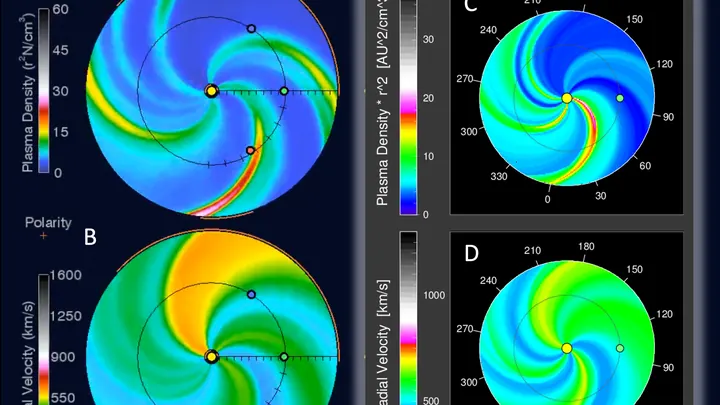
The solar wind, a stream of charged particles from the Sun, slams into the tenuous gas that fills the space between the stars. The collision produces a faint X-ray glow. For astronomers, this is like fog in front of headlights: it obscures distant objects.
An album with hundreds of family photos holds countless stories. If you look at each picture on its own, you might easily decide that Uncle is a real giant: that day he happened to stand a step higher than everyone else. But flip through the whole album, and it becomes clear — his height is perfectly ordinary; it's just that a step showed up in a couple of frames.
The night sky looks as smooth as the surface of a calm lake. But if you look at gamma-ray bursts (brief, blinding explosions visible across the entire universe) you'll find ripples in that smoothness.
Scientists took a catalog of such bursts and divided the sky into two hemispheres. In the southern one, they found a tiny group: 4–5 bursts huddled together.
By day in Chile's Atacama Desert, the air shimmers with heat like the haze above a hot skillet. Sunlight passing through this shimmer begins to dance and flicker. Astronomers call this airy trembling "seeing" — and it keeps telescopes from getting a sharp view of the stars.
To fight this nuisance, engineers have built a special instrument — a solar seeing monitor.
Solar flares — sudden energy releases on the Sun — can knock out satellites and power grids. Previous models often either cried wolf or missed a real blow. The fix: attach a reliability estimate to every prediction.
The light of every star is its unique passport, but the entries are written in the language of spectra and colors. For old giants, such documents are almost indistinguishable: their spectra overlap, and deciphering the details by hand was practically impossible.
Light from a distant star, after passing through air and telescope lenses, loses its sharpness, like looking at a streetlamp through wet glass. Astronomers call this blur the telescope's "fingerprint": each instrument has its own, and you need to know it down to the smallest detail.
At night, the sky is never completely black. Even far from cities, the upper atmosphere glows faintly: sunlight makes hydrogen atoms emit a reddish glow that astronomers call geocoronal emission. For a telescope, it's like a fogged-up window: it adds extra light and hinders seeing distant galaxies.
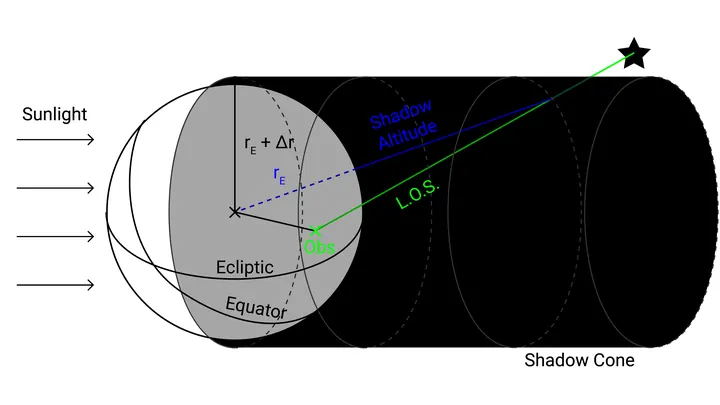
Back in the 18th century, William Herschel was searching for life on Mars. Today, astronomers are targeting not planets but artifacts — for example, alien probes lurking in the Solar System. The problem is that spotting a tiny object next to the blinding Sun is nearly impossible.
Setting up an orchestra without a conductor: the algorithm itself decides which instruments (basis functions) and at what volume (weights) should play to reproduce Earth's gravitational symphony.
Every night, an invisible sentinel hangs over the Andes. The GOES-12 satellite, and later its successor GOES-13, watches Earth from an altitude of 36,000 kilometers, recording how the mountains breathe clouds. For five straight years, it tracked where the sky stayed clear and where it got wrapped in cotton.