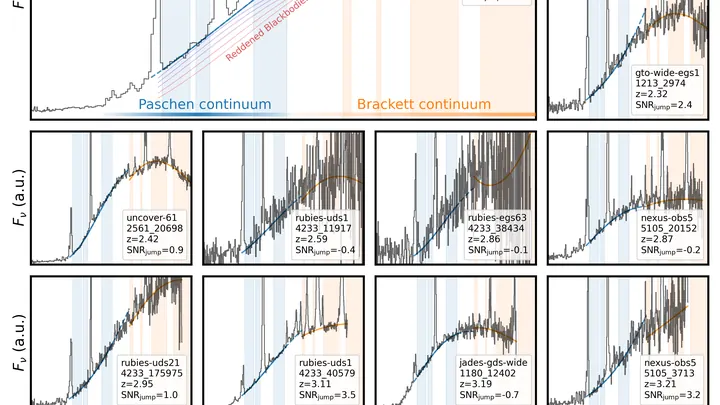
Active galactic nuclei (AGN) are extremely luminous regions at the centers of some galaxies, powered by the accretion of matter onto a supermassive black hole. 'Red dots' is a term used to describe a class of compact, red point sources found in deep sky surveys, which are often identified as AGN. These objects are typically distant, meaning they are seen as they were in the early universe, and their red color can be due to dustreddening or to the intrinsic properties of the AGN emission.
History
The term 'red dots' gained prominence with deep surveys like the Hubble Ultra-Deep Field and later with the James Webb Space Telescope, which has revealed many such sources at very high redshifts.
How it works
When matter falls toward a supermassive black hole, it forms a hot, rapidly spinning accretion disk that emits radiation across the electromagnetic spectrum. The 'red dot' appearance in optical and infrared surveys arises because the AGN's light is often absorbed and re-emitted by surrounding dust, which shifts the observed spectrum to longer wavelengths. Some red dots may also be heavily obscured AGN, where the central engine is hidden by a thick torus of gas and dust.
In practice
Red dots are used to trace the growth of supermassive black holes in the early universe and to understand the co-evolution of galaxies and their central black holes.
Fun fact
Some red dots are so distant that their light has been traveling for over 13 billion years, meaning we see them as they were when the universe was less than a billion years old.
In active galactic nuclei, supermassive black holes are surrounded by a dense ring of dust that acts like a curtain: it hides everything happening at the center. If a star ventures too close to the black hole, tidal forces tear it apart, and the resulting flare is usually visible in optical and X-ray light.
The night sky looks serene, but it is actually pierced by an invisible rain of charged particles: cosmic rays. Scientists have long tried to figure out where the most energetic ones are born. Until recently, it was thought that our Galaxy supplies particles up to about 4 EeV, the so-called "ankle" in the spectrum.
The night forest is full of fireflies, but before, we only saw those that happened to be in the beam of a flashlight. That was the case with ultraluminous X-ray sources: points in other galaxies that shine in X-rays more brightly than a stellar-mass black hole can steadily emit. Telescopes looked at galaxies chosen for other purposes, missing most of the fireflies.
At the center of the Milky Way, where the supermassive black hole Sagittarius A* churns gas clouds like a millstone, astronomers have caught an irregular pulse. Gamma-ray emission, the most energetic light in the universe, arrives not as a smooth wave but with a break, as if the Galaxy's heart beats with arrhythmia.
At the center of a galaxy, where a supermassive black hole spins a disk of scorching gas around itself, giant stars sometimes form. They are unlike ordinary stars: the disk continuously feeds them with matter, and a star can grow to hundreds of solar masses, staying bright as long as the gas flow lasts.
At the heart of nearly every large galaxy sits a supermassive black hole. Usually it behaves quietly, but sometimes, like a waking volcano, it spits out narrow plasma jets. These jets glow in the radio band, making the galaxy 'radio-loud.' Astronomers have long known this happens, but they couldn't catch the very moment of switching on.
The night sky looks calm, but in reality, invisible particles, cosmic rays, are constantly flying through us. Among them are electrons and their antimatter counterparts, positrons. When they collide with detectors on satellites or balloons, the instruments record their energy.
Dark matter is the invisible scaffolding of the universe. It's there, we know from the motion of stars and galaxies, but what this scaffolding is made of remains unknown. One guess is ultra-light particles similar to axions. They barely interact with ordinary matter, yet occasionally they do get involved.
The cosmic detective story began with a quiet flash in the optical band. AT2019wzc slowly brightened and faded like a smoldering ember. But hidden inside was something more energetic — repeating soft X-ray bursts that astronomers call quasi-periodic eruptions.
These eruptions last minutes to hours and repeat every few hours or days.
The fastest wind in the Universe travels at 0,58 times the speed of light. It covers the distance from Earth to the Moon in two seconds. This wind is not a jet stream but a broad flow of gas erupting from the center of a galaxy. Not all black holes work the same: some create such hurricanes, while others produce narrow plasma beams.
Assembling the puzzle of the Universe, astronomers are used to every new detail fitting perfectly into the already completed picture. But sometimes there are pieces that seem cut from another jigsaw. Twenty thousand active galactic nuclei, and eleven percent of them the neural network confidently rejects as alien.
The James Webb Space Telescope peered into an era when the universe was less than a billion years old and spotted strange objects—'little red dots.' These are black holes with masses of millions of suns, but in very compact, chemically pristine galaxies. Standard scenarios can't grow such heavyweights that early.
The cosmic spectacle unfolds on the stage of Galaxy галактики Centaurus A. In the lead role: a supermassive сверхмассивная чёрная дыра with a powerful jet that pierces space for hundreds of thousands of light-years.
The Universe is less than a billion years old, yet at its centers already sit black holes with masses of a billion suns. According to the conventional picture, they grew by voraciously devouring matter, but calculations show that 'feeding' must have been almost continuous, while visible quasar flares last only a few million years. So where does all the accreting fuel go?
In the center of almost every large galaxy lurks a supermassive black hole, whose gravitational abyss was first mathematically described by Karl Schwarzschild. When it swallows gas, a dazzling active nucleus is born — a quasar.
Active galactic nuclei (AGN) are the universe’s powerhouses: their X-ray coronae blaze millions of times hotter than stellar atmospheres. But what strikes the spark? A ten-day X-ray campaign by the XRISM and XMM-Newton satellites, aimed at NGC 3783, provided the answer: it’s actual thunderstorms.
In the boundless night of space, galaxies come together in a slow gravitational dance, merging into one. Such collisions are not head-on impacts but rather like fingers moving slowly through water, leaving swirls and tails behind.
The heart of many galaxies is a supermassive black hole. It doesn't just sit at the center; it occasionally flares brightly as it swallows surrounding gas.
Nearly a decade and a half ago, the Fermi gamma-ray telescope spotted mysterious "bubbles" — giant plasma blobs, as if inflated by invisible lungs, towering tens of thousands of light-years from the Galactic center.
At the heart of nearly every large galaxy shines an active nucleus — a supermassive black hole surrounded by a flat, rotating disk of incandescent gas. The disk itself flickers, but astrophysicists suspect that within it lurks a whole swarm of small, stellar-mass black holes.
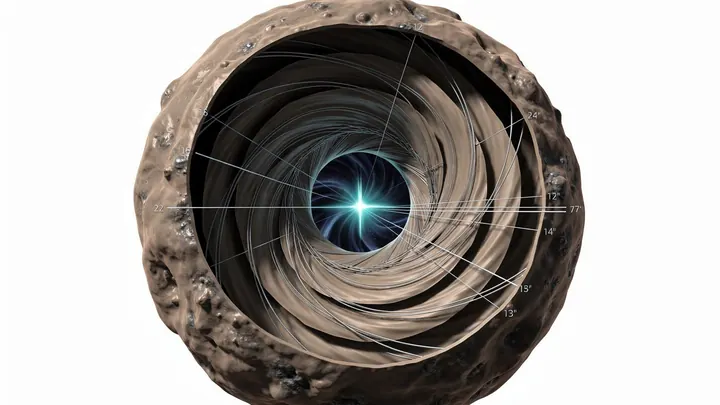
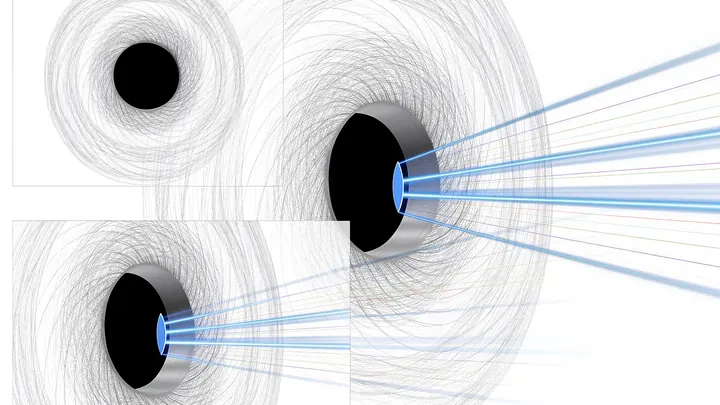
Imagine a spotlight: if you look at it from the side, it glows dim red, but if you stare straight into it, it blinds you with white-blue light. That, according to new data, is exactly what the mysterious 'little red dots' in the early universe look like. They are giant black holes, objects with gravity so strong that even light cannot escape, turned edge-on to us.
Elliptical galaxies are quiet stellar metropolises in retirement. By all rights, their light should be calm, reddish, like a sunset. But their spectra scream otherwise: in the far ultraviolet, these old-timers blaze like holiday lights. For three decades, astronomers have puzzled over this 'ultraviolet upturn' (UV upturn).
The James Webb Space Telescope peered into the era when the expansion of the Universe stretched the light of distant objects into the red, and found a scattering of strange sources — 'little red dots'. Their spectra broke the usual patterns: they are blue in the ultraviolet, but deep red in the optical, as if seen through a cherry veil.
The James Webb Space Telescope has spotted astonishing objects in the depths of space — tiny red dots that shine so brightly it's as if a spotlight were hidden inside a small bulb. These dots are not stars or galaxies in the usual sense, but rather 'cocoons' around supermassive black holes greedily gulping down surrounding gas.
The city has long been asleep: not a single lit window, not a single new house. Only in the very center, in one lone building, someone forgot to turn off a spotlight. That's what a galaxy looks like when stars are no longer born, yet its central black hole still shines.
A powerful vacuum cleaner sucks in not only dust but also its own collection bag. That's roughly how a black hole behaves at the center of a 'red dot'—a distant galaxy where the glow comes not from the hole itself but from its dense gas shroud. This shroud is so thick it resembles a puffed-up cool star. And, like many stars, it has a magnetic field.
At the center of many galaxies sits a supermassive black hole. When gas falls onto it, the gas heats up and shines brighter than an entire galaxy: this is an active galactic nucleus. Sometimes a true hurricane erupts from there: a stream of ionized gas racing at tens of percent of the speed of light.
A powerful searchlight shines through thick fog. The beam itself is invisible, but the fog begins to glow faintly, and gives away the searchlight's presence.
Out in the distant cosmos, there are galaxies that astronomers have nicknamed 'little red dots': in images they appear as tiny reddish specks, even though they are mind-bogglingly far away. Their light looks red not because they are cold, but because the expanding universe stretches light waves.
Eight red giants — bloated old stars like the future Sun — are not behaving by the book. Their surfaces oscillate steadily, like a bell, but within this chime there are glitches: some tones are missing, and the rhythm breaks. Scientists suspected an invisible hand inside — a magnetic field — and tried to calculate its strength.
A massive star's explosion is bright but brief. The flash itself lasts weeks, but the dust it heats around it glows in infrared for years. It's like a camera flash illuminating a room, then hot dust particles lingering in the air — only on a cosmic scale.
A fountain shoots from the center of the city at a speed thousands of times faster than a courier bike. Such a 'fountain'—a stream of gas accelerated to 5500 kilometers per second — has been spotted by astronomers in the galaxy GLIMPSED-329380.
In the galaxy NGC 1566, located in the constellation Dorado, there is an active nucleus — a supermassive black hole surrounded by a cloud of fast-moving gas. As the gas falls toward the hole, it heats up and emits bright spectral lines. Sometimes these lines become very broad — a sign of the gas's rapid rotation.
The Fermi telescope spent 17 years recording gamma rays from the active nuclei of galaxies with giant black holes at their centers. The glow of their jets resembles a chaotic cacophony: it constantly changes.
At the heart of galaxy NGC 4051 lies a black hole with a mass of 800,000 Suns. Around it swirls a blazing hot gas that shines brightly. This light doesn't reach us all at once: blue rays arrive first, then green, then red.
If a supermassive black hole lives at the center of a galaxy, it heats the infalling gas to incredible temperatures. That gas glows, and we see it as a quasar — the brightest beacon in the universe. But how do you measure the size of the light source itself?
At the center of every large galaxy, including our own Milky Way, resides a supermassive black hole. It doesn't just sit there — sometimes it pulls in gas and dust, and part of that material is blasted back out in powerful outflows. These outflows, or "winds," carry material far from the center and affect the entire galaxy.
The distant galaxy TXS 2005+403, located in the constellation Cygnus, behaves like a lighthouse whose beam shines through fog. Light from its active nucleus, a region where a supermassive black hole heats infalling matter, crosses clouds of charged gas in our Galaxy on its way to us.
Deep in the constellation Ophiuchus lies the galaxy NGC 6447. Until recently, it was quiet and unremarkable, like a house with its windows dark. But over the past 14 years, something has ignited at its center, and now it's visible in infrared light.