Changing active galactic nuclei (AGN) are supermassive black holes at the centers of galaxies that exhibit significant variability in their brightness, emission spectra, or other properties over time. This variability can range from rapid flickering on timescales of hours to dramatic changes over years or decades, and it provides a powerful probe of the physics of accretion, jets, and the immediate environment of black holes. AGN are among the most luminous persistent sources in the universe, and their variability is a key observable for understanding how they grow and interact with their host galaxies.
History
The variability of AGN has been known since the discovery of quasars in the 1960s, but systematic studies of their changing behavior, especially across multiple wavelengths, have intensified in the last two decades with dedicated monitoring programs and space telescopes.
How it works
The variability is thought to arise from instabilities in the accretion disk of matter spiraling into the black hole, as well as from changes in the relativistic jets that some AGN launch. For example, fluctuations in the accretion rate can cause the disk to brighten or dim, while shocks or magnetic reconnection events in the jet can produce rapid flares. Observations across the electromagnetic spectrum, from radio to gamma rays, reveal different aspects of this variability, and monitoring campaigns allow astronomers to map out the structure and dynamics of the central engine. Some AGN also show changes in their absorption features, indicating outflows of gas that vary in density or velocity.
In practice
Studying AGN variability helps astronomers measure black hole masses, probe the physics of accretion and jet formation, and use AGN as cosmological probes to study the expansion of the universe, as in the case of 'changing-look' quasars.
Fun fact
Some AGN, called 'changing-look' quasars, have been observed to turn off their bright emission completely and then turn back on years later, a dramatic transformation that challenges simple models of accretion.
In active galactic nuclei, supermassive black holes are surrounded by a dense ring of dust that acts like a curtain: it hides everything happening at the center. If a star ventures too close to the black hole, tidal forces tear it apart, and the resulting flare is usually visible in optical and X-ray light.
Galaxy Mrk 590 behaves like a radio receiver that sometimes picks up a signal and sometimes fades into static. Its supermassive black hole has been brightening and dimming for decades, and astronomers caught every such 'switch-on.' In 2017, the receiver came alive again, but the VLA radio telescope heard not the signal they expected.
At the center of a galaxy, where a supermassive black hole spins a disk of scorching gas around itself, giant stars sometimes form. They are unlike ordinary stars: the disk continuously feeds them with matter, and a star can grow to hundreds of solar masses, staying bright as long as the gas flow lasts.
The XMM-Newton X-ray telescope stared at galaxy Mrk 1044 for two straight hours. Inside it, a black hole is surrounded by a swirling disk of superheated gas. This gas glows in X-rays, and its light flickers — brighter, then dimmer.
For the first half hour, the flickering of soft and hard X-rays was in step.
At the heart of nearly every large galaxy sits a supermassive black hole. Usually it behaves quietly, but sometimes, like a waking volcano, it spits out narrow plasma jets. These jets glow in the radio band, making the galaxy 'radio-loud.' Astronomers have long known this happens, but they couldn't catch the very moment of switching on.
The fastest wind in the Universe travels at 0,58 times the speed of light. It covers the distance from Earth to the Moon in two seconds. This wind is not a jet stream but a broad flow of gas erupting from the center of a galaxy. Not all black holes work the same: some create such hurricanes, while others produce narrow plasma beams.
Assembling the puzzle of the Universe, astronomers are used to every new detail fitting perfectly into the already completed picture. But sometimes there are pieces that seem cut from another jigsaw. Twenty thousand active galactic nuclei, and eleven percent of them the neural network confidently rejects as alien.
For decades astrophysicists painted a neat picture: a galaxy, like a giant carousel, spins in a unified rhythm, and the supermassive black hole at its center inherits that dance.
The universe rewrites its history again and again. Where ordinary astronomy sees only a point, a black hole, gravitational waves peel back thin layers of the past, like an ancient palimpsest. The idea that black holes can grow by devouring each other, and their offspring can enter new unions, has been discussed by astrophysicists for half a century.
The Universe is less than a billion years old, yet at its centers already sit black holes with masses of a billion suns. According to the conventional picture, they grew by voraciously devouring matter, but calculations show that 'feeding' must have been almost continuous, while visible quasar flares last only a few million years. So where does all the accreting fuel go?
In the center of almost every large galaxy lurks a supermassive black hole, whose gravitational abyss was first mathematically described by Karl Schwarzschild. When it swallows gas, a dazzling active nucleus is born — a quasar.
A black hole with an electric charge is like a vacuum cleaner that not only sucks in everything around it but can also hold light particles in orbit. These particles form a kind of fuzzy cloud around the hole — physicists call it a quasi-bound state.
In the boundless night of space, galaxies come together in a slow gravitational dance, merging into one. Such collisions are not head-on impacts but rather like fingers moving slowly through water, leaving swirls and tails behind.
The heart of many galaxies is a supermassive black hole. It doesn't just sit at the center; it occasionally flares brightly as it swallows surrounding gas.
Massive gas outflows from active galactic nuclei are a key regulator of galactic evolution. They sweep out the interstellar medium, quench star formation, and dictate the growth of supermassive black holes.
At the heart of nearly every large galaxy shines an active nucleus — a supermassive black hole surrounded by a flat, rotating disk of incandescent gas. The disk itself flickers, but astrophysicists suspect that within it lurks a whole swarm of small, stellar-mass black holes.
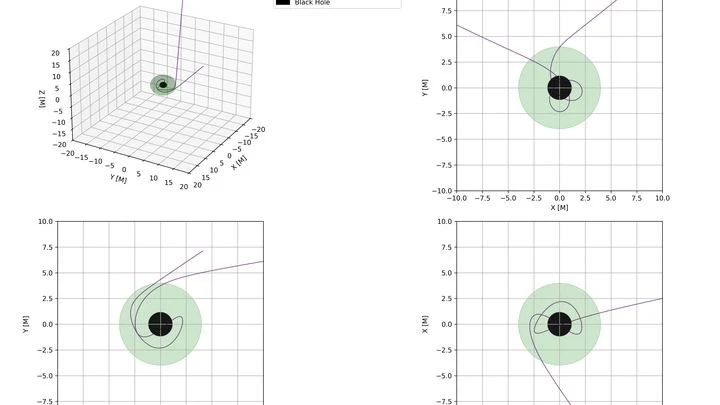
Light passing by a black hole falls into a gravitational trap: its trajectory curves and the particle bounces along a nearly closed orbit, like a pinball.
The beacon flares up and then nearly goes out, even though the lamp inside burns steadily. That is exactly what astronomers saw when they pointed their telescopes at the galaxy I Zwicky 1. At its center sits a supermassive black hole that devours gas and dust so greedily that a scorching disk forms around it, shining brighter than an entire galaxy.
A powerful vacuum cleaner sucks in not only dust but also its own collection bag. That's roughly how a black hole behaves at the center of a 'red dot'—a distant galaxy where the glow comes not from the hole itself but from its dense gas shroud. This shroud is so thick it resembles a puffed-up cool star. And, like many stars, it has a magnetic field.
A translator gets distracted by every rustle in the hall, and a one-hour meeting stretches into two. Gluons, the particles that carry the strong force inside protons, behave much the same way. Usually, they dart back and forth, holding quarks together.
At the center of many galaxies sits a supermassive black hole. When gas falls onto it, the gas heats up and shines brighter than an entire galaxy: this is an active galactic nucleus. Sometimes a true hurricane erupts from there: a stream of ionized gas racing at tens of percent of the speed of light.
At the heart of galaxy 1ES 1927+654, a black hole behaves like a lighthouse with a faulty mechanism. Every six and a half minutes, it releases a burst of X-ray light, a rhythm astronomers have been tracking since 2022. At first, the beacon's tempo wandered — speeding up and slowing down, with intervals ranging from one beat every eighteen minutes to one every seven.
A powerful searchlight shines through thick fog. The beam itself is invisible, but the fog begins to glow faintly, and gives away the searchlight's presence.
At the center of the Milky Way lies the supermassive black hole Sagittarius A*. It is four million times more massive than the Sun, but by cosmic standards it behaves quietly: it only occasionally flares up when it swallows a clump of gas.
A fountain shoots from the center of the city at a speed thousands of times faster than a courier bike. Such a 'fountain'—a stream of gas accelerated to 5500 kilometers per second — has been spotted by astronomers in the galaxy GLIMPSED-329380.
In the galaxy NGC 1566, located in the constellation Dorado, there is an active nucleus — a supermassive black hole surrounded by a cloud of fast-moving gas. As the gas falls toward the hole, it heats up and emits bright spectral lines. Sometimes these lines become very broad — a sign of the gas's rapid rotation.
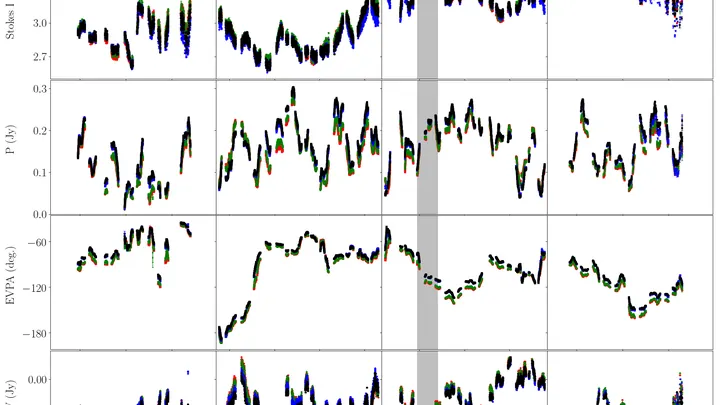
The Fermi telescope spent 17 years recording gamma rays from the active nuclei of galaxies with giant black holes at their centers. The glow of their jets resembles a chaotic cacophony: it constantly changes.
At the heart of galaxy NGC 4051 lies a black hole with a mass of 800,000 Suns. Around it swirls a blazing hot gas that shines brightly. This light doesn't reach us all at once: blue rays arrive first, then green, then red.
If a supermassive black hole lives at the center of a galaxy, it heats the infalling gas to incredible temperatures. That gas glows, and we see it as a quasar — the brightest beacon in the universe. But how do you measure the size of the light source itself?
The distant galaxy TXS 2005+403, located in the constellation Cygnus, behaves like a lighthouse whose beam shines through fog. Light from its active nucleus, a region where a supermassive black hole heats infalling matter, crosses clouds of charged gas in our Galaxy on its way to us.
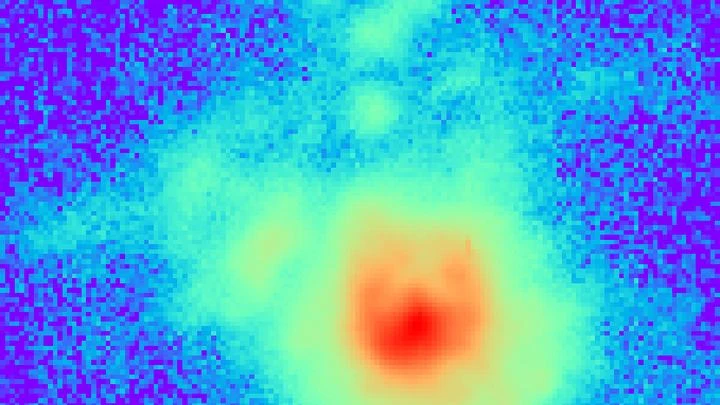
Deep in the constellation Ophiuchus lies the galaxy NGC 6447. Until recently, it was quiet and unremarkable, like a house with its windows dark. But over the past 14 years, something has ignited at its center, and now it's visible in infrared light.
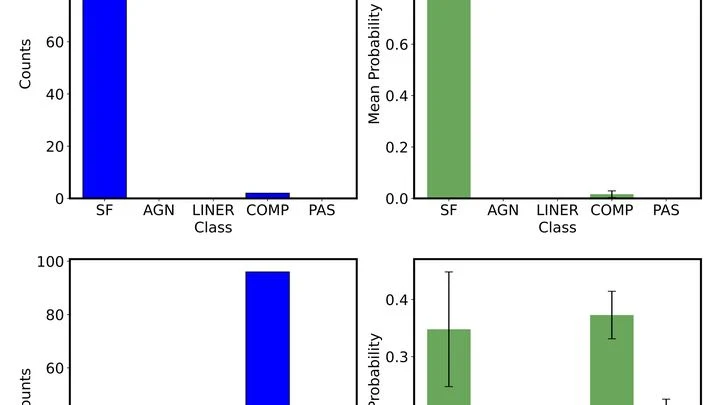
A galaxy is not just a sprinkle of stars. At the center of many, something shines brighter than billions of suns: hot gas falling into a black hole. The color of this glow reveals what kind of life the galaxy leads — quietly birthing stars or violently consuming matter.
One night in 2008, something in the core of the distant galaxy J1047+5907 flared sharply in X-rays. That's how the neighborhood of a supermassive black hole sometimes behaves: a scorching cloud of gas above it suddenly blasts out a powerful stream of light. The black hole itself emits nothing, but its surroundings can light up like a neon sign.
A rotating black hole is a cosmic whirlpool that sucks in everything around it. Some of these holes have invisible threads that stretch from the event horizon like spokes from a wheel. Scientists have long debated what these threads are and whether they can be observed.
In a new study, physicists have shown that these threads are not just a mathematical artifact.
At the center of galaxy NGC 4278 sits a black hole that shoots out two plasma jets, like a giant cannon firing particles into space. These jets accelerate particles to energies that no earthly accelerator could ever dream of.
Light from a distant lantern reflects off the surrounding fog, and from the delay of the reflection you can infer the distance. If the fog is uneven, the reflection arrives earlier or later, and the distance comes out wrong.
A quasar is a supermassive black hole at the center of a galaxy that devours matter and shines brighter than all the stars around it. Some of that energy goes into radio emission, which, it was thought, could heat or expel cold gas — the raw material for new stars.
At the heart of every galaxy slumbers a supermassive black hole. When it devours matter, its surroundings flare up: this is an active nucleus. How can we learn about past outbursts if the black hole is silent? The answer lies in light echoes.