Graphene and Silicon Nitride: Two Strings in Perfect Duet express
Two strings are stretched side by side: one thick and dull, the other thin and bright. Pluck the thick one, and you get a muddy sound with no clear pitch. The thin one responds with a pure tone. But link them together, and an unexpected effect appears: a sharp dip in the spectrum, as if someone muted a single note. This is the Fano resonance — a phenomenon physicists know from atoms, light, and even radio waves.
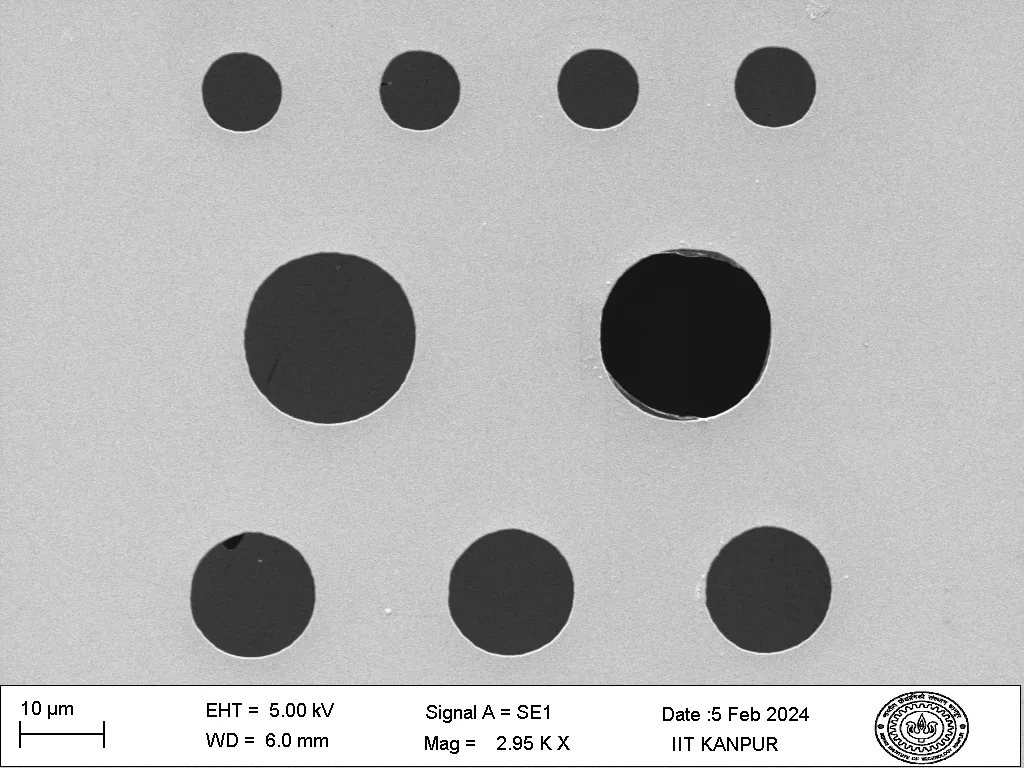
Now it has been reproduced in a miniature mechanical system. A sheet of graphene, just one atom thick, was placed on a tiny silicon nitride plate. The graphene vibrates sluggishly and broadly, like a big drum, while the silicon nitride sings with many narrow, high-pitched tones, like a comb with fine teeth. When the drum and the comb vibrate together, their voices interfere: at some frequencies they amplify each other, at others they cancel. By adjusting the gate voltage, you can shift these frequencies relative to each other and thereby switch the Fano resonance: change its sign and strength.
A weak additional tone can flip the system from one step to the next. This is like shifting gears in a transmission: each position is fixed and independent of how hard you press the pedal. This 'frequency ruler' made of silicon nitride stabilizes the graphene's vibrations, turning the hybrid device into a precise mechanical frequency standard.
The practical benefits are clear: mass and force sensors become more sensitive, and clock generators become more stable. Instead of complex electronics to fine-tune the frequency, you just apply a DC voltage. Two strings coupled on a single chip give more than either alone.
The Fano resonance is named after Italian physicist Ugo Fano, who in 1961 explained asymmetric peaks in the absorption spectra of noble gases. Later, the phenomenon was found in optics, plasmonics, superconductors, and even neutron scattering.