The fundamental tone is the lowest-frequency, dominant mode of a ringing signal, often referred to as the first harmonic. In acoustics, it is the pitch we perceive as the 'note' of a vibrating object, such as a guitar string or a bell. In physics, the concept extends to any oscillating system, from black holes to crystals, where the fundamental mode carries the most energy and defines the system's characteristic frequency. The provided articles explore fundamental tones in diverse contexts, including gravitational waves from black holes, sound in crystals, and electronic modes in thin films.
History
The concept of fundamental tones and overtones has roots in ancient Greek music theory, but the mathematical description of vibrating strings was developed by Jean le Rond d'Alembert and Daniel Bernoulli in the 18th century. For black holes, the quasi-normal modes were first studied in the 1970s, with the fundamental mode being the most prominent in gravitational wavesignals.
How it works
When a physical system is perturbed, it vibrates at a set of discrete frequencies called normal modes. The fundamental tone is the lowest of these frequencies, corresponding to the simplest standing wave pattern. For a string, it is the full-length vibration; for a black hole, it is the lowest-frequency quasi-normal mode of its spacetime ringing. Higher modes, or overtones, have frequencies that are integer multiples (or more complex ratios) of the fundamental. The fundamental tone often dominates because it has the largest amplitude and longest decay time.
In practice
Fundamental tones are used in musical instrument design, acoustic engineering, and materials testing. In physics, they are crucial for analyzing gravitational wavesignals from black hole mergers and for developing precision clocks and sensors based on crystal vibrations.
Fun fact
The fundamental tone of a black hole's ringdown is so characteristic that it encodes the black hole's mass and spin, allowing astronomers to measure these properties from gravitational wavesignals.
Two strings are stretched side by side: one thick and dull, the other thin and bright. Pluck the thick one, and you get a muddy sound with no clear pitch. The thin one responds with a pure tone. But link them together, and an unexpected effect appears: a sharp dip in the spectrum, as if someone muted a single note.
When two heavy balls merge into one, ripples spread across the water's surface for a long time. A black hole behaves similarly: after a merger, it 'rings' for a while, emitting special gravitational oscillations — quasinormal modes. Usually, this ring fades quickly, like an echo dying out in an empty hall.
You could send a short radio pulse toward a black hole and wait for the reflected echo. Intuitively, the shorter the signal, the better it would probe the finest details of spacetime right at the horizon: that region from which even light cannot return.
In the first fractions of a second after the Big Bang, the universe was a stage of rapid change. A stretched rubber sheet that cools quickly becomes covered with microscopic cracks. A similar process on a cosmic scale could have given rise to cosmic strings — ultra-thin but super-dense threads of energy stretching across the entire universe.
These strings are not just defects in space.
A massive aluminum cylinder weighing a ton hangs in a vacuum. A gravitational wave, a ripple in spacetime, passes through it, and the bar begins to tremble almost imperceptibly. That trembling can be heard as sound: gravitational waves turn into a phonon — a quantum of sound vibrations.
In 1915, Albert Einstein and Wander Johannes de Haas demonstrated that when an iron rod is magnetized, it twists slightly — the angular momentum of electrons is transferred to the crystal lattice.
The merger of two black holes is not just a silent dance, but a grand act after which spacetime itself vibrates for a long time. These damped oscillations — quasi-normal modes — are like the ringing of a gigantic bell. But there is another echo: barely perceptible, almost ghostly.
The cosmic microwave background is the first light that pierced the dense fog of the early universe. Its spectrum, like a frozen score of a cosmic symphony, preserves the tiniest density fluctuations from which galaxies grew.
The mystery of dark matter has puzzled physicists for nearly a century. Among the candidates for its role are primordial black holes (PBHs), born in the fiery embrace of the first moment after the Big Bang.
A black hole rings like a bell when something massive falls into it. This ring is gravitational waves, and its overtones tell us about the shape of the horizon.
A swarm of tiny ice balls is scattered across a warm room. Some melt faster, others slower, but when only wet spots remain, they all vanish in the same way: the last drop evaporates according to the same law. This is roughly how primordial black holes behave — hypothetical objects born in the first moments after the big bang.
Astronomers listen to the cosmos like an old radio: they twist the knob not to find a particular station, but to catch any unusual noise. This approach breaks the mold: instead of hunting for gravitational waves using memorized patterns, they catch everything — without bias.
The familiar metronomes placed on a movable platform eventually start to swing in sync. In the quantum world, this trick long eluded scientists. But now physicists have synchronized even the most exotic state — a Fock state, where the number of light particles is precisely defined, like in a counter.
A black hole can be compared to a bell: after being struck, it vibrates, emitting a decaying 'ring.' This ring is the gravitational waves that detectors on Earth pick up.
Strike a bell, and it rings. But the sound isn't arbitrary: the bell itself picks out the notes to which its metal is tuned. It turns out a black hole behaves the same way. When something falls into it, or its spacetime gets warped, it starts to oscillate.
A fundamental string plucked at the moment of the Big Bang doesn't just hum a single note — waves run along it, and occasionally tiny loops peel off. These loops, like tuning forks, begin to ring at their own frequency, producing a very high-pitched sound.
The mystery of dark matter, first glimpsed in the stellar whirlpools by Vera Rubin, has been tormenting physics for nearly a century. One of the boldest hypotheses: primordial black holes, born in the scalding broth of the early universe.
Strike a diamond and it rings, but sound lives inside it even without a strike. Waves of compression and rarefaction constantly ripple through it, like the ripples a stone makes on water. Except this ripple is the thermal jitter of the atoms themselves, and it can be detected with a laser.
Three twins on the run constantly change clothes. That's roughly how neutrinos behave — nearly elusive particles that pass through us by the trillions every second.
When two black holes merge, the resulting black hole 'rings' for a while, emitting gravitational waves — like a dying bell. This ringing is captured by giant detectors created by Rainer Weiss and Kip Thorne.
A hot spoon in a cup of tea — heat runs along the metal from the hot end to the cold one. Textbooks describe this process as atoms jiggling and passing on their jolts to each other. But atoms don't just jiggle: they also spin, like tiny tops. Until now, physicists had no common language to describe both motions at once.
The authors of the work built such a language.
An ultra-sensitive microphone tries to catch the whisper of a distant galaxy. But the microphone itself trembles from heat: its atoms jitter like popcorn in a pan. Physicists call this jitter thermal noise, and it often drowns out weak signals.
In a strong magnetic field, electrons in a thin metal film move along circular orbits. When the film thickness is comparable to the size of such an orbit, the resistance starts to oscillate: these are Sondheimer oscillations, known since the mid-20th century as a purely geometric effect.
Music relies on repetition: we expect the beat to return, like a chorus coming back. But if you repeat the same thing for too long, it gets boring. The composer seems to walk a tightrope between the familiar and the unexpected.
Scientists translated this balance into the language of physics.
Atomic clocks are pendulums that tick at the frequency of light. Inside a trap, an aluminum ion hangs, and a laser probes it like a tuning fork. If the laser's frequency matches the atom's natural frequency, the atom responds. The clock's rate is checked against this response.
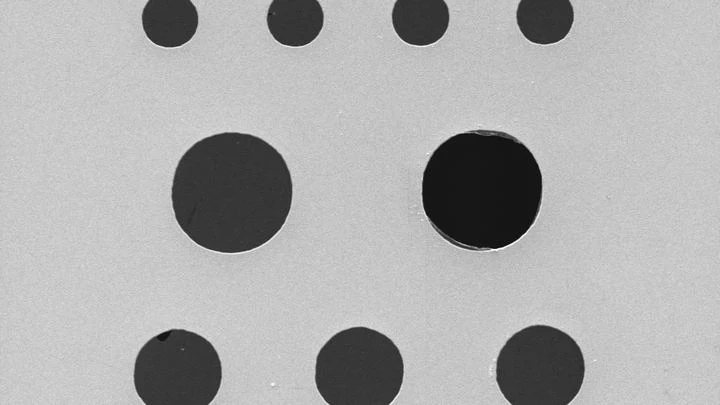
You can launch sound in a crystal at a frequency so high that the human ear can't hear it, and make that sound run in circles, like a train on a loop track. Engineers took a thin film of silicon nitride, deposited it on a lithium niobate substrate, and carved waveguides for sound waves into it.
The universe wasn't born in silence. Primordial gravitational waves — ripples in spacetime — still carry the echo of that event. Scientists try to hear it in two ways. Low 'notes' are captured in the Big Bang's afterglow — light emitted 380,000 years later.
In a solid, atoms vibrate, transmitting sound. Sometimes this wave doesn't run straight but curls into a spiral, like a corkscrew entering a cork. In ordinary crystals, such 'sound vortices' are known, but in magnetic materials they had long eluded detection.
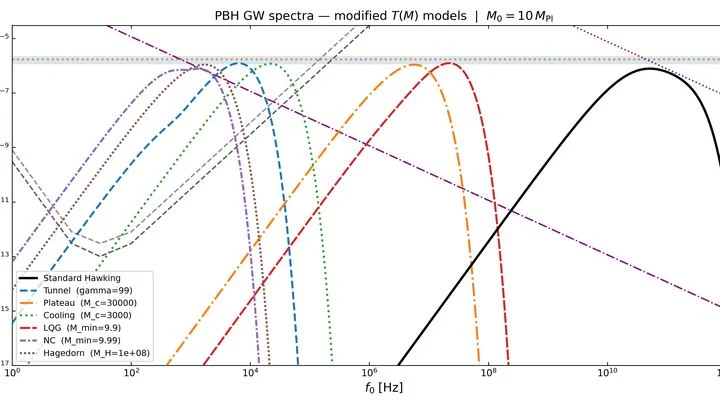
Primordial black holes behave like boiling kettles: as they evaporate, they whistle gravitational waves. The character of the whistle, its spectrum, depends on how the hole's temperature relates to its mass.
If you shake a box of sand long enough, patterns appear on its surface — patterns that weren't there when the box was still. It's the same here: physicists took a cloud of cold atoms, trapped them in an optical lattice, and began shaking it periodically. This gave rise to a new state in the atoms, like a new pattern in the sand that doesn't exist without the shaking.
When two black holes merge, the newborn hole rings like a bell, emitting gravitational waves. In the past, only the fundamental tone of this ringing was captured. But analysis of the GW250114 merger showed that the signal hides extra faint vibrations — nonlinear overtones.
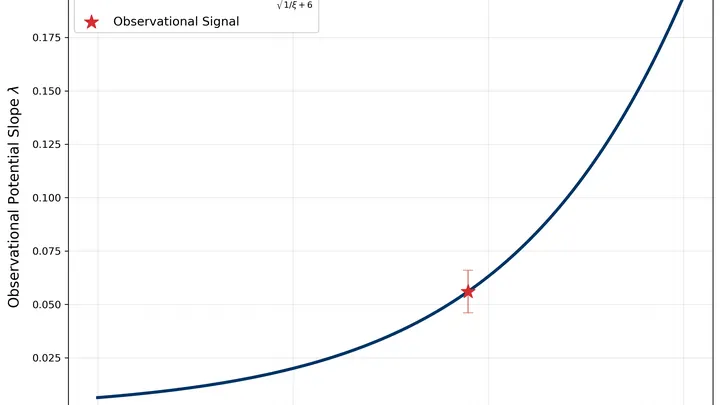
Modern telescopes see distant galaxies flying apart faster and faster. The cause is called dark energy, but its nature has been a mystery. On top of that, calculations of the expansion rate in the early and late Universe don't match. The answer might lie in an event much like a falling pencil.
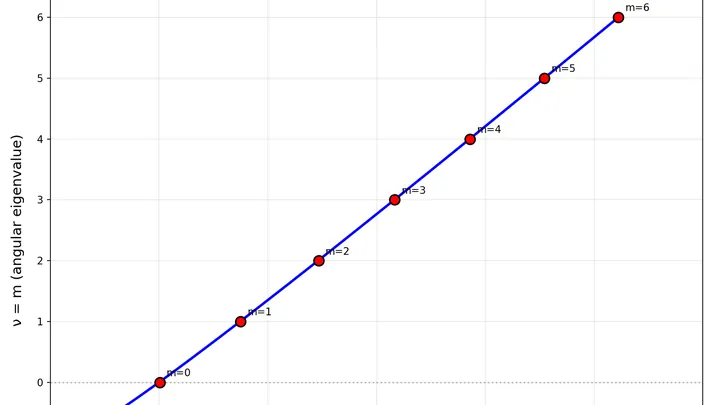
A metal sphere is a trap for light waves. Bouncing off the walls, they combine into frozen oscillations — like crests on a pond, frozen in time. For each such pattern (mode), Maxwell's equations prescribe a strict frequency.
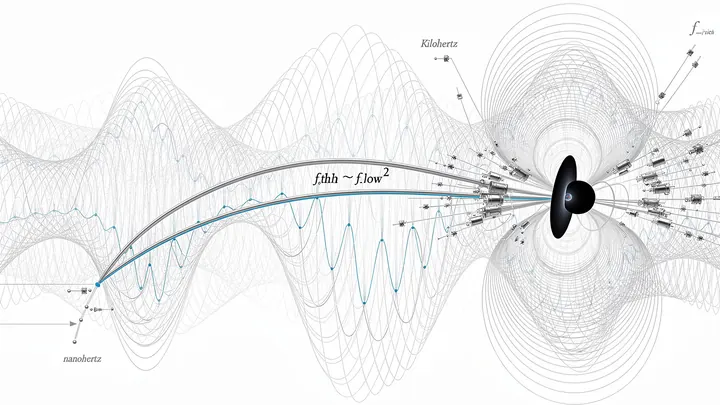
A gravitational-wave detector catches not only the roar of mergers but also the quiet splash when a star or gas cloud dives into a supermassive black hole. Such a dive, like a stone falling into a well, generates waves at all frequencies at once—and in that spectrum lies encoded the nature of the well itself.