Gamma Cephei: Two Stars and One Planet, Verified Over 45 Years ✛
Imagine looking at an old photograph where two people are spinning in a dance while a third stands apart. The image was blurry, but now it has been restored. In the Gamma Cephei system, two stars and one planet dance under the force of gravity, and astronomers have for the first time precisely described their motions.
The primary star is a red giant, swollen and brighter than the Sun. A companion star, about two and a half times less massive than the Sun, orbits it every 70 years. And very close in, a planet about one and a half times the mass of Jupiter completes a circle every 2.5 years.
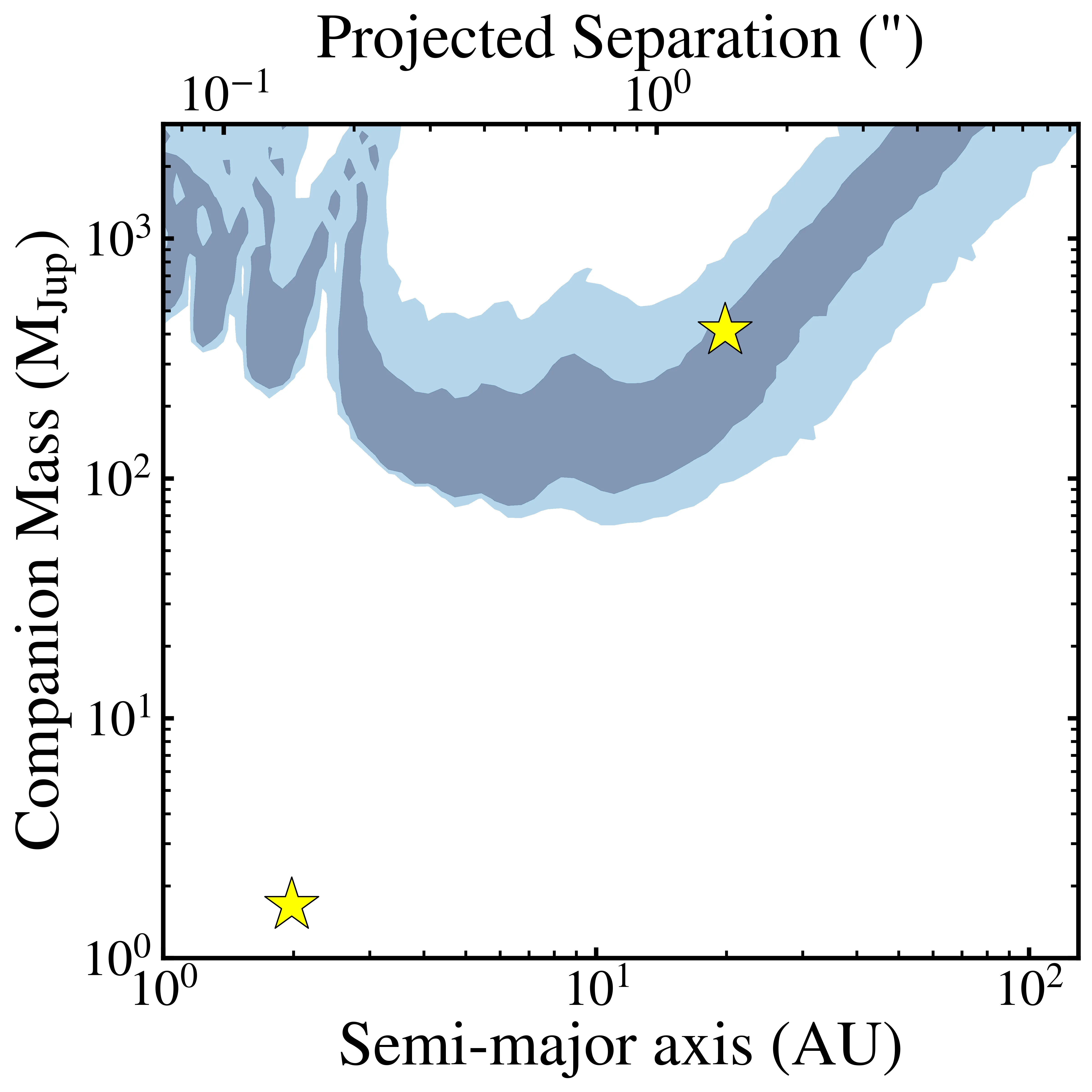
Astronomers checked whether the system harbors any other large planets. They found none, neither between the orbits of the star and the planet nor closer to the star. This is no coincidence: the nearby companion star's gravity disrupts the formation of new planets from dust and gas. It acts like a strict dance floor manager, keeping extra participants off the floor.
Now that the motions of all three bodies have been measured with high precision, this dance can serve as a template for studying other stellar systems.
Gamma Cephei is a star visible to the naked eye in the constellation Cepheus, and its companion is so close that from 2003 to 2026 the angular separation between the stars grew from 0.689 to 1.979 arcseconds.