Gamma Cephei: How 45 Years of Observations Rewrote the Family Portrait of a Binary Star ✛
The family album of this stellar pair has been filling up for 45 years, but the pictures were blurry and the captions contradictory. Now astronomers have pulled out the old photographs, taken new sharp shots, and put everyone back in their proper places. Gamma Cephei is a bright star visible to the naked eye, and it has an invisible companion that orbits it every 70 years.
The companion turned out to be a low-mass star of 0.396 solar masses, not a heavy planet as previously thought. Its orbit is elongated: at closest approach it comes within 11.6 astronomical units of the primary, and at farthest it swings out to 28.5. For comparison, the distance from the Sun to Neptune is about 30 astronomical units.
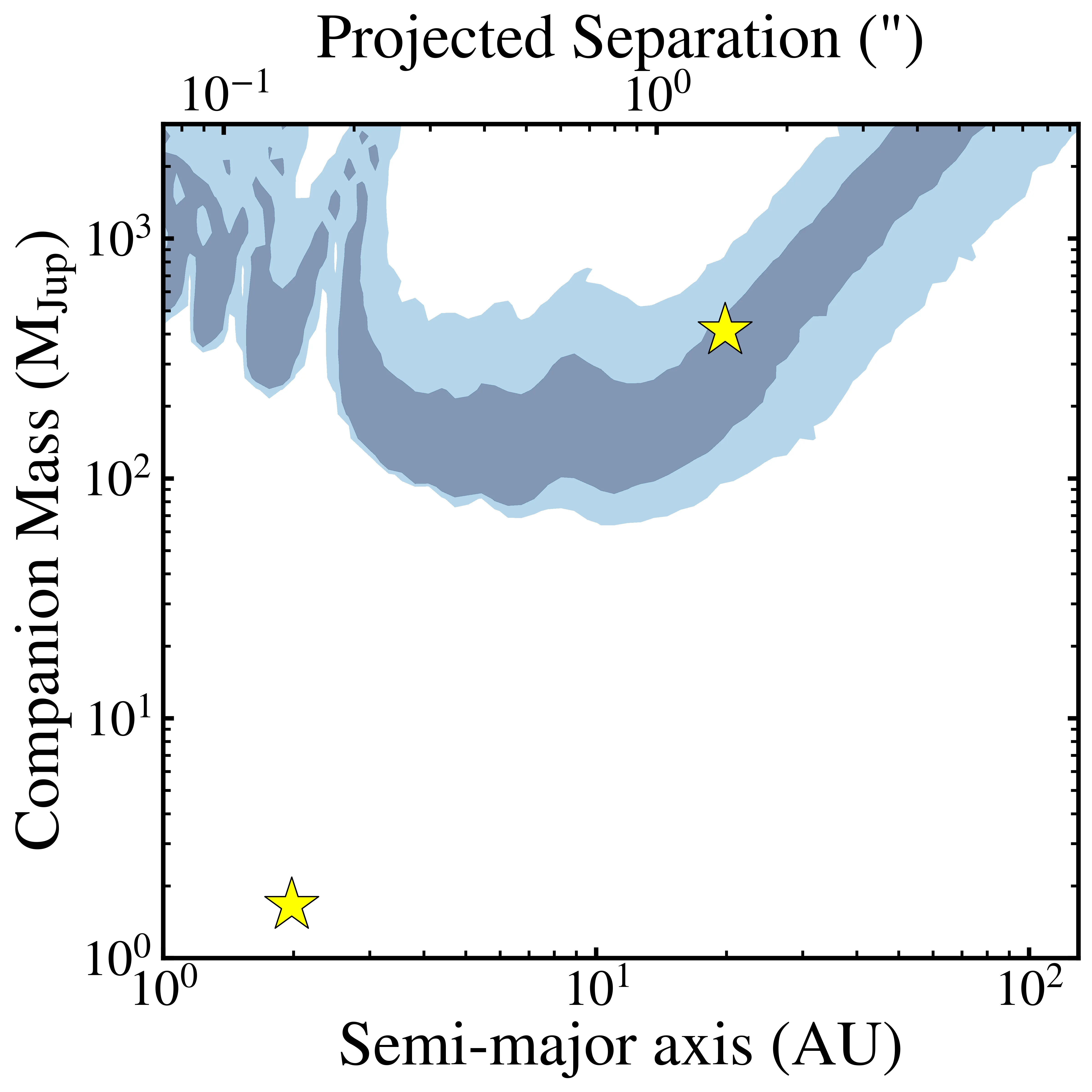
Inside this system, at a distance of 2 astronomical units from the primary, orbits the planet Gamma Cephei Ab. It is one and a half times more massive than Jupiter and completes an orbit in 2.5 years. Its orbit is nearly circular, but the inclination is still not precisely measured: the planet could be tilted at any angle relative to the companion star's orbital plane.
The big surprise is what the system lacks. Astronomers checked whether other giants might be hiding between the orbits of the planet and the star. It turns out that in the gap from 2.5 to 20 astronomical units there is no planet heavier than Jupiter, and within 1 astronomical unit nothing heavier than Neptune.
The empty rooms are explained by the influence of the stellar companion. Its gravity acts like a strict architect: it prevents material from gathering into new planets at intermediate distances and sweeps away anything extra. The Gamma Cephei system has become a benchmark for how a close neighboring star constrains a planetary family.
Now this family portrait hangs in a prominent place: it helps calibrate the mass-luminosity relation for small cool stars, and thus more accurately determine the masses of stars in other systems from their brightness. The architectural blueprint has been refined, and other houses can be checked against it.
Gamma Cephei is a star visible to the naked eye in the constellation Cepheus, and its companion is so close that from 2003 to 2026 the angular separation between the stars grew from 0.689 to 1.979 arcseconds.