Exomoons are natural satellites of exoplanets. Their detection is the cutting edge of observational astronomy. Two main methods are used for the search. During the transit of a planet across the star's disk, a moon can cause an additional slight dimming (photometric method). Additionally, the moon's gravity makes the planet wobble, which leads to uneven timing of transits—transit timing variations (TTV). Detection requires ultra-precise measurements, so the main hopes are pinned on telescopes like Kepler, TESS, and future missions. It is thought that exomoons can be born from a circumplanetary disk or be captured by the planet's gravity. Their presence expands the possible habitable zones, as a moon can maintain a stable climate thanks to tidal heating and the presence of an atmosphere.
History
The term 'exomoon' appeared in the 1990s with the discovery of the first exoplanets. Systematic searches began after the launch of the Kepler telescope: the 'Hunt for Exomoons with Kepler' (HEK) project was led by David Kipping. In 2017, the candidate Kepler-1625 b I was announced, but subsequent Hubble observations did not confirm its existence unambiguously. The search for exomoons remains a collective task.
How it works
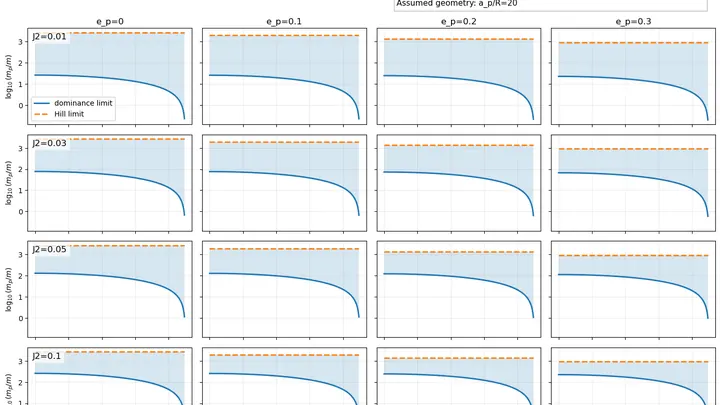
The detection of exomoons relies on high-precision photometry. During a planet's transit, starlight dims according to a known law; a moon adds a secondary signal. If the moon is far from the planet, its transit may be observed as a separate event before or after the planetary transit. The TTV method is based on the fact that the planet and moon move around a common barycenter: this shifts the planet's position and causes deviations of transit times from strict periodicity. The TTV amplitude can reach minutes and depends on the moon's mass and orbital size. Additionally, dynamical stability is assessed: the orbit must lie within the planet's Hill sphere and be stable against perturbations from the star and other planets. Tidal heating of the moon is described by the quality factor Q. The light curve is modeled using the Mandel–Agol algorithm for the planet plus the moon's contribution.
In practice
Understanding the formation of moons helps refine models of planetary evolution; some exomoons may turn out to be more habitable than their planets.
Fun fact
The most famous candidate is the moon of the planet Kepler-1625 b, which could be the size of Neptune. If its existence is confirmed, it will be the first discovered 'mega-moon'.
The family album of this stellar pair has been filling up for 45 years, but the pictures were blurry and the captions contradictory. Now astronomers have pulled out the old photographs, taken new sharp shots, and put everyone back in their proper places. Gamma Cephei is a bright star visible to the naked eye, and it has an invisible companion that orbits it every 70 years.
Astronomers catch distant planets by the trembling of their stars: an invisible companion tugs the star toward us and away, and its light subtly shifts in color. But that trembling tells only half the truth. If the planet's orbit is tilted to our line of sight, only part of its weight rocks the star, so telescopes reveal not the true mass but its shadow.
A telescope stares at a star for many nights in a row. Somewhere in the stream of light hides a tiny dip in brightness — an Earth-sized planet briefly blocking part of the star. Such a dip lasts a few hours and repeats once a year or less. Catching it is like hearing a single quiet click in a noisy hall.
The birth of a moon is a cosmic car crash. Two young planets collide, and a cloud of scorching debris swirls around the surviving world. From this disk, like clay on a potter's wheel, a satellite gradually takes shape. That's probably how our Moon came to be.
The birth of a moon is a cosmic car crash. Two young planets collide, and a cloud of scorching debris swirls around the surviving world. From this disk, like clay on a potter's wheel, a satellite gradually takes shape. That's probably how our Moon came to be.
Two hundred million stars. In the heart of the Galaxy, where the future survey by the Nancy Grace Roman telescope will aim, about 250 times during its mission the light of one of them will flicker at an invisible touch.
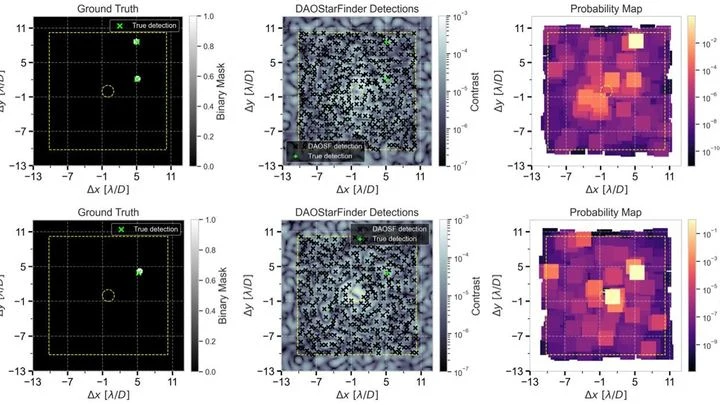
A pebble on a streambed lies still as sunlight sparkles dance on the water's surface. In astronomy, the contrast is similar: a real exoplanet is the stone, while myriad speckles (patches of scattered starlight) are the ripples trembling in instruments.
Every 165 days, the giant planet dives toward its star, nearly grazing its fiery corona, then flies off into the icy void. This is TIC 241249530 b — an exoplanet with a record eccentricity of 0,94.
A typical tracking program resembles a navigator steering a ship by the stars. But as soon as the sky clouds over, coordinates drift, and entropy (a measure of uncertainty) builds up in the data. The new algorithm gets a ‘co‑pilot’ — a module that monitors how confident the main navigator is.
The Moon is an airless sphere of dense rocky grit called regolith. When fast particles from space slam into it, muons are born in the soil — unstable relatives of electrons, but two hundred times heavier. Most fly downward and fade away in the depths. But those that pop upward into the vacuum can travel tens of kilometers before decaying.
The gravitational dances of celestial bodies long remained silent to astronomers. We learned to catch the shadows of planets against stars with the transit method — a breakthrough that delivered thousands of worlds thanks to William Borucki and his Kepler telescope.
The gravitational dances of celestial bodies long remained silent to astronomers. We learned to catch the shadows of planets against stars with the transit method — a breakthrough that delivered thousands of worlds thanks to William Borucki and his Kepler telescope.
Remember the sensational comet 1I/‘Oumuamua — the first object to come to us from another star? Its hyperbolic trajectory left no doubt: it was a wanderer from the interstellar void. But astronomers wondered: could some of these visitors not be strangers at all, but our own, escaped from the Solar System millions of years ago?
When a giant planet grows, it pulls in gas. Some of that gas swirls around it into a small disk — called a circumplanetary disk. It is in such disks that moons are thought to form. For the planet PDS 70 c, located 370 light-years away, such a disk was directly observed using the ALMA antenna array in the millimeter range.
The Sun is not just a source of heat; it's also the largest lens in the solar system. Its gravity bends light rays like glass, focusing them into a bright ring far beyond Pluto's orbit. If light from a distant planet enters this ring, astronomers could reconstruct its portrait — not a point, but a map with surface details.
The Moon is a natural archive that has been collecting cosmic dust for billions of years. Among the microscopic grains that arrived from distant stars, there could be techno-specks — particles created by alien civilizations.
Young Earth was a boiling sphere of liquid rock, while Theia, which crashed into it, had had time to cool and solidify. It’s like dropping a chunk of cold butter into a pot of soup: the soup splashes out, but the butter barely moves. Similarly, Earth’s interior spewed into space, forming a cloud of cosmic dust and debris.
In the catalogs of exoplanets, there are many worlds with sizes between Earth and Neptune. They are divided into two groups: rocky super-Earths and gaseous mini-Neptunes. The Solar System has none of these, and scientists debate where they come from.
The authors of the study looked into each planet's 'passport'—its orbit.
A planet glides across a star's disk, and for a moment becomes a flashlight. It blocks a tiny patch of surface, revealing details that otherwise escape our view. That's exactly how astronomers peered into the dark spots on V1298 Tauri, a young twin of our Sun. They were aided by the James Webb Space Telescope JWST and three giant planets in orbit.
Think of a baby mobile: figurines dangling on threads, twitching at even a whisper of breeze. In the same way, planets on very wide orbits barely cling to their star's gravity, and they feel the faintest gravitational drafts. Astronomers have proposed turning such planets into detectors of dark matter.
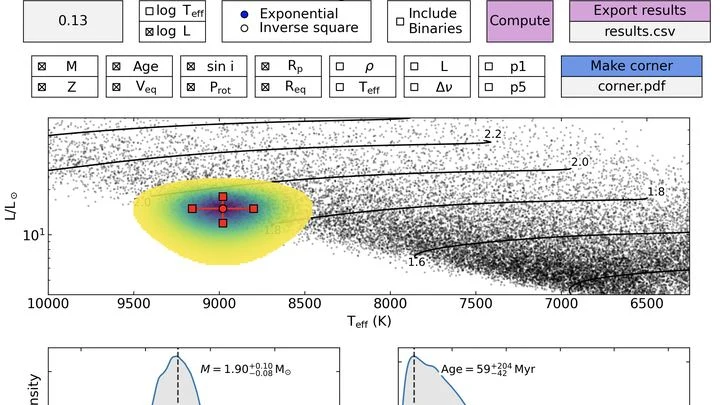
Imagine a person in an old photograph standing in a crowd while spinning — guessing their age would be nearly impossible. That's roughly how astronomers determine the ages and masses of distant stars, and they often get it wrong. For stars slightly heavier than the Sun (from 1.4 to 2.5 solar masses), standard methods like chemical-composition 'clocks' work poorly.
A star's light curve is not chaotic noise, but a text written by pulsations, spots, and the steady glow of a thermonuclear furnace. Any planet slipping across the disk leaves a typo in this text: a tiny dip in brightness lasting hours.
Among the hundreds of moons in the Solar System, Nereid dances the most desperate dance: diving toward Neptune as close as 1.4 million kilometers, then soaring away to 9.7 million — all within less than an Earth year. An eccentricity of 0.75 — the brand of a captured wanderer.
A star's light curve is not chaotic noise, but a text written by pulsations, spots, and the steady glow of a thermonuclear furnace. Any planet slipping across the disk leaves a typo in this text: a tiny dip in brightness lasting hours.
At the edge of the solar system, where the Sun is barely brighter than other stars, icy boulders, trans-Neptunian objects, circle around. Their orbits resemble hoops scattered by someone. But look closer: twelve of these hoops are not just floating in the void.
The first exoplanet was discovered around an unusual cosmic lighthouse — a neutron star known as a pulsar. These ultra-dense remnants of dead stars spin at tremendous speeds and emit precise radio pulses.
For decades, the search for extraterrestrial intelligence has waited for quiet, coherent signals from space — a kind of 'whistle' in the radio silence. However, our own technosphere has created a continuous radio background — the hum of a vast metropolis, emitted by all communications, radars, and broadcasting stations.
Enceladus is a tiny moon of Saturn, covered in a thick crust of ice. Beneath it sloshes a salty ocean, and deep down, a hot, porous core may be at work, like a sponge soaked with water and heat. But how do you see through tens of kilometers of ice? No need to drill: you can use an electromagnetic "echo."
A person with a metal detector walks along a beach.
The hunt for life on distant planets is like diagnosing a rare disease with a test of unknown accuracy. A single positive result means nothing: maybe it's a glitch? We search the atmospheres of exoplanets (worlds around other stars) for traces of water and other compounds, but any signal could be a false alarm.
At the edge of the solar system, far beyond Neptune, hundreds of icy chunks circle the Sun. Some of them move as if an invisible hand had aligned their orbits like compass needles. Ten years ago, this led astronomers to suspect that a massive planet, about ten times heavier than Earth, is hiding there.
Astronomers pointed JWST at a planet near the star Epsilon Indi — a giant gas ball resembling Jupiter, just 12 light-years away. In thermal images, the planet shone like a lantern. But nearby they noticed a faint dot — like a firefly. Calculations showed that two objects describe the picture better than one. However, it's most likely a lens flare — like a ghost of a lamp.
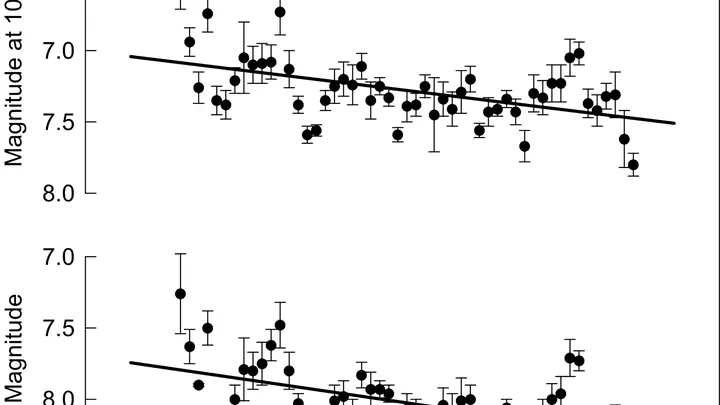
For five consecutive years, the automated MMT9 observatory measured the brightness of Starlink and OneWeb satellites using photometry (precise light measurement). The results were surprising: VisorSats, equipped with visors to reduce glare, became brighter by 0.6 magnitudes, while OneWeb, on the contrary, dimmed by 0.4.
On Earth, the radio spectrum is clogged with signals: communications, television, radar. But on the far side of the Moon, it's quiet. There, Earth's noise is inaudible, and that's exactly where China's Chang'e-4 went to listen to the cosmos for the first time, hunting for alien radio transmissions.
Scientists processed the recordings from its antennas.
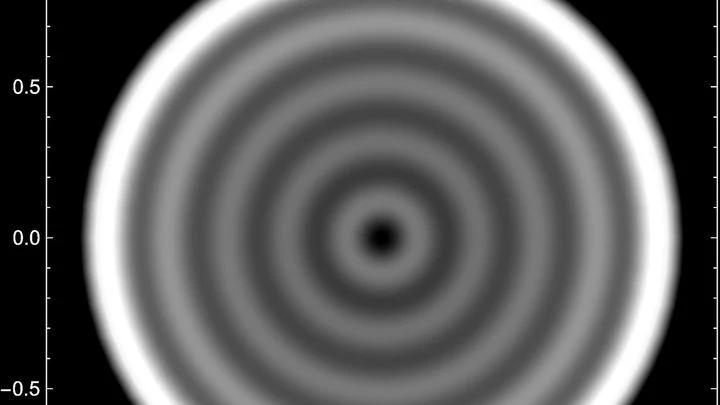
A guitar string only sounds at certain notes, when pressed at the frets. So it is with the gas-dust disk around a young star: it's shot through with standing waves, but only chosen oscillations survive. Where the wave crests, cosmic dust and hydrogen collect, and later exoplanets are born.
At night, a distant streetlamp seems motionless, but if you walk closer and look carefully, you might notice it swaying slightly in the wind. That's roughly how astronomers hunt for planets around other stars: they measure how a star shifts ever so slightly under the gravitational tug of its invisible companions.
The light from a distant star is never steady. It shimmers like heat over hot asphalt. When astronomers pointed JWST at the star TOI 700, they saw this shimmer especially clearly: every 16 minutes, the brightness changed by a tiny fraction, just 46 parts per million.For comparison: if you placed a light bulb a kilometer away, this change would be…
A rock knocked off one planet by an asteroid impact hurtles through space and lands on another. If microbial spores are hiding inside, they might survive the cold, the radiation, and the rough landing. That's panspermia — the idea that life travels between worlds. But imagining such a journey is one thing; calculating every step is quite another.
Around distant icy bodies the size of a city, circling beyond Neptune, rings of dust and ice have been found. Small moons often whirl nearby. Mathematical analysis shows that a moon's gravity rocks the ring like a swing, making it tilt.
Every galaxy is wrapped in an invisible shell of hot gas, like steam rising from a pot of boiling water. This gas barely glows in X-rays, making it notoriously difficult to measure. Yet it holds the memory of stellar explosions and the galaxy's growth.
The new method uses light from a galaxy's bright center.
The Kepler telescope spent years watching thousands of stars, spotting planets by the tiny dips in starlight when a planet passes in front of its star. Such a passage, or transit, lets us measure the planet's size but not the shape of its path.