Planets do not circle the Sun in perfect circles — their path resembles a slightly flattened circle, an ellipse. The Sun does not sit at the center of the ellipse but is offset to one of two special points — the foci. In winter the Earth is slightly closer to the star, in summer — farther away. The difference in distance is small, but it is precisely what makes the planet accelerate and decelerate. The same elliptical dance is performed by satellites around planets and even exoplanets around distant stars.
History
Johannes Kepler, working in Prague with the most precise observational data of his time from Tycho Brahe, focused on the mysterious behavior of Mars. After years of attempts to describe its motion with a combination of circles (epicycles), he encountered a discrepancy of 8 arcminutes — too large to dismiss as an error. Having abandoned the dogma of perfect circles, Kepler tried several oval curves and finally chose the ellipse. He placed the Sun at one of the foci, not at the center. The result was instantly confirmed by all positions of Mars. Thus in 1609 the first of three laws was born, later generalized by Newton and becoming the starting point of celestial mechanics.
How it works
The law is used to calculate ephemerides — positions of planets on the celestial sphere. In combination with the second law, it gives the complete kinematics of orbital motion. The orbit is determined by six elements, among which a and e are key. Modern applications include mission design (gravity assists, Hohmann transfers), analysis of light curves and radial velocities of exoplanets, and study of the dynamics of star clusters. The limit of applicability is weak gravitational fields and speeds far from the speed of light. Near black holes or in systems with strong relativistic corrections, the Kepler ellipse is replaced by a precessing ellipse of general relativity (Einstein effect).
Fun fact
Mars gave Kepler a real quest: eight years of calculations and about forty attempts to fit its orbit to a circle failed. Having discarded the perfect circle, he obtained an ellipse — and the discrepancy with observations reduced to a couple of arcminutes. Thus the first law was born, along with the habit of not trusting old dogmas.
In a rubber band stretched in the lab, three different elasticity mechanisms operate simultaneously. At small strains, Hooke's law prevails; at intermediate strains, entropic chain elasticity; at large strains, strain-induced crystallization.
The family album of this stellar pair has been filling up for 45 years, but the pictures were blurry and the captions contradictory. Now astronomers have pulled out the old photographs, taken new sharp shots, and put everyone back in their proper places. Gamma Cephei is a bright star visible to the naked eye, and it has an invisible companion that orbits it every 70 years.
A thrown stone arcs through the air, but a planet around the Sun follows a closed curve. Why an ellipse, and not a circle or a spiral? Kepler's first law provides the answer, but its usual proof requires heavy computation. This work offers a shorter path — through a single simple ratio of velocities.
A thrown stone arcs through the air, but a planet around the Sun follows a closed curve. Why an ellipse, and not a circle or a spiral? Kepler's first law provides the answer, but its usual proof requires heavy computation. This work offers a shorter path — through a single simple ratio of velocities.
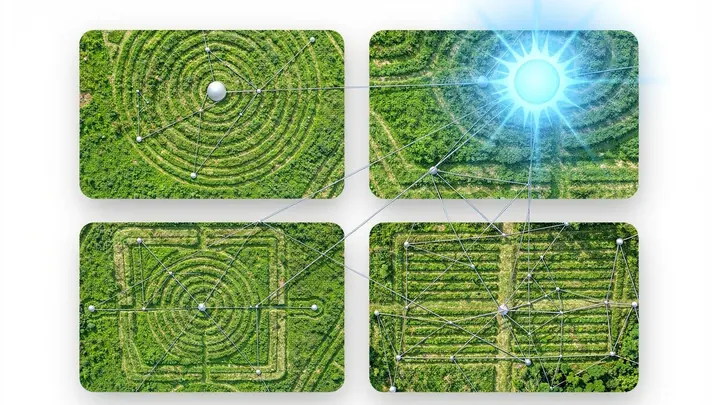
Deep in the Amazon rainforest, beneath a multi-layered canopy of leaves, lie vast earthen figures — squares, rectangles, the occasional rhombus. For decades they teased archaeologists with their silent geometry, until a researcher armed with orbital optics saw them as an astronomical instrument.
An ordinary magnet always carries two poles — north and south. Split it in half, and each piece immediately grows its own pair. But deep in particle theory lives a strange notion: the monopole — a particle carrying just one magnetic charge, a lone pole without a partner.
The Kepler telescope spent years watching thousands of stars, spotting planets by the tiny dips in starlight when a planet passes in front of its star. Such a passage, or transit, lets us measure the planet's size but not the shape of its path.
Three distant giant planets circle their stars so closely that a year on them lasts just a few Earth days. These worlds are called hot Jupiters, and their orbits are a real puzzle: how did they end up right next to the star if they were born far away, in the cold outskirts of the system? One key clue is the angle at which a planet orbits relative to the star's rotation.
The night sky is dotted with stars, and many of them have planets. But how do you spot a tiny dark disk against the glare of a distant sun? The Kepler telescope spent nine years watching hundreds of thousands of stars, waiting for a planet to pass in front of its star and briefly dim it. That 'wink' is the only way to find worlds like ours.
The law discovered by Wolfgang Pauli forbids identical particles from occupying the same spot. Hence, in cold matter, a Fermi sea is born: particles, like water, fill energy levels from bottom to top. The shape of the sea's surface — including 'islands' of emptiness — dictates the properties of the whole system.
The three planets in the Kepler-51 system have long intrigued astronomers: they are Saturn-sized but less dense than water. These 'super-puff' worlds, with masses no more than ten Earths, are like cosmic dandelions — massive yet almost weightless. Their orbits are arranged like musicians in an orchestra, each playing its part, beating the rhythm with transits.