Cassiopeia A (Cas A) is a supernova remnant located about 11,000 light-years away in the constellation Cassiopeia. It is the youngest known supernova remnant in the Milky Way, with light from the explosion reaching Earth around 1680. The remnant is famous for its lopsided distribution of heavy elements, particularly iron, which is ejected unevenly during the explosion. This asymmetry challenges simple models of supernova nucleosynthesis and provides a natural laboratory for studying how stars forge elements and disperse them into space.
History
Cassiopeia A was first detected as a strong radio source in 1947 by Martin Ryle and Francis Graham-Smith at Cambridge. Its optical counterpart was identified in 1950, and it has since become one of the most studied supernova remnants.
How it works
When a massive starcollapses and explodes, the inner layers undergo rapid nuclear fusion, creating elements like oxygen, silicon, and iron. The explosion is not perfectly spherical; instabilities and rotation cause clumps of material to be ejected at different speeds and directions. In Cas A, observations show that iron is concentrated in one region while silicon and other elements are distributed differently, revealing the complex hydrodynamics of the blast. The remnant also contains fast-moving knots of debris and a central compact object, likely a neutron star or black hole.
In practice
Studying Cas A helps astrophysicists refine models of supernova explosions and element production, which are essential for understanding the chemical evolution of galaxies and the origin of elements in the universe.
Fun fact
The light from the Cas A explosion reached Earth in the late 17th century, but it was not noticed by contemporary astronomers, possibly because dust obscured it or because it was mistaken for a faint star.
The family album of this stellar pair has been filling up for 45 years, but the pictures were blurry and the captions contradictory. Now astronomers have pulled out the old photographs, taken new sharp shots, and put everyone back in their proper places. Gamma Cephei is a bright star visible to the naked eye, and it has an invisible companion that orbits it every 70 years.
In a quiet back alley of a galaxy, where stars are rare and old, a light suddenly flares up, brighter than an entire galaxy. This is a Type Ia supernova: a thermonuclear explosion of a white dwarf that astronomers use as a standard candle to measure cosmic distances.
Twenty thousand years ago, the star that would become supernova 1987A put on a ring. Not one — three. The two outer ones, like lampshades, tilted relative to the equatorial ring, and the star's light, struggling through them, barely reached an observer who happened to be in the plane of the equatorial ring.
When a star explodes, its material flies into space. In the supernova remnant SNR 0509-67.5, this material did not spread into a smooth cloud but gathered into separate clumps, like lumps in batter that is quickly stirred. The MUSE telescope in Chile saw these clumps in the faint glow of forbidden iron and calcium lines.
Cosmic rays are particles that race across our Galaxy at enormous speeds. Their energies can be millions of times higher than those of particles in the most powerful accelerator on Earth. But the higher the energy, the fewer such particles there are: the plot of their numbers shows a noticeable kink, which is called the knee.
In July 1969, as Apollo 11 flew toward the Moon, astronauts noticed something unusual: brief flashes of light that appeared even with their eyes closed. At first, this was attributed to fatigue, but the flashes recurred in different crews. Gradually, it became clear: cosmic rays were to blame — tiny particles hurtling through space at tremendous speeds.
The explosion of a massive star is not just a flash: it's a blow to the surrounding gas. But until now, no one had looked at how the gas itself moves at the sites of such explosions. Now astronomers have gathered data on 33 nearby supernovae and for the first time measured the turbulence of the cold molecular gas around them.
17 supernovae from the ZTF DR2 sample lit up ahead of schedule. In the first hours and days after the explosion, they emitted more light than standard models predict. Astronomers compare this to a Bickford fuse: before the blinding flash tears across the sky, a precursor spark runs through the outer layers.
Deep underground, in the silence of a cryostat (a cooled container), lie crystals of lead that once belonged to an ancient Roman ship. This material barely emits background radiation — over two thousand years, unstable isotopes have decayed, leaving it perfectly clean for hunting the rarest events.
On August 6, 1181, Chinese astronomers spotted a new star in the constellation Cassiopeia. It shone for 185 days, slowly fading, and then vanished, leaving only a record in the chronicles. Today, at its location, there is a hot white dwarf — a compressed stellar core with no nuclear reactions, heated to tens of thousands of degrees.
The hunter of ancient light, the James Webb Telescope, aimed its mirrors at a tiny patch of sky and caught a strange beacon. The object, with the working name beacon_1420-$$5253_{4770}$$, flashed and faded. At first, it was logged as a candidate for the most distant galaxy, as if we were seeing it just 300 million years after the big bang.
The cosmic spectacle unfolds on the stage of Galaxy галактики Centaurus A. In the lead role: a supermassive сверхмассивная чёрная дыра with a powerful jet that pierces space for hundreds of thousands of light-years.
A massive star doesn’t simply fade away — it blows up as a supernova, leaving behind an expanding remnant and a wildly spinning neutron star — a pulsar. In this cosmic storm, astonishing patterns emerge, and the 'Nimbus'–'Thunder' system is a dazzling illustration.
A shockwave erupts from the star's surface, and for a brief moment, a blinding flash of ultraviolet and X-rays is born. This very event, named EP260321a, was spotted by the Einstein space telescope in March 2026. The light took about 450 million years to reach Earth.
A massive star ends its life in a spectacular collapse: the core compresses into a neutron star or a black hole, while the outer layers fly off in a dazzling supernova.
In the constellation Scorpius, 3,000 light-years from Earth, a dead star steals matter from a living one. A white dwarf in the system IGR J17014-4306 — a superdense carbon-oxygen ball with the mass of the Sun but the size of Earth — siphons hydrogen from a normal companion star.
In April 2021, in a galaxy 35 megaparsecs away, supernova SN 2021foa erupted. It immediately puzzled astronomers: its spectrum feverishly switched between hydrogen and helium lines — as if the star, in agony, was frantically shedding its outer layers.
The stellar halo of the Milky Way is a galactic palimpsest: an ancient manuscript where earlier layers lie hidden beneath the visible text. For a long time, the Gaia-Sausage-Enceladus (GSE) structure was thought to be the final entry in this manuscript, the scar of a single catastrophic merger.
Eight hundred million years ago, in the main asteroid belt, a giant inkwell shattered. The parent body, over a hundred kilometers in diameter, made of primitive carbonaceous chondrites, suddenly broke apart near the J3:1 resonance with Jupiter.
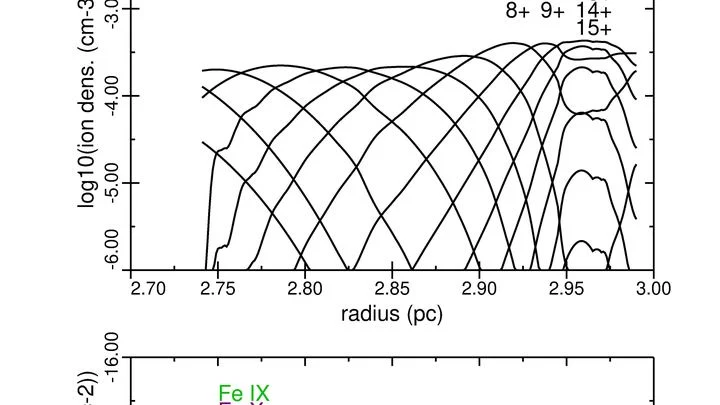
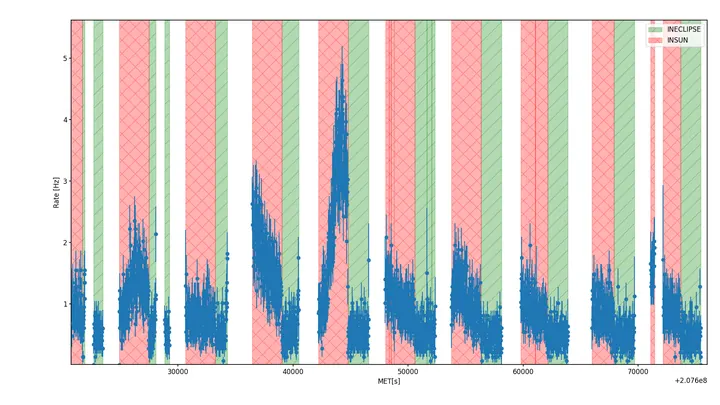
The XRISM X-ray telescope spent 170,000 seconds staring at the core of galaxy Cygnus A — one of the most powerful radio sources in the sky. At its center lurks a supermassive black hole that sucks in matter and heats it until it glows in X-rays. The instrument caught light from iron atoms that had lost electrons.
Two stars circle each other like dancers in a slow waltz. This dance is not eternal: the partners gradually draw closer until they collide and merge into a single entity. At that very moment, a red nova is born — a flash that lights up the sky for a few weeks, then slowly fades, enveloped in a dense cloud of dust.
A light bulb that doesn't burn out but flares brighter and brighter until it blows the whole fixture apart. That's roughly how the most massive stars in the universe die. When a star's core heats up to billions of degrees, pairs of particles (electrons and their antimatter counterparts, positrons) begin to form.
A supernova is the final explosion of a massive star, scattering its material over light-years. Inside the expanding shell, a neutron star remains, and the shell itself continues to plow through interstellar gas for thousands of years.
For nearly half a century, astronomers have been searching for glycine, the simplest amino acid and one of the fundamental building blocks of proteins, in the interstellar medium.
Cosmology holds that on large scales, the Universe is a calm ocean without storms or currents. This is the cosmological principle, the foundation of the standard ΛCDM cosmological model.
An old chest of family heirlooms opens, and inside lie jewels that were thought to be as old as great-grandmother. But suddenly it turns out: the gold was remelted, the stones were recut, and this happened much later than thought. A similar story happened to the oldest particles in meteorites — calcium-aluminum inclusions, or CAIs.
Be stars are rapidly rotating luminaries with bright gas disks. Usually, a companion star spins them up: mass flowing from the neighbor whirls the star like a bullet in a rifled barrel. But there are also lone Be stars without a partner: their origin long remained a mystery.
New research shows that solitaries can be born from a supernova explosion.
A supernova explosion is the death of a massive star, leaving behind a gas cloud. If there's plenty of hydrogen around, the shock wave spreads like an echo from a distant gunshot.
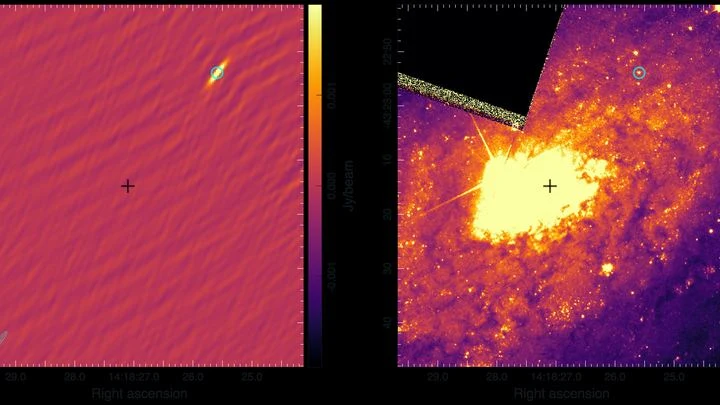
The ASKAP radio telescope in Australia has spotted a very faint glowing ring in the southern sky, like a soap bubble the size of several full moons. Inside the ring, exactly at the center, shines a tiny point. Usually, such a picture means one thing: a star exploded here, leaving behind an expanding shell and a collapsed core at its heart.
But this pair has a quirk.
A massive star's explosion is bright but brief. The flash itself lasts weeks, but the dust it heats around it glows in infrared for years. It's like a camera flash illuminating a room, then hot dust particles lingering in the air — only on a cosmic scale.
The center of our galaxy is a crowded kitchen where several dishes are simmering at once, and their steam blends into a single cloud. X-rays from the exploded star's remnant, from the stellar wind around the supermassive black hole, and from hot gas between stars all overlap.
Cosmologists have measured how fast distant galaxies are receding in different parts of the sky. To do this, they used two kinds of "cosmic rulers": galaxy clusters and a certain type of supernova explosion. Both methods showed the same thing: in one direction, the Universe is expanding slightly faster than in the opposite direction.
Deep inside a massive star, before it explodes, layers sit on top of each other like the layers of an onion. Sometimes two adjacent layers, the carbon and oxygen layers, mix together. It's like how layers of broth and vegetables in a pot of soup blend when you stir them with a spoon.
In a gas cloud left after a star exploded (called a supernova remnant), astronomers noticed a giant glowing letter S. It was drawn by two jets of superheated material ejected during the cataclysm. These jets didn't just shoot straight out — they slowly spun like a top, which bent their path into curves.
At the center of the Milky Way, among dense clouds of gas and dust, lies a region called Sagittarius C. It's like a bustling crossroads: stars are born here, streams of matter collide, and the whole scene is illuminated by X-rays. For a long time, this glow remained a mystery.
When a massive star explodes, it hurls giant clouds of gas into space. These clouds, known as supernova remnants, can stretch across hundreds of trillions of kilometers. Two such clouds — G107.7-5.1 and G150.3+4.5—were recently studied by astronomers using a telescope in Turkey.
In a constellation where new stars are born, one of them behaves like a faulty lightbulb: sometimes shining steadily, sometimes dimming by a factor of several. Astronomers have been monitoring the star Gaia-GIC-1 for several years and now understand that its blinking is the shadow of a huge dust cloud that periodically passes in front of it.
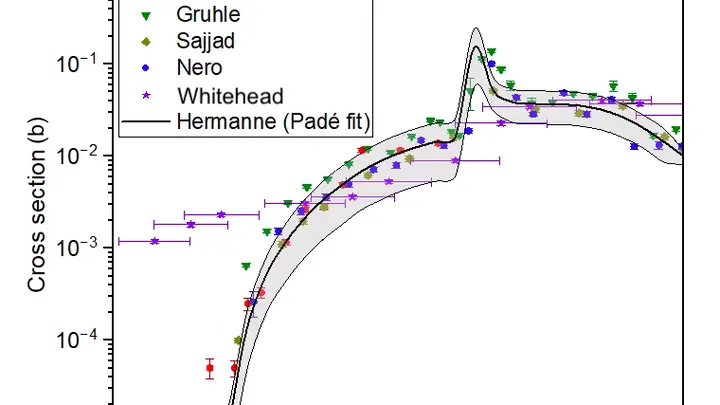
Deep inside a dying star, just before it goes supernova, nuclear reactions determine which chemical elements will be scattered across the cosmos. One such reaction is the collision of an oxygen nucleus with a proton, producing a nitrogen nucleus and an alpha particle (a helium nucleus).
Deep in the Galaxy, runaway stars are sometimes born. A monstrous force, a supernova explosion, flings them from their usual place. One such wanderer has recently been found: a star of the LP 40-365 class, a fragment of a white dwarf that survived an incomplete explosion.
The edge of the supernova remnant RCW 86 is where the shock wave from a star's explosion slams into the surrounding gas. The IXPE telescope looked at the southwestern part of this boundary in X-rays and tried to catch polarization — the way these rays oscillate.