Gamma Cephei: Revised Orbits and Limits on Hidden Companions ✛
Context
Gamma Cephei (γ Cep) is a bright, nearby red giant branch star known for over a century. It became one of the first targets in the search for exoplanets via radial velocities: in 1988 a planet was suspected, but the signal was later attributed to stellar activity. Only in 2003 was the planetary nature confirmed. The system is notable because the companion star γ Cep B lies just 20 AU from the primary, while the planet γ Cep Ab orbits at 2 AU. This is one of the closest binary systems with an S-type planet (the planet orbits one of the stars). The work fits into the broader study of planet dynamics in binary systems, alongside studies of brown dwarfs, moons, and mysteries of cosmic expansion, but stands out for its unprecedented observational baseline and joint analysis of all data types.
Methods
The authors compiled 532 radial velocity measurements from seven instruments over 45 years, including 328 new observations from Keck/HIRES, APF/Levy, McDonald/Tull, and Whipple/TRES. They added 16 epochs of relative astrometry, including eight new adaptive optics images from Keck/NIRC2, with the earliest image of γ Cep B obtained in 2003. Absolute astrometry came from the Hipparcos-Gaia Catalog of Accelerations (HGCA), providing the star's acceleration. The joint orbit fit was performed with the orvara code using parallel-tempered Markov chain Monte Carlo (ptemcee), with 30 parameters including masses, orbital elements, jitter, and instrument zero points. To search for additional planets, they ran injection-recovery tests with RVSearch and Lomb-Scargle periodogram analysis.
Results
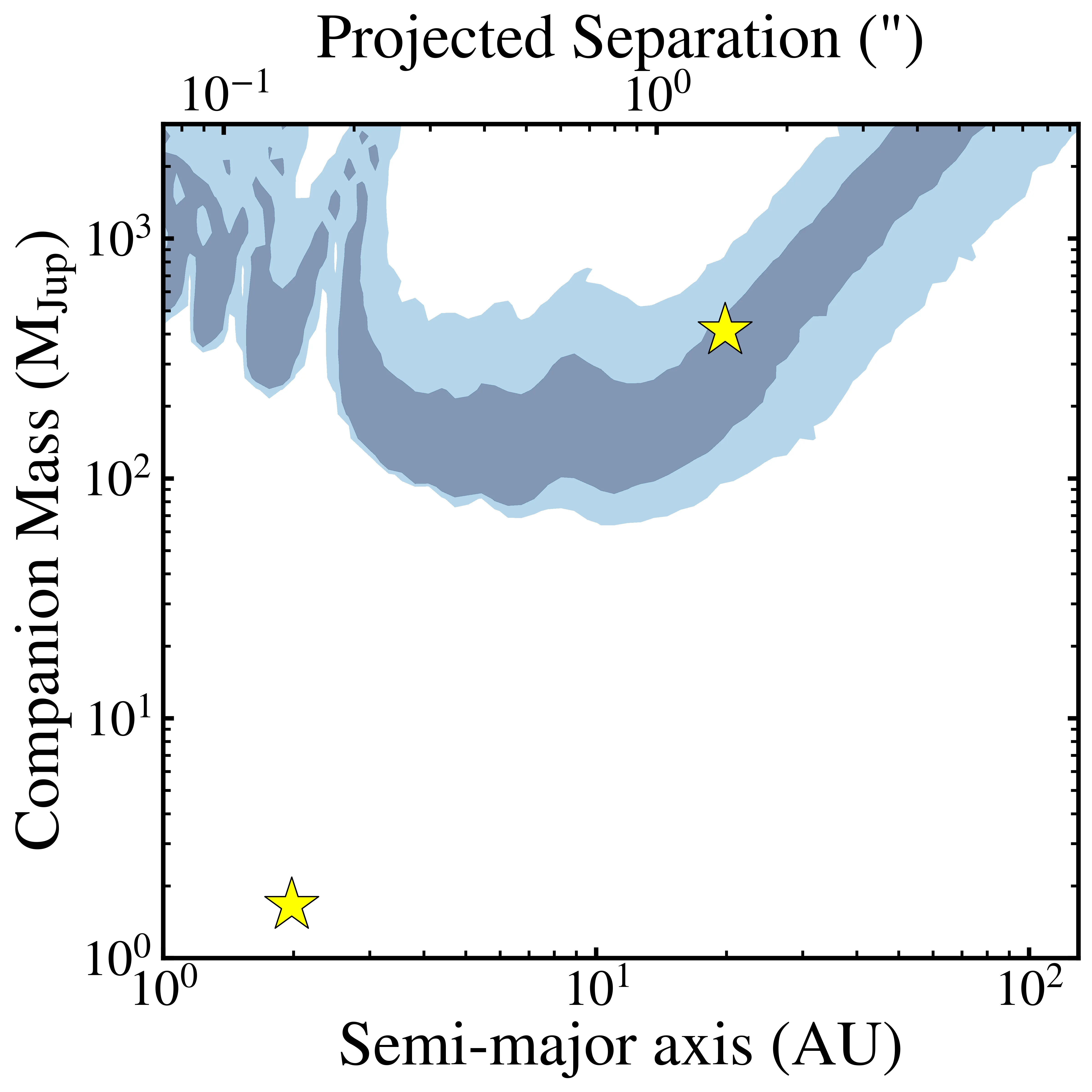
For the stellar companion γ Cep B: semimajor axis 20.07 ± 0.06 AU, mass 415 ± 2 Jupiter masses (0.396 ± 0.002 solar masses), eccentricity 0.422 ± 0.002, inclination 119.8 ± 0.1 degrees. The orbital period is 69.9 ± 0.4 years. For the planet γ Cep Ab: semimajor axis 1.978 ± 0.007 AU, minimum mass 1.62 (+0.04/−0.04) Jupiter masses, eccentricity 0.07 (+0.03/−0.03), period 2.475 ± 0.002 years. The planet's orbital inclination remains poorly constrained (90 ± 40 degrees), preventing determination of the mutual inclination. Parameter precision improved by a factor of 2–10 compared to previous works. Injection tests showed 50% sensitivity to planets with masses around 130 Earth masses at a period of 100 days and to 5 Jupiter masses at a period of 28 years. No additional Jupiter-like companions between 2.5 and 20 AU, nor bodies more massive than Neptune within 1 AU, were detected with confidence above 90%.
Implications
This work refines the dynamical architecture of one of the benchmark systems with a planet in a close binary. Unlike neighboring studies that often rely on a single method or short time span, here radial velocities, relative and absolute astrometry are combined over decades, yielding masses with fractional precision. This is the first test for γ Cep with such a long baseline: previously the binary period was estimated at 58 years, now it is about 70 years, changing the picture of stability. The absence of additional giants supports the dynamical sculpting scenario, where the close companion limits the formation and survival of other planets. The derived mass of γ Cep B (0.396 solar masses) serves as a test for empirical mass-luminosity relations for M dwarfs: it agrees with the Benedict et al. (2016) relation and slightly disagrees with Mann et al. (2019).
Future development
A key step is measuring the planet's orbital inclination γ Cep Ab with high precision. This will determine its true mass and the mutual inclination with the companion star's orbit, which is critical for testing the von Zeipel-Lidov-Kozai mechanism. The fourth Gaia data release (DR4) is expected to provide astrometry with 10 times better precision, which should pin down the inclination. Additional adaptive optics images in the 2040s–2050s will improve the orbit of γ Cep B. Future observations with extremely large telescopes might directly image the planet.
Impact
The results will impact statistics of planets in binary systems, models of planet formation and evolution, and calibration of mass-luminosity relations for low-mass stars.
Next steps
Wait for Gaia DR4 and perform a joint fit with new astrometric measurements. Continue radial velocity monitoring to search for long-period signals.
Key open problems
This work is directly connected to the unsolved problem of formation and long-term stability of planets in close binaries. The absence of additional giants confirms that the dynamical influence of the stellar companion strongly constrains the system architecture, but the specific mechanism (disk truncation, eccentricity excitation, scattering) remains debated. The precise mutual inclination, not yet measured, is needed to test the hypothesis of migration via the Kozai-Lidov mechanism.
The knowledge machine's view
This section is addressed to the author of the paper and their colleagues. Neighbouring works were found by meaning-based search across our archive, not by word overlap. We do not review: we show the field around the work.
What the work does
The authors combined 45-year-long radial velocity series with relative and absolute astrometry to jointly determine the orbits of the stellar companion γ Cep B and the planet γ Cep Ab. They obtained precise masses and orbital elements: for B, a semimajor axis of about 20 AU, a mass of 0.396 M⊙, and an eccentricity of 0.42; for the planet, a minimum mass of 1.62 M_J and a period of 2.475 years. Injection tests constrained the presence of additional planets over a wide range of masses and distances.
Where its strength is
This work demonstrates the power of long-term combined analysis of heterogeneous data: parameter precision improved by a factor of 2–10, which allows a reliable determination of the dynamical architecture of a system with a close stellar companion.
Where it could go next
- It might be interesting to compare the obtained constraints on additional companions with Gaia results on the brown dwarf 'desert' in binary systems: our archive includes a review discussing the lack of such objects at intermediate orbits.based on: Dance of the Invisible Giants: Gaia Finds a 'Desert' of Brown Dwarfs arXiv:2601.03539v1
- Since γ Cep B itself could be a binary star, it is worth considering the possibility of a hierarchical triple configuration: there is a nearby paper on a stellar companion hiding a secret binary, where a similar scenario was tested.based on: A Star’s Companion Hides a Secret Twin arXiv:2604.03767
- To refine the mutual inclination of the planet and stellar companion orbits, one could use approaches from the paper on a binary star within a binary star, where the mutual orientation of orbits in multiple systems was analyzed.based on: A Double Star Inside a Double Star arXiv:2603.09489
Worth trying
- Check whether the planet's orbit remains stable if γ Cep B has a close companion, using the method from the paper on a hidden binary.
- Apply injection-recovery tests to simulated data with a brown dwarf on a 5–15 AU orbit to assess how sensitive current data are to such objects in the 'desert' zone.
- Investigate the evolution of mutual orbital inclination in the system under tidal effects and relativistic corrections, comparing with results for other close binaries.
Why this may matter
Refining the dynamics of γ Cep is important as a benchmark for models of planet formation in close binary systems: constraints on additional bodies and precise masses allow testing scenarios of migration and survival of giants in a perturbed environment.
Nearby works in our archive
- The Mystery of Gamma Cassiopeiae: Half a Century to Solve the X-ray Phantomsimilarity 0.55
- The Pulse of Cepheids Without a Spectrographsimilarity 0.51
- Cosmic Mirages: What Was Really Behind the 'Dyson Spheres'similarity 0.51
- A Star’s Companion Hides a Secret Twinsimilarity 0.51
- A Double Star Inside a Double Starsimilarity 0.51
- A Dance of Two Stars 57 Light-Years Awaysimilarity 0.49
- Dance of the Invisible Giants: Gaia Finds a 'Desert' of Brown Dwarfssimilarity 0.49
The archive is sparse around this work: the closest review is only 0.55, against a usual 0.64. It looks like few have drilled nearby.
Gamma Cephei is a star visible to the naked eye in the constellation Cepheus, and its companion is so close that from 2003 to 2026 the angular separation between the stars grew from 0.689 to 1.979 arcseconds.
Key numbers
- orbital period of the companion star: 69.9 ± 0.4 years
- mass of the companion star: 0.396 ± 0.002 solar masses
- semimajor axis of the planet's orbit: 1.978 ± 0.007 AU
- minimum mass of the planet: 1.62 (+0.04/−0.04) Jupiter masses
- eccentricity of the companion star's orbit: 0.422 ± 0.002