The Kepler telescope was a space observatory launched by NASA in 2009 to discover exoplanets, particularly Earth-sized planets in the habitable zone of their stars. It monitored over 150,000 stars in a fixed field of view, looking for periodic dips in brightness caused by a planet transiting in front of its host star. Kepler's mission fundamentally changed our understanding of planetary systems, revealing that planets are common and that many are unlike anything in our solar system.
History
The Kepler mission was proposed in the 1980s by William Borucki and launched on March 7, 2009. It operated until 2018, having discovered over 2,600 confirmed exoplanets.
How it works
Kepler used the transit method: a sensitive photometer measured the brightness of thousands of stars every few minutes. A planet passing in front of its star blocks a tiny fraction of light, producing a periodic dimming. By analyzing the depth, duration, and timing of these dips, astronomers can infer the planet's size, orbital period, and sometimes even its atmosphere.
In practice
Kepler's data has been used to statistically estimate the frequency of Earth-like planets in the galaxy, guiding future missions like TESS and the James Webb Space Telescope in targeting promising systems.
Fun fact
Kepler's field of view covered only about 0.25% of the sky, yet it found thousands of planets, implying that there are likely billions of planets in our galaxy alone.
The family album of this stellar pair has been filling up for 45 years, but the pictures were blurry and the captions contradictory. Now astronomers have pulled out the old photographs, taken new sharp shots, and put everyone back in their proper places. Gamma Cephei is a bright star visible to the naked eye, and it has an invisible companion that orbits it every 70 years.
The night sky seems unchanging, but galaxies constantly exchange matter. The Milky Way, like a great river, absorbs smaller streams — dwarf galaxies. Along with their stars, planets may also come to us.
Tabby's Star, a beacon in the cosmic sea, has baffled astronomers since 2015. Its light flickered not in the rhythm of planets, but as if scattered by a storm — deep dips, sharp spikes. But amid this chaos, a smooth, nearly perfect dip was found. The eye of the storm.
Night on La Palma. The 4.2-meter William Herschel Telescope is aimed at Venus. At the focus is the experimental polarimeter ExPo, designed to catch the ghostly light of exoplanets.
The universe sounds with silence. The lion's share of matter — about 85%—remains invisible, manifesting only through gravity. Back when Vera Rubin Vera Rubin showed that galaxies spin as if wrapped in unseen mass.
When a distant planet passes in front of its star, it briefly blocks part of the light. Astronomers call this a transit and judge the planet's size by the depth of the dip. But light has a property: a massive body acts like a lens. Even a giant planet can slightly bend the star's rays, and the dip becomes a bit shallower than you might expect.
A spotlight blazes straight into your eyes, and a few steps away a tiny firefly flickers. That's roughly what it's like hunting for an Earth-like planet around a neighboring star: the planet is a hundred million to ten billion times fainter than its star, and in the sky they almost merge into a single point.
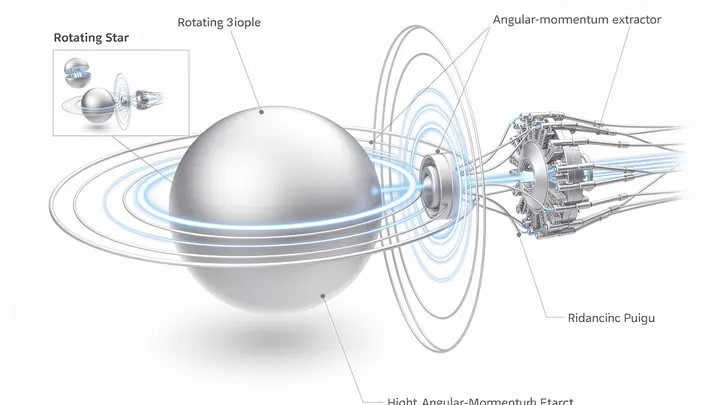
For decades, SETI has hunted for Dyson spheres — hypothetical shells that capture a star's light stars and re-radiate it in the infrared. But the cosmos remains silent. Perhaps an alien intelligence operates more elegantly: instead of collecting light, it tames the rotation of a sun, like a giant flywheel.
In the Galactic bulge, where the light of billions of stars merges into a continuous glow, four cold giants passed unnoticed. You can't see them through a telescope — too far, too dim.
The light of a distant star is no perfect beacon. Passing through the gravitational field of another star, it bends, splits, and magnifies, creating a fleeting Einstein ring in the sky. This is how gravitational microlensing manifests, predicted by Fritz Zwicky back in the 1930s.
Using James Webb, astronomers 'fished out' a third giant planet from the murky dust disk of the star β Pictoris. Two others were already known, but this one was hiding in the bright light, like a fish in muddy water.
A star's light curve is not chaotic noise, but a text written by pulsations, spots, and the steady glow of a thermonuclear furnace. Any planet slipping across the disk leaves a typo in this text: a tiny dip in brightness lasting hours.
When a planet slips behind the edge of its star, the star backlights the planet's atmosphere, just as a setting sun illuminates clouds on the horizon. This brief moment, lasting only minutes, carries the imprint of the gases through which the starlight has passed.
Neutron stars are the ultra-dense remnants of stars, where matter is compressed to the limit described by Subrahmanyan Chandrasekhar. Magnetars are a type of neutron star with a magnetic field a quadrillion times stronger than Earth's.
Deep in the Mediterranean Sea, where water presses down with the force of hundreds of atmospheres, a network of light-sensitive spheres waited for a rare guest. And it came — a neutrino that carried through the bulk of the Earth an energy comparable to the impact of a flying brick.
Searching for extraterrestrial signals is like trying to hear a whisper at a roaring stadium. The Green Bank Telescope listened to 70,000 stars, but 100 million bursts turned out to be earthly noise — from phones, satellites, microwave ovens.
Edwin Hubble and Georges Lemaître discovered the expansion of the Universe nearly a century ago. One way to test it is the surface brightness test: in an expanding cosmos, the light of a distant galaxy should fade like a pattern on a stretching film.
At the edge of the solar system, far beyond Neptune, hundreds of icy chunks circle the Sun. Some of them move as if an invisible hand had aligned their orbits like compass needles. Ten years ago, this led astronomers to suspect that a massive planet, about ten times heavier than Earth, is hiding there.
In 1987, astronomers saw a supernova flare up in a neighboring galaxy — the Large Magellanic Cloud. It was a rare gift: the explosion was close enough to catch not just light but also neutrinos, those nearly undetectable particles that pass straight through Earth.
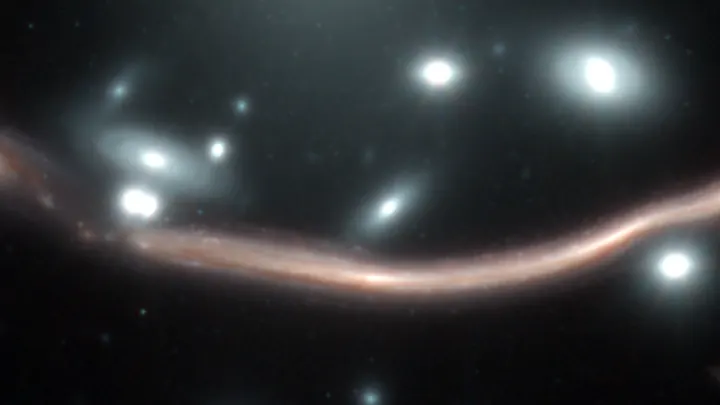
Light from the distant Dragon Galaxy has been traveling toward us for more than seven billion years. On its way, it passes by a huge galaxy cluster whose gravity bends the path of light like a lens. As a result, the galaxy appears brighter and larger than it really is, just as a magnifying glass enlarges fine print.
A handful of coins accelerates to one-fifth the speed of light. That's what Coracle interstellar probes will be like — tiny spacecraft weighing just a few grams, each with an ultrathin sail film. A powerful laser beam pushes them forward: light presses on the sail like wind fills a yacht's sails, except instead of air, it's a stream of photons.
A glowing cloud in a telescope looks like a wisp of fog about to dissipate. Planetary nebulae are gas shells cast off by dying stars. Young nebulae are bright and compact, but as they age, they expand, cool, and become increasingly transparent until they vanish into the interstellar medium.
The TESS telescope photographed the sky for a full year, but its standard pipeline skipped over dim stars. The T16 project took the same images and cleaned them from scratch — resulting in 83,717,159 light curves, like EKGs for every star. Planets passing in front of their star briefly dim it, and these dips in the EKGs are what we look for.
At the edge of the solar system, far beyond Neptune's orbit, something is knocking icy chunks off their paths. Their orbits are stretched and tilted in the same way, as if an invisible hand arranged them in a pattern.
For half a century, astronomers puzzled over the nature of the powerful X-ray emission from Gamma Cassiopeiae — a bright beacon in its constellation whose X-ray glow didn't fit models of single stars. An invisible companion was suspected, but direct evidence was lacking.
Galileo, legend has it, dropped balls from the Tower of Pisa to prove that heavy and light objects fall equally. This law formed the foundation of Einstein's theory of gravity. Today, scientists have turned an entire space station into such a tower.
The Kepler telescope spent years watching thousands of stars, spotting planets by the tiny dips in starlight when a planet passes in front of its star. Such a passage, or transit, lets us measure the planet's size but not the shape of its path.
The Gaia space telescope measures star positions with an accuracy of a microarcsecond, like spotting a coin on the Moon from Earth. In 2022, it noticed that the bright star HD 12800 was wobbling slightly, as if tugged by an invisible companion. Astronomers hypothesized that a planet orbits the star.
But a wobble can be deceiving.
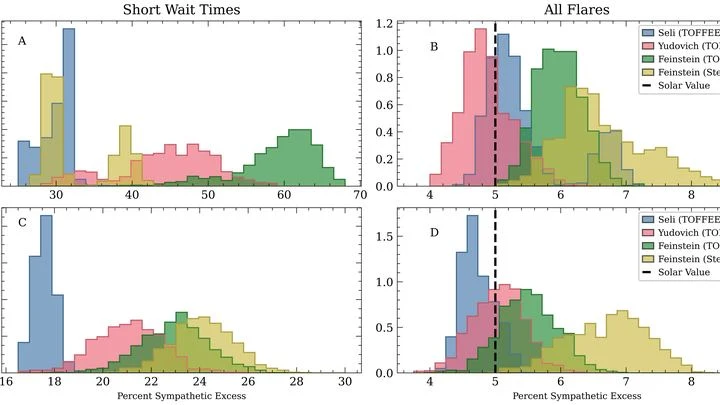
The Sun occasionally produces flares — powerful bursts of energy that last from minutes to hours. Most are random, like raindrops hitting a roof. But sometimes one flare seems to ignite another: the second begins almost immediately after the first, even though they occur in different locations. Astronomers call these sympathetic flares.
Astronomers caught the young planet AU Mic b in the act of hiding behind its star. The Spitzer telescope tracked its infrared glow: as the planet slipped behind, the system's total light dimmed slightly. The dip was just 171 parts per million, like a single drop of ink in ten buckets of water.
For ten hours, the star HD 137010 dimmed a little, like a lamp with a speck of dust on it. The K2 telescope caught this in 2017, and in all the observing time, it happened only once. Astronomers realized: a planet had passed in front of the star.
This way of finding worlds is called the transit method. When a planet crosses the star's disk, the star briefly fades.
The night sky is dotted with stars, and many of them have planets. But how do you spot a tiny dark disk against the glare of a distant sun? The Kepler telescope spent nine years watching hundreds of thousands of stars, waiting for a planet to pass in front of its star and briefly dim it. That 'wink' is the only way to find worlds like ours.
The merger of two neutron stars is like a strike on a gong: a ripple in space, a gravitational wave, spreads through the universe. Detectors on Earth catch this ripple and, from its strength, calculate the distance to the source.
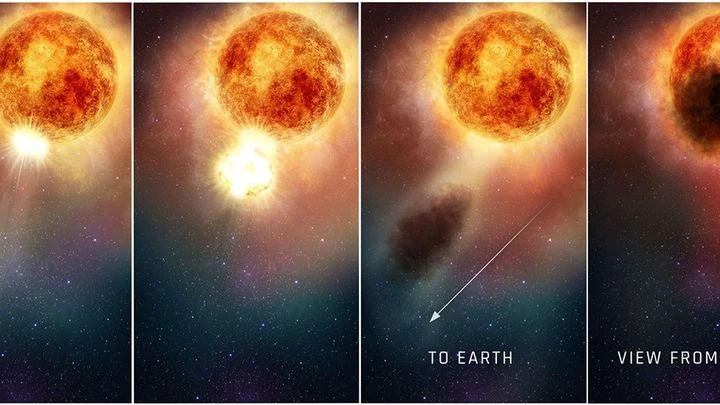
In 2019, Betelgeuse suddenly dimmed, sparking rumors of an imminent explosion. But clouds of cosmic dust turned out to be the culprit. Now, the Gemini North telescope has discerned a minuscule companion star in its dazzling glare, just as calculations had predicted.
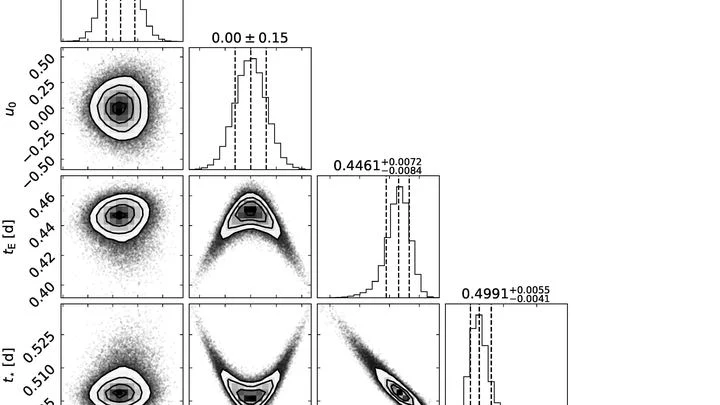
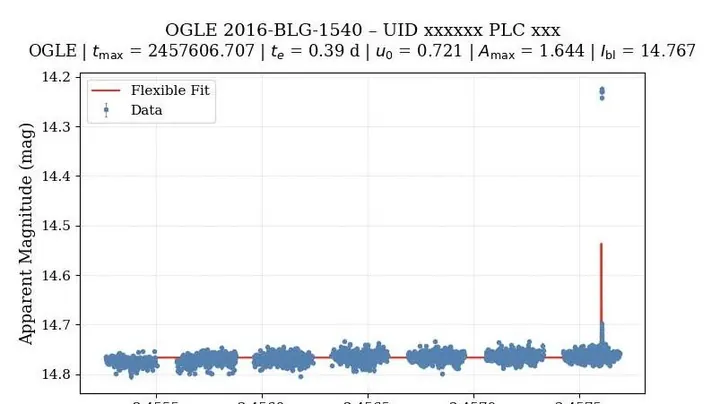
The lone planet KMT-2024-BLG-0816, one of many free-floating planets, was discovered when its gravity acted like a magnifying glass for a few hours. Passing in front of a distant star, the invisible body warped space like a glass marble, and boosted the background light.
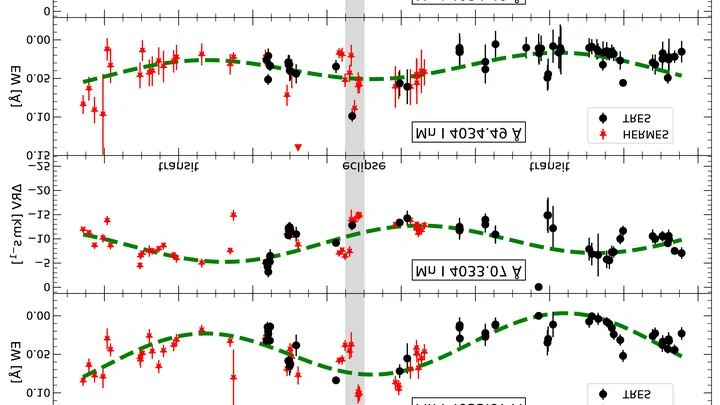
Betelgeuse is a giant star ready to explode as a supernova. But it may not be alone: a small companion star, Sivarkha, circles in a tight orbit. Every 2000 days, it plunges through Betelgeuse’s outer layers, like a boat cutting through water, leaving waves of superheated gas.
In the darkness of interstellar space drift millions of rogue planets — worlds not bound to any star. They are almost impossible to see, but when such a wanderer passes in front of a distant star, its gravity bends the light and momentarily creates a cosmic magnifying glass.
The Sun is not just a ball — it's a magnetic mansion. Its invisible force lines, like electrical wiring, thread through space and control space weather. But until now, we've only seen this wiring from the landing — the plane of Earth's orbit. The attic and basement, the magnetic poles, remained a mystery.
Picture a star waltzing with an invisible partner: its rhythmic wobble, caused by the gravitational pull of a companion, is picked up by instruments, yet the partner itself eludes detection. Usually, such wobbles are the result of a Doppler shift, a change in the frequency of light due to the star's motion, that betrays the presence of a planet.
The Comet Interceptor mission launches without a target. The spacecraft freezes at a point of space equilibrium, like a fighter jet on combat standby: engine warmed up, but takeoff only on alert.