Enzyme Courier in a Thick Gel: Who Sets the Pace ✛
A courier carrying a package enters a dense forest of intertwined ropes. He needs to deliver the cargo deep inside, but along the way he loses strength, and each step becomes harder. This is what an enzyme looks like as it degrades a dense gel of biological molecules. Until recently, no one could simultaneously see how the courier moves and how the forest thins out.
It turned out that the courier moves at the same speed regardless of how strong he is or how dense the forest is. His pace is set solely by the thermal motion of molecules. However, the boundary where the forest has already been felled advances more slowly than one would expect from simple penetration by the courier.
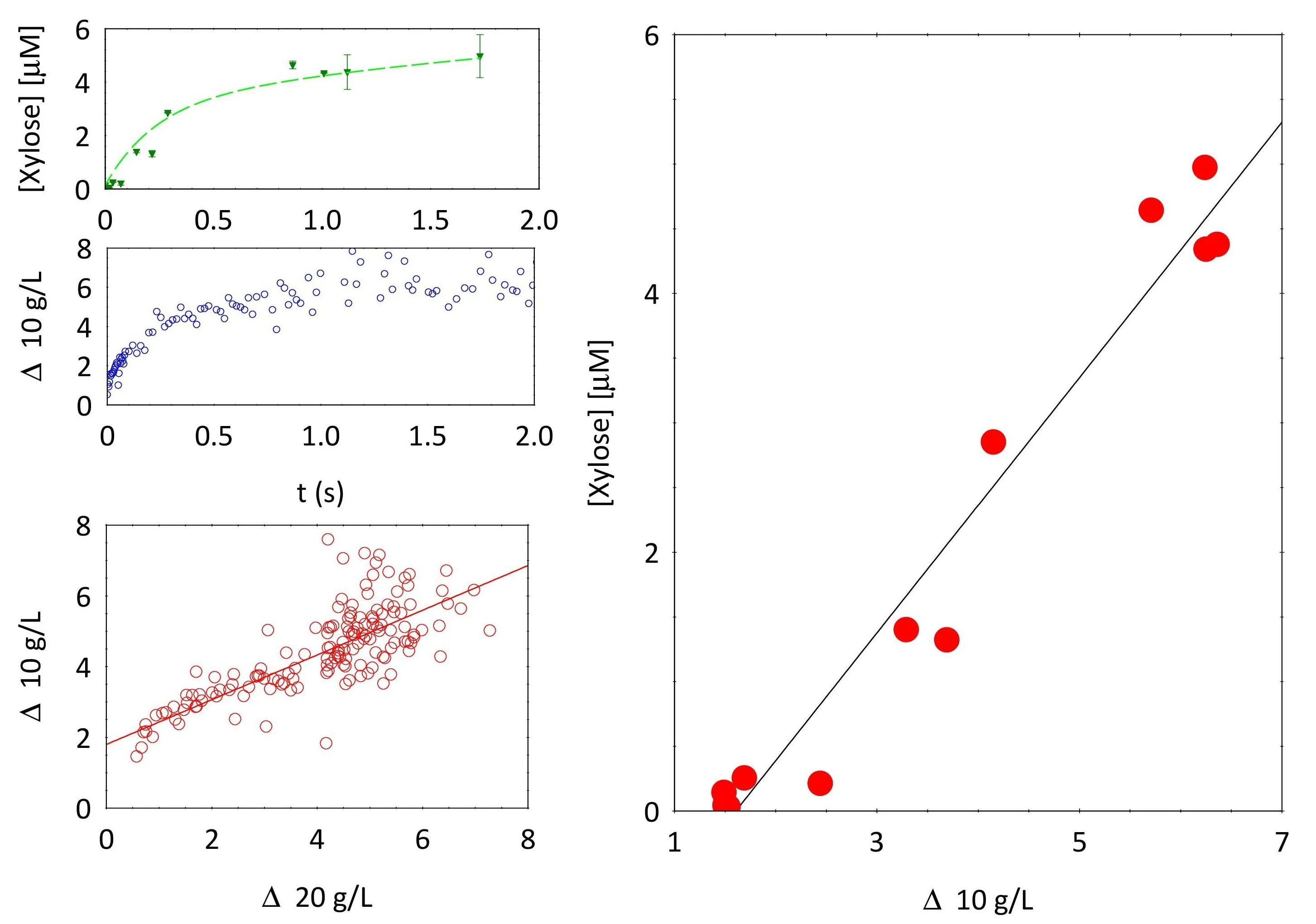
The reason is that the courier gradually runs out of breath. His activity decays via two exponentials: a large fraction is lost quickly, while a small fraction persists for a long time. It is this slow decay, not walking speed, that determines how quickly the forest melts away.
Previously, it was thought that gel degradation might speed up enzyme movement, but that did not happen here. The courier gets no tailwind from his own work. Now that both processes are measured together, we can more accurately calculate how much enzyme and which type is needed for converting biomass into fuel or for delivering a drug to a specific spot in the body.
The exponent of 0.5 in the front motion law for the wild-type enzyme initially suggested purely diffusion-controlled behavior, but data for the mutant with an exponent of 0.7 and modeling showed this to be a coincidence: the front actually slows down due to gradual loss of enzyme activity.