In 1913, German biochemist Leonor Michaelis and Canadian physician Maud Menten published an equation that became a cornerstone of enzymology. They studied the enzyme invertase, which breaks down sucrose, and noticed that the reaction rate depends nonlinearly on sucrose concentration. Michaelis and Menten proposed that the enzyme (E) and substrate (S) first form a complex (ES), which then breaks down into product (P) and free enzyme. This is like a checkout queue: customers (substrate) approach the cashier (enzyme), form a 'cashier-customer' pair, after which the customer leaves with goods (product), and the cashier is ready to serve the next one. The equation is derived from this model and gives the reaction rate v = (V_max * [S]) / (K_m + [S]). Here V_max is the maximum rate when all cashiers are busy, and K_m is the substrate concentration at which half the cashiers are occupied. Surprisingly, the equation works even for many enzymes whose mechanisms are more complex than this simple scheme.
History
In 1902, British chemist Adrian Brown proposed that an enzymatic reaction involves the formation of an enzyme-substrate complex. In 1913, Leonor Michaelis and Maud Menten, working in Berlin, mathematically formalized this idea and derived the equation using the assumption of rapid equilibrium between enzyme, substrate, and complex. In 1925, George Briggs and John Haldane improved the derivation by introducing the quasi-steady-state assumption for the enzyme-substrate complex concentration, which broadened the equation's applicability. Maud Menten, one of the first female physicians in Canada, also contributed to histochemistry and protein electrophoresis.
How it works
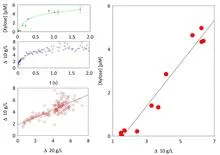
The Michaelis-Menten equation is widely used in biochemistry and pharmacology to determine enzyme kinetic parameters. In practice, the initial reaction rate is measured at various substrate concentrations, and a plot of v versus [S] yields a hyperbola. For accurate determination of V_max and K_m, linearizations are used, such as the Lineweaver-Burk plot (1/v vs. 1/[S]) or the Eadie-Hofstee plot. Limitations: the equation is valid for simple single-substrate reactions without cooperativity or allosteric regulation. For more complex cases, the Hill equation or models with multiple dissociation constants are used.
In practice
Calculating drug dosages and understanding how quickly the body metabolizes them. In biotechnology, it helps design efficient enzymes for producing cheese and detergents.
Fun fact
The Michaelis constant for different enzymes varies by millions of times. For example, for catalase, which breaks down hydrogen peroxide, K_m is about 1 mole per liter—the enzyme is ready to work even at enormous concentrations. But for hexokinase, which initiates glucose utilization, K_m is only 0.1 mmol/L—it becomes saturated even at low sugar levels.
Write down a recipe, then check it an hour later: if the proportions are off by even a gram, the taste is gone. Chemical reactions in open systems behave much the same way: the slightest difference in initial concentrations grows over time into completely different states.
A courier carrying a package enters a dense forest of intertwined ropes. He needs to deliver the cargo deep inside, but along the way he loses strength, and each step becomes harder. This is what an enzyme looks like as it degrades a dense gel of biological molecules. Until recently, no one could simultaneously see how the courier moves and how the forest thins out.
A protein in a cell doesn't hang motionless like a mannequin in a store window. Its atoms are constantly jiggling, stretching, and bending, like a plucked guitar string that keeps vibrating after you strum it. To understand how a protein works, you need to know how tightly each part holds onto its neighbors.
When sugar goes into tea, it dissolves. But why doesn't it just fall back out? It's all about chemical potential — a quantity that shows how 'favorable' it is for a substance to be in a given place and state. For a pure substance, it's easy to calculate, but for a mixture of several components, it's a real puzzle.
Hot water sometimes freezes faster than cold. Ice forms more quickly from boiling water. This paradox, discovered by schoolboy Erasto Mpemba, long puzzled physicists. It turns out: the farther a system is from equilibrium, the faster it relaxes back to it.
The Mpemba effect remains controversial today: too many variables, hard to reproduce.
A kitchen mixer runs at a single speed, but start jabbing the button and the mixture whips up differently. Chemical reactions behave much the same way when the rates of their individual steps are not constant but pulse over time.
Cooking a complex dish requires a clear recipe: first chop, then sauté, add spices at just the right moment. Chemical transformations also follow step-by-step recipes — mechanisms where atoms of carbon and hydrogen rearrange in a strict order.
Previously, neural networks often invented nonexistent steps, like a whimsical cook swapping salt for sugar.
A cell is like a library where thousands of books are copied every day. Molecular machines, polymerases and ribosomes, slide along a template chain and assemble a copy, link by link. These machines have several states: they can slow down, make mistakes, or switch. Previously, calculating such a process took hours.
A busy intersection without traffic lights. Cars drive, brake, and change lanes, and from the outside, it looks like complete chaos. But if you watch for a while, you can notice a rhythm: the flow thickens and thins. In physics, this rhythm of disorder is called entropy: it shows how far a system is from calm equilibrium, like water in a boiling kettle.
Imagine a factory where hundreds of tiny assembly lines run nonstop. Each line is a molecular motor that converts chemical fuel into motion. To make the motor go faster or in the right direction, an engineer tweaks the settings — the shape of parts, the strength of interactions.
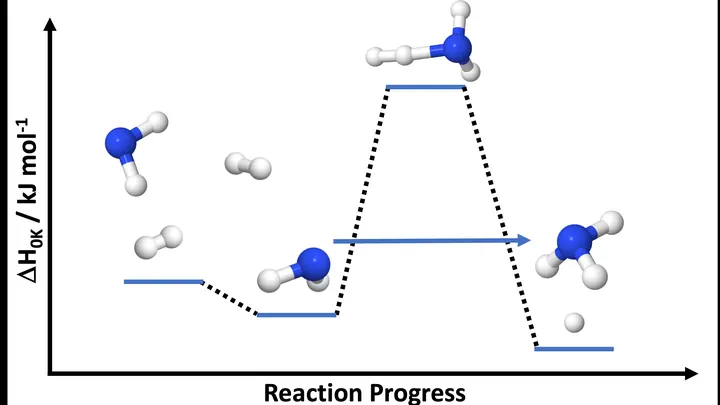
A ball rolls up a hill, but it doesn't have enough energy, so it rolls back down. That's classical mechanics for you. But in the quantum world, a tiny particle can sometimes pass right through the hill, as if the barrier weren't there. This trick, tunneling, is business as usual for a light atom like hydrogen.
When two atomic nuclei collide, the outcome depends on their energy and the angle at which the fragments fly apart. Typically, such calculations demand enormous computing power, and accuracy hits a wall due to approximations.
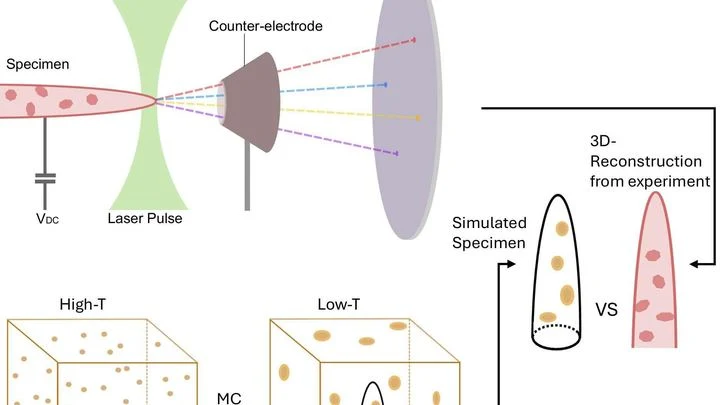
A seven-metal alloy is like a team where every player is pulling the blanket their own way. Atoms of iron, cobalt, nickel, aluminum, titanium, tantalum, and vanadium can either fall into a strict pattern or scatter into random positions. This determines whether the material will be as strong as steel or as light as aluminum.
When you stir sugar into a glass, the water seems to move every which way. But inside a chemical reactor with an impeller, the liquid isn't just churning: it forms hidden "islands" that barely exchange their contents. Scientists found a way to see these islands by following the paths of tiny particles.
Just as Water changes phase, freezing into ice or evaporating into vapor, forsterite, a key mineral of Earth's mantle, under pressures of hundreds of thousands of atmospheres, reassembles its crystal lattice.
Inside every muscle is a team of rowers: myosin proteins that grab actin filaments, take a stroke, and let go. The fuel for the stroke is the ATP molecule. When the rowers work in sync, the muscle contracts and the body moves.
For decades, two models existed: one explained why the boat moves slower with increasing load, the other — how the rowers move their arms.
In a heart-lung machine, blood flows through narrow tubing and past rapidly spinning pump blades. Sometimes red blood cells can't take it: their membranes rupture, and hemoglobin spills into the plasma. For a patient, this is like pouring sand into a car's fuel system — small damages accumulate and wreck the whole mechanism.
Inside a tiny accelerometer, gas behaves nothing like the air in a room. There are so few molecules that they rarely collide with one another, and the familiar laws of viscosity and thermal conductivity stop working.
An ordinary chemical reaction is like a ball rolling down a hill: it has one natural path. But if you place molecules in a tiny mirrored box, an optical microresonator, the light inside starts to interfere with the ball's motion. It can nudge it, hold it back, or even split its trajectory.
In a new study, physicists traced exactly how this happens.