Enzymes are biological catalysts, mostly of protein nature, that accelerate biochemical reactions by lowering the activation energy (the energy barrier that must be overcome to start a reaction). They have high substrate specificity and work under mild conditions (temperature, pressure, pH) typical of living systems. Enzyme activity is regulated by inhibitors and activators.
History
The history of enzyme study began with work on fermentation: Louis Pasteur in the 1850s believed enzymes were inseparable from living cells, while Eduard Buchner in 1897 proved the possibility of cell-free fermentation (Nobel Prize 1907). James Sumner in 1926 first crystallized an enzyme (urease) and proved its protein nature. In the 1960s, the three-dimensional structures of the first enzymes were determined using X-ray crystallography.
How it works
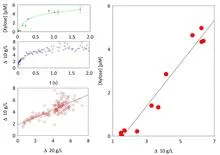
The enzyme binds the substrate in the active site, forming an enzyme-substrate complex, stabilizes the transition state, lowering the activation energy. After the reaction, the product is released, and the enzyme returns to its original state. The Michaelis-Menten kinetic equation describes the dependence of velocity on substrate concentration.
In practice
Enzymes are used in laundry detergents to remove stains at low temperatures, in cheese and bread production, and in medicines to dissolve blood clots.
Fun fact
The enzyme catalase, found in our liver, breaks down hydrogen peroxide at a rate that, if working at full power, could fill more than half a million liters of water with bubbles in one second.
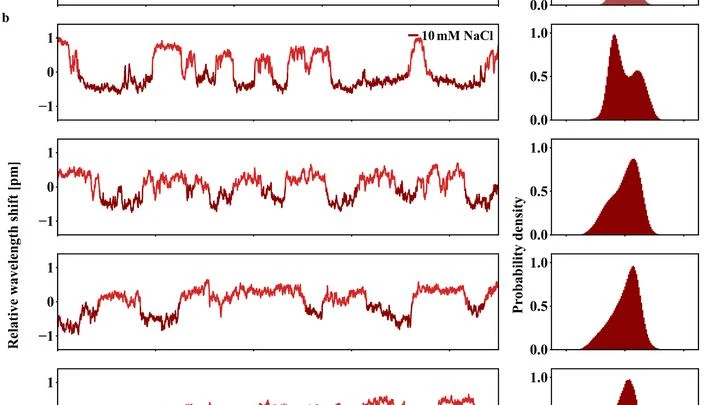
A courier carrying a package enters a dense forest of intertwined ropes. He needs to deliver the cargo deep inside, but along the way he loses strength, and each step becomes harder. This is what an enzyme looks like as it degrades a dense gel of biological molecules. Until recently, no one could simultaneously see how the courier moves and how the forest thins out.
Hot water sometimes freezes faster than cold. Ice forms more quickly from boiling water. This paradox, discovered by schoolboy Erasto Mpemba, long puzzled physicists. It turns out: the farther a system is from equilibrium, the faster it relaxes back to it.
The Mpemba effect remains controversial today: too many variables, hard to reproduce.
Inside every cell, logistics is in full swing: tiny protein motors, like couriers, haul cargo along a network of microtubules. One of the main workhorses is kinesin, which steps using the energy of ATP (the cell's main energy currency). For a long time, researchers tried to evaluate it like a car: how much fuel it burns, how fast it gets there.
A kitchen mixer runs at a single speed, but start jabbing the button and the mixture whips up differently. Chemical reactions behave much the same way when the rates of their individual steps are not constant but pulse over time.
A protein in a cell is not a frozen sculpture but a restless mechanism. Its parts are constantly vibrating, and these movements determine how it grabs molecules, transmits signals, or builds the cellular scaffold. But filming the life of a single protein was hampered by two nuisances at once. First, the movements last millionths of a second — ordinary cameras simply cannot catch them.
Cooking a complex dish requires a clear recipe: first chop, then sauté, add spices at just the right moment. Chemical transformations also follow step-by-step recipes — mechanisms where atoms of carbon and hydrogen rearrange in a strict order.
Previously, neural networks often invented nonexistent steps, like a whimsical cook swapping salt for sugar.
Imagine a packed subway car at rush hour. Passengers don't just stand there: they breathe, release moisture, squeeze toward exits, and sometimes get stuck in doors, blocking movement. Now imagine these passengers can remodel the car's walls, add handrails, or turn the floor into gel.
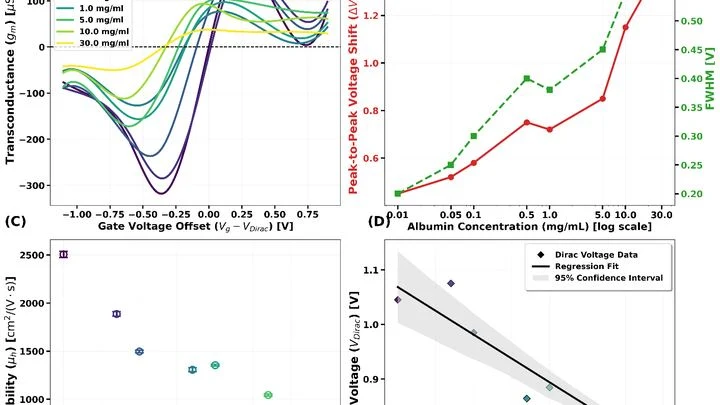
In a drop of blood float millions of albumin molecules — the main transport protein. Its level drops in kidney and liver diseases, so doctors need a fast and accurate way to measure it. Engineers have proposed a detector the size of a dust particle: a graphene transistor that works directly in liquid.
Graphene is a sheet of carbon one atom thick.
A torn telephone wire is a nuisance, but a torn DNA is a catastrophe. A double-strand break, when both strands of the helix snap at the same spot, threatens the cell with death or transformation into cancer. Fortunately, the cell has its own 'glue': special proteins that gather into a droplet right at the accident site.
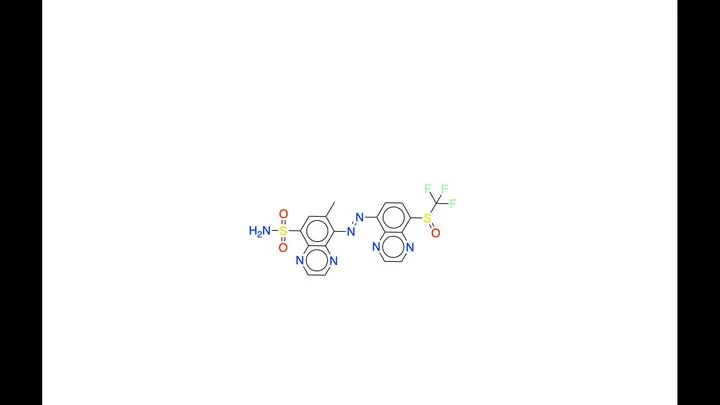
The light bulb turns on only in the room where you need it. That's roughly how photoactivatable drugs work: they 'switch on' only where light is directed, leaving the rest of the body untouched. This is especially important in cancer treatment: conventional chemotherapy hits all dividing cells indiscriminately, causing severe side effects.
Long protein threads, their tangled entanglements, and random contacts: this is how the birth of cellular droplets was usually explained. These membrane-less organelles, where important reactions take place, resemble oil drops in water: they arise on their own when molecules separate into phases.
Inside a cell, there are tiny liquid droplets, like oil droplets in water. They form from proteins and RNA and serve all sorts of purposes, from storing molecules to speeding up reactions. But if droplets start merging with each other, you'd end up with one big puddle, which would wreck the cell's organization.
Inside every cell, there is a scaffold of filaments, like construction scaffolding that gives the cell its shape and allows it to move. These filaments are connected by crosslinking proteins: some simply hold them together like ropes, while others act as tiny motors that crawl along the filaments and pull them toward each other.
Searching for a new drug is like matching a key to a lock. The protein in a cell is the lock, and the candidate molecule is the key. You need to know whether the key fits and how snugly it sits. Previously, the computer would examine every atom in the lock and the key to check this. A single lock could take hours or even days. Checking millions of keys was out of the question.
A chemist searching for a new drug is like a cook without a recipe: they have a list of desired properties but millions of possible ingredients. Each trial is costly and time-consuming, so you need to experiment wisely.
The new program SEISMO acts like a chef who tastes the dish after every step and immediately decides what to add next.
Tiny particles that look like flowers can do two things at once: heat up and tell you how hot they are. This isn't science fiction: it's the result of working with nanoparticles made of cobalt ferrite, a magnetic material that responds to magnetic fields.
An ordinary chemical reaction is like a ball rolling down a hill: it has one natural path. But if you place molecules in a tiny mirrored box, an optical microresonator, the light inside starts to interfere with the ball's motion. It can nudge it, hold it back, or even split its trajectory.
In a new study, physicists traced exactly how this happens.
Inside a living cell, there are tiny liquid droplets where proteins gather together, like ingredients in a drop of vinaigrette. Some proteins form the droplet's scaffold, while others, clients, don't create the droplet themselves but happily jump in and change its composition.
In every handful of fertile soil, there are bacteria that do something no factory can: they take nitrogen straight from the air and turn it into fertilizer. The secret lies in the enzyme nitrogenase, and its working core, a cluster of iron and molybdenum atoms, looks like a tiny factory floor.
Chemists have long tried to understand how this factory works from the inside.