Terawatt Pulses in Two Cycles: an Ytterbium Laser Compressed to the Limit
Context
This work sits at the intersection of two research directions: on one hand, neighboring studies (e.g., [2606.07147] and [2605.17491]) develop post-compression methods in multipass cells for various laser systems; on the other, laser-plasma acceleration demands ever shorter and more powerful pulses. Ytterbium lasers are attractive for their high average power and scalability, but their native pulses are too long (hundreds of femtoseconds) for direct use in acceleration. Post-compression has therefore become a key step. This work fills a gap: previous demonstrations either achieved sub-two-cycle duration at lower energy or higher energy at longer duration, but did not combine both parameters at kilohertz repetition.
Methods
Pulses from a commercial MAGMA25 laser (18 mJ, 400 fs, 1 kHz) were sent through two successive multipass cells. The first cell (Herriott-type) is filled with argon at 140 mbar and provides 29 passes; the second (matrix-type) is filled with helium at 500 mbar and provides 9 passes. Spectral broadening via self-phase modulation in the gas was accompanied by dispersion compensation with chirped mirrors: nine mirrors compensated -1800 fs² after the first cell, and a pair of additional mirrors -120 fs² after the second. For diagnostics, d-max (temporal profile measurement), an imaging spectrometer (spatio-spectral homogeneity), and a beam profiler (focal spot) were used.
Results
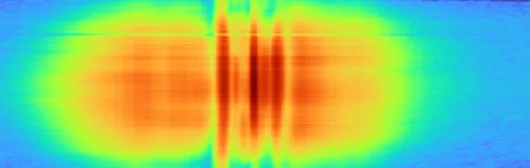
After two-stage compression, the pulse duration was 6.2 fs (1.8 optical cycles at 1030 nm), the energy was 12.5 mJ, giving a peak power of 1.4 TW. The compression factor reached 65. Spatio-spectral homogeneity is high: the V parameter exceeds 95% at the 50% level of maximum intensity and 90% for spectrograms. The focal spot measures 5.8 μm × 5.4 μm, with 83.4% of the energy contained within the 1/e² ellipse. The peak intensity is estimated at 1.2×10¹⁹ W/cm², corresponding to a0 = 3.0. Pointing stability was 0.18 μm (about 3% of the beam diameter) over 18 minutes.
Implications
This work demonstrates that a commercial ytterbium laser can be turned into a source of terawatt sub-two-cycle pulses using a relatively compact two-stage scheme. Unlike neighboring works, where compression is often limited to a single cell or lower energies, here a record balance between duration, energy, and repetition rate is achieved for post-compressed ytterbium systems. This paves the way for practical use of such lasers for high-repetition-rate laser-plasma electron acceleration, which is important for applications in medicine, non-destructive testing, and radiation sources.
Future development
Further shortening to a single cycle would require mirrors with octave-spanning reflection bandwidth or an additional compression stage for finer control of the spectral phase. Energy scaling is possible by using higher-order Laguerre-Gauss modes, which distribute the fluence more uniformly and allow bypassing the limit on peak fluence on the mirrors. Increasing average power will require mirror substrates with high thermal conductivity and active cooling.
Impact
Laser-plasma electron acceleration, generation of secondary radiation (X-rays, gamma rays), studies of ultrafast processes in matter.
Next steps
Perform high-dynamic-range temporal contrast measurements of the pulses to assess suitability for sensitive experiments. Investigate the possibility of using higher-order modes to increase energy without increasing the footprint.
Key open problems
For laser physics, a key unsolved problem remains the simultaneous achievement of extremely short duration, high energy, and high repetition rate without loss of beam quality. This work shows that two-stage post-compression in multipass cells can approach this limit for ytterbium lasers, but issues of thermal effects under power scaling and carrier-envelope phase control remain open.
A pulse of 6.2 femtoseconds is so short that light travels only 1.86 micrometers during it, less than the thickness of a human hair.
Key numbers
- Pulse duration: 6.2 fs (1.8 optical cycles)
- Pulse energy: 12.5 mJ
- Peak power: 1.4 TW
- Repetition rate: 1 kHz
- Normalized vector potential: a0 = 3.0