Crossings Where Roads Diverge Instead of Meeting ✛
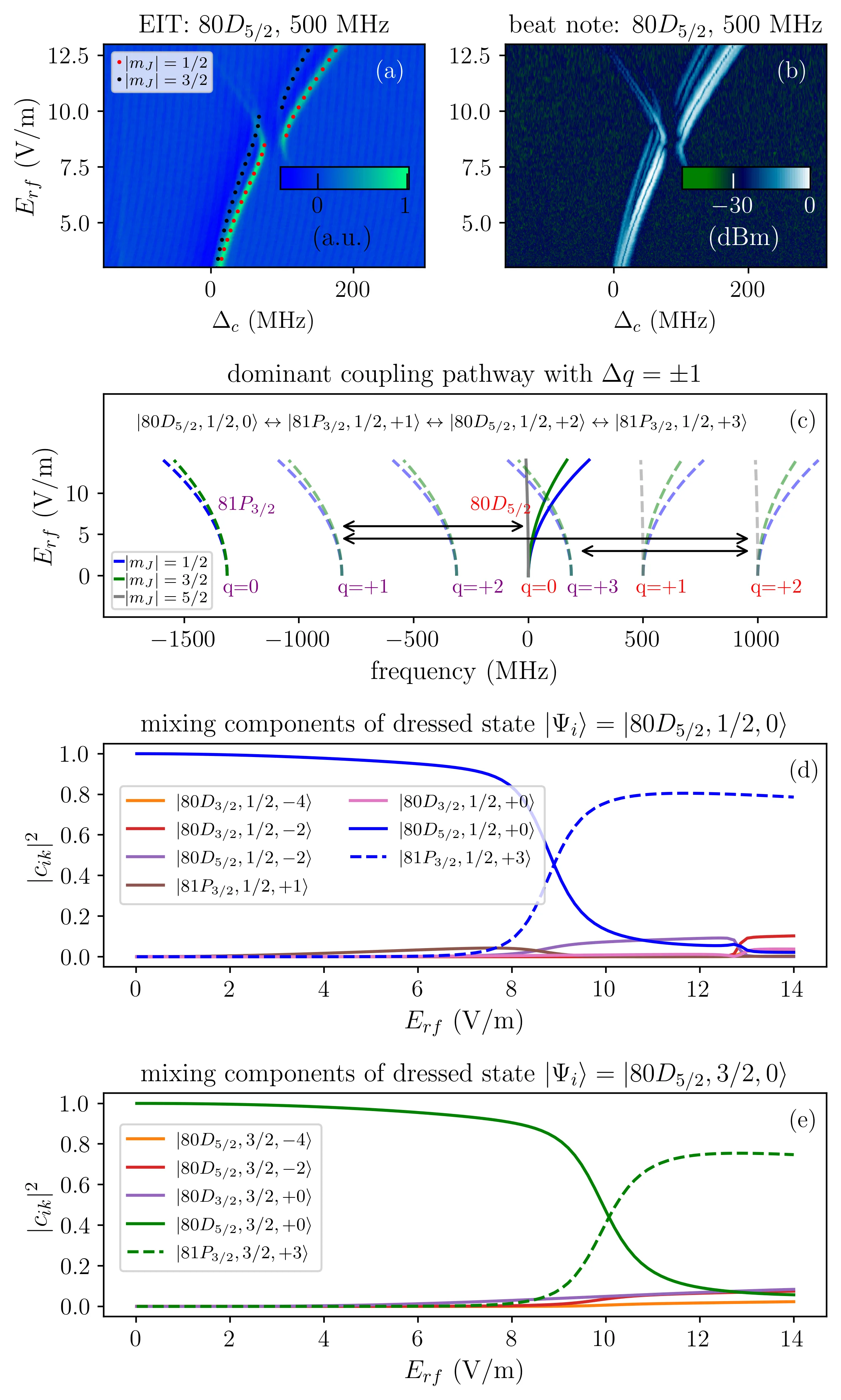
Two roads on a map converge at a single point, but drivers know there is no intersection there: one route passes over the other on a bridge. Energy levels of a Rydberg atom in a varying electric field behave in much the same way. As the field strengthens, the levels draw closer, but instead of merging, they repel and diverge, leaving a gap between them. Physicists call this behavior an avoided crossing, and in the spectra of cesium atoms it appears as a characteristic fork.
To understand what happens at these crossings, researchers placed pairs of cesium atoms in a small glass cell and irradiated them with lasers and radio waves. A Rydberg atom, with one electron on a very high orbit, is extremely sensitive to external fields. The varying field makes the energy levels tremble and split, like a string plucked with varying force. As a result, the spectrum seen by the detector fills with many lines, and among them appear those fork-like crossings.
The main question was not where these forks are located, but which invisible roads connect the levels to each other. It turned out that a direct path is often forbidden: the electron cannot jump from one orbit to another in a single leap; it must make several intermediate steps. These steps resemble transfers in the subway: to get from one line to another, sometimes you have to ride through a third station. In one case, crossing levels required three transfers, in another only two, and this determines how wide the gap at the crossing will be.
The researchers compared experimental spectra with calculations that included all possible paths with up to five transfers. The agreement was excellent but not perfect: some weak lines appeared in the experiment where the calculation did not predict them. This may be a consequence of stray electric fields that slightly distort the picture. Such sensitivity to interference is not a drawback but a hint: if we learn to account for it, the sensor will become even more accurate.
Crossings where roads diverge rather than meet turned out to be convenient landmarks for calibration. If you know at what field strength a particular fork appears, you can measure unknown fields simply by observing the spectrum. A Rydberg atom becomes a ruler with divisions marked by nature itself. And the better we understand how these divisions are arranged, the more accurately we can measure electric fields in a wide range of conditions, from the laboratory bench to open space.
Avoided crossings in Rydberg spectra can serve as natural calibration markers: their position on the field-strength scale is known with high precision, allowing them to be used for self-calibration of atomic sensors without external references.