Rydberg State Crossings: Floquet Analysis of Avoided Crossings ✛
Context
Rydberg atoms with large principal quantum numbers are extremely sensitive to external electric fields, making them a platform for precision electrometry and quantum sensing. In the non-resonant probing regime using Stark shifts, as the radio-frequency field amplitude increases, the interaction between neighboring Rydberg levels gives rise to a rich Floquet spectrum with numerous avoided crossings. These crossings occur when two Floquet states approach resonance and couple via a non-zero electric dipole interaction, leading to level repulsion and coherent hybridization. Although the positions and overall structure of avoided crossings have been described previously, their interpretation has often been limited to identifying spectral features without revealing the state composition and coupling pathways. This work stands alongside studies that use Floquet spectra to describe radio-frequency-modulated Rydberg states, but it differs by focusing on the evolution of eigenstates rather than just energy maps.
Methods
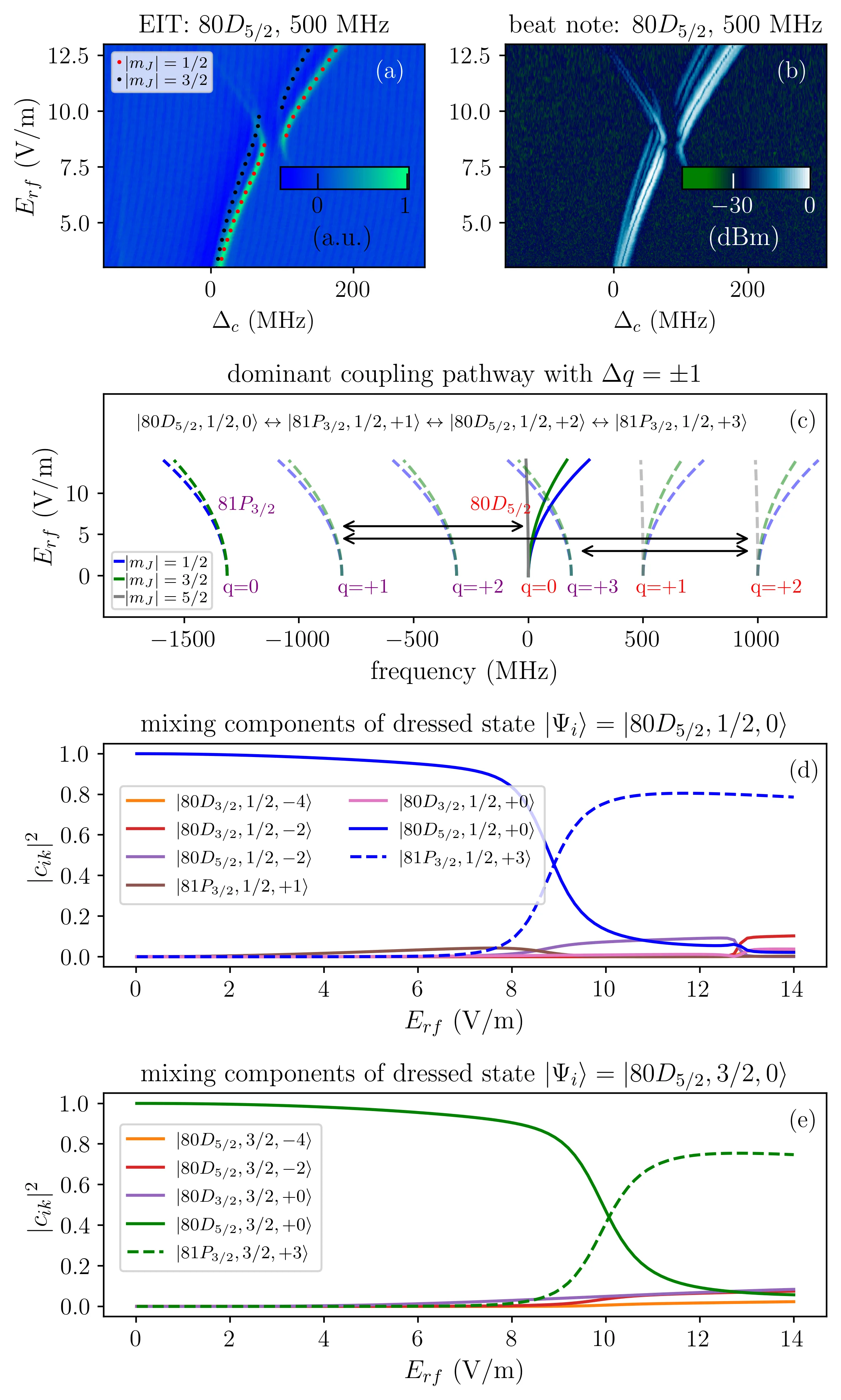
The experimental setup included cesium vapor in a cylindrical cell with a diameter of 25 mm and a length of 75 mm at room temperature, placed inside an open transverse electromagnetic cell (TEM cell). Two-photon excitation of the Rydberg state was performed with counter-propagating probe and coupling lasers with linear polarization aligned with the radio-frequency field. Two radio-frequency sources (signal and local oscillator) with a frequency offset of 200 kHz created beat notes detected in the transmitted probe beam. EIT spectra were recorded by scanning the coupling laser frequency and varying the radio-frequency field amplitude. For theoretical analysis, Shirley's method was implemented in the ARC package: the time-periodic Hamiltonian was transformed into an infinite-dimensional stationary matrix, including Floquet replicas with indices up to ±5 and states with principal quantum numbers within ±5 of the target. The eigenvectors of this matrix provided the contributions of Floquet basis states to the dressed states.
Results
Experimental EIT spectra for the 80D5/2 state at 500 MHz, 60D5/2 at 200 MHz, and 80D5/2 at 50 MHz showed excellent agreement with Shirley-method calculations. Analysis of the evolution of basis-state contributions revealed three distinct mechanisms for avoided crossings. For 80D5/2 at 500 MHz, the crossing between |80D5/2, mJ=1/2, q=0⟩ and |81P3/2, mJ=1/2, q=+3⟩ arises via a third-order coupling at a field of about 8.8 V/m, and for mJ=3/2 at 10 V/m. For 60D5/2 at 200 MHz, the crossing is due to a second-order coupling between |60D5/2, mJ=3/2, q=0⟩ and |60D3/2, mJ=3/2, q=+2⟩ at a field of about 33 V/m through an intermediate P state, since the direct dipole transition between D states is forbidden. For 80D5/2 at 50 MHz, a weak crossing was observed for mJ=3/2 via the path |80D5/2,3/2,+0⟩ ↔ |81P3/2,3/2,+1⟩ ↔ |80D5/2,3/2,+2⟩ ↔ |81P3/2,3/2,+3⟩ ↔ |80D3/2,3/2,+4⟩. The calculations did not reproduce the experimentally observed replicas q=−1 and q=−3 for mJ=1/2, which may indicate the influence of stray electric fields or other symmetry-breaking perturbations.
Implications
This work differs from neighboring studies by using Floquet eigenstate analysis, rather than just Stark energy maps, to uncover the physical mechanisms of avoided crossings. This allows identification of the order of the coupling process, intermediate states, and pathways leading to the crossing, which previously remained unclear. This approach explains why some resonances exhibit pronounced avoided crossings while others remain almost uncoupled due to weak effective coupling or selection rule prohibitions. It also shows that matching energy intervals alone does not guarantee a crossing if the direct dipole transition is forbidden.
Future development
Future research could extend the analysis to alternative laser and radio-frequency polarizations, states with higher angular momenta (l > 2), and the influence of magnetic fields on avoided crossings. This may open new possibilities for magnetometry and more precise control over dressed states. Also promising is the study of the influence of stray fields and symmetry violations on the appearance of additional Floquet replicas not reproduced by the current model.
Impact
The results impact Rydberg-atom-based precision electrometry, radio-frequency field calibration, and the development of quantum sensors, where avoided crossings can serve as calibration markers or limit operational ranges.
Next steps
The next step could be a systematic study of avoided crossings for a wide range of states and frequencies, incorporating stray fields and polarization imperfections into the model. It is also important to experimentally verify predictions about higher-order coupling pathways through selective excitation of intermediate states.
Key open problems
In the field of Rydberg electrometry, the complete description of spectra in strong radio-frequency fields remains an unsolved problem, where numerous crossings and replicas complicate interpretation. This work links observed features to specific coupling pathways and process orders, helping to address reliable calibration and extending the dynamic range of sensors.
The knowledge machine's view
This section is addressed to the author of the paper and their colleagues. Neighbouring works were found by meaning-based search across our archive, not by word overlap. We do not review: we show the field around the work.
What the work does
The study investigates avoided crossings in the EIT spectra of Rydberg cesium atoms shifted by an alternating Stark field. The authors applied the Shirley method to analyze Floquet eigenstates and linked the observed spectral features to the dynamics of dressed states. By tracking the evolution of state mixing and dominant higher-order coupling pathways, they identified the physical mechanisms behind the formation of avoided crossings at various principal quantum numbers and radio frequencies.
Where its strength is
The strength of this work lies in its use of Floquet eigenvector analysis to reveal the composition of dressed states and higher-order coupling pathways, which provides a detailed interpretation of avoided crossings that goes beyond a simple description of energy maps.
Where it could go next
- It might be interesting to see how Floquet eigenstate analysis methods apply to systems with periodic time modulation, where moiré time crystals arise, as in the work with two rhythms giving rise to a slow quantum wave.based on: How Two Rhythms Give Birth to a Slow Quantum Wave arXiv:2607.27999v1
- A related study uses radio-frequency fields to create an echo from an invisible object; perhaps the technique of tracking the evolution of dressed states could help interpret such experiments.based on: Echo of the Invisible Stone arXiv:2310.15936
- It could also be useful to compare the approach with a study that examines a paired dance of atoms enhanced by a push, to see how the interaction of neighboring Rydberg levels manifests in collective effects.based on: Atomic pas de deux, amplified by a jolt arXiv:2605.14909
Worth trying
- Test Floquet eigenvector analysis for predicting the positions and widths of avoided crossings in other atomic systems with strong coupling.
- Use the method to optimize radio-frequency field parameters for precision electrometry.
- Extend the model by including more states and Floquet replicas to check convergence and identify new coupling pathways.
Why this may matter
Understanding the mechanisms of avoided crossings in Rydberg atoms is important for the development of quantum sensors and devices that exploit sensitivity to external fields, as well as for controlling coherent dynamics in multilevel systems.
Nearby works in our archive
- Atomic pas de deux, amplified by a joltsimilarity 0.50
- Echo of the Invisible Stonesimilarity 0.50
- How Two Rhythms Give Birth to a Slow Quantum Wavesimilarity 0.50
- Atomic String and Harmony of Frequenciessimilarity 0.50
- NMR Radar for Invisible Moleculessimilarity 0.49
- How to See Invisible Fermions with Chameleon Atomssimilarity 0.49
The archive is sparse around this work: the closest review is only 0.50, against a usual 0.64. It looks like few have drilled nearby.
Avoided crossings in Rydberg spectra can serve as natural calibration markers: their position on the field-strength scale is known with high precision, allowing them to be used for self-calibration of atomic sensors without external references.
Key numbers
- Cell diameter: 25 mm
- Cell length: 75 mm
- Radio-frequency source offset: 200 kHz
- Field strength for 80D5/2 crossing (mJ=1/2): 8.8 V/m
- Field strength for 60D5/2 crossing: 33 V/m