Crosstalk is the unwanted coupling of signals between adjacent channels or components, where a signal in one circuit or transmission line leaks into another. In everyday terms, it is the 'bleed' you hear when a phone conversation picks up a faint second conversation, or the ghost image on a television screen caused by a reflected signal. In physics and engineering, crosstalk is a fundamental limitation in any system that packs many signal-carrying elements close together, from microchips to quantum processors.
History
The term originated in early telephone engineering in the late 19th century, when multiple conversations on adjacent wires would audibly interfere. Systematic study began with Oliver Heaviside's work on transmission lines in the 1880s.
How it works
Crosstalk arises through two main mechanisms: capacitive and inductive coupling. When two conductors run parallel, an alternating voltage on one creates an electric field that induces a charge on the other (capacitive coupling), while an alternating current creates a magnetic field that induces a current in the other (inductive coupling). The effect scales with frequency and proximity, so high-speed or high-frequency systems are especially vulnerable. In quantum devices, crosstalk can also occur through shared substrate vibrations or stray photons, causing unwanted interactions between qubits.
In practice
Crosstalk is a central design constraint in superconducting quantum chips, where it limits qubit coherence and gate fidelity; engineers use careful layout, shielding, and compensation pulses to minimize it.
Fun fact
In the 1950s, crosstalk in submarine telephone cables was so severe that engineers developed 'compandors'—compressors and expanders—that deliberately distorted the signal to mask the leak.
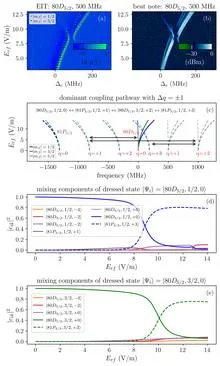
Two roads on a map converge at a single point, but drivers know there is no intersection there: one route passes over the other on a bridge. Energy levels of a Rydberg atom in a varying electric field behave in much the same way. As the field strengthens, the levels draw closer, but instead of merging, they repel and diverge, leaving a gap between them.
In an aquarium the size of a dining table, two schools of black neon tetras swim in adjacent compartments separated by a transparent wall. They cannot touch each other, but they see every movement. And here's the surprising part: when one school decides to turn left, the other does the same a moment later. It's like two pendulums hanging behind glass, starting to swing in rhythm.
If you clap your hands in an empty room, the echo will tell you about its size and shape. Every object (a chair, a book, a person) adds its own signature to this echo: sound reflects off it in a particular way. The authors of the paper have figured out how to completely rewrite this acoustic signature. They surrounded a region of space with a closed surface of microphones and loudspeakers.
Drop a pebble into a pond, and ripples spread across the water. Strike a bell, and it rings at its own frequency. When a black hole collides with another, it too 'rings'—except instead of sound, it's the trembling of space itself.
A quiet tube with a heated grid inside. The voltage on the grid is suddenly raised, and the tube starts to hum, sustaining itself. This is not a malfunction but a transition to another stable state, like a ball rolling over a hill into a neighboring hollow.
A quantum computer in the lab resembles an orchestra: lasers play the role of bows, and ions are the strings. To play the desired melody, powerful radio signals are sent to the lasers: they set the rhythm and pitch. But part of this "music" escapes the stage.
A crowd of people in a subway station moves slower than individuals: everyone gets in everyone else's way. A similar picture emerges in a dense cloud of magnetic atoms exchanging energy. Previously, it was thought that the transfer rate depended only on the atoms' own properties.
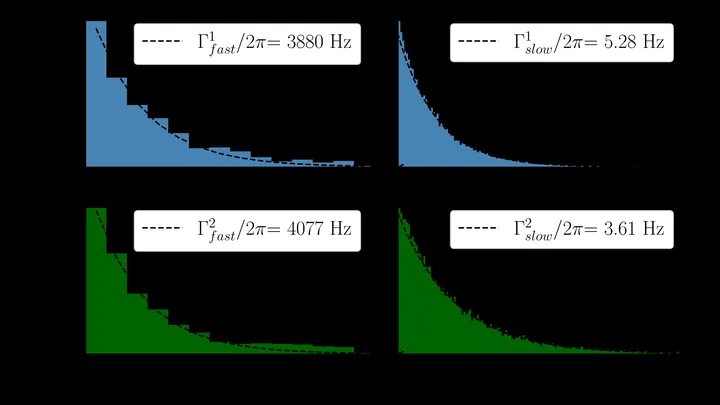
In the superconducting circuits that make up quantum computers, extra particles, quasiparticles, are born from time to time. They are like random passersby who barge into the processor's work and spoil the calculations.
Tuning a piano is delicate work. Strike one string, and its neighbors resonate. A silicon chip with crystal defects, being prepared for quantum computing, behaves similarly.
In a silicon carbide (SiC) crystal, there are special spots — silicon vacancies. There, an electron behaves like a tiny magnet with four states.