A phenomenon where excitation of one atom prevents excitation of its neighbors due to strong interactions.
11 related articles
Description
The Rydberg blockade is a collective effect in which atoms that have been excited into high-lying, or Rydberg, states prevent nearby atoms from being excited in the same way. A Rydberg atom is an atom with one electron promoted to a very large orbit, far from the nucleus. Such an atom is physically huge — its electron cloud can span hundreds of nanometres — and it is easily polarized, meaning its internal charge distribution shifts in response to nearby charges. When one atom in a small group is in this state, its shifted charge distribution changes the energy levels of its neighbours so strongly that the laser frequency used to excite the first atom no longer matches the transition for the others. The result is a hard limit: within a certain radius, called the blockade radius, only one atom can be excited at a time. This turns a loose cloud of atoms into a system with an all-or-nothing constraint, which is exactly the kind of constraint that makes a physical system useful for storing and processing information.
How it works
The mechanism is a shift in atomic energy levels caused by the interaction between two highly excited atoms. When two Rydberg atoms are close, the electric field from one atom's separated charges perturbs the other atom's energy levels. This interaction grows very rapidly as the distance between the atoms decreases — much faster than the usual inverse-square falloff of ordinary forces. Because the excitation laser is tuned to a precise frequency, any atom whose levels have been shifted by a neighbour simply does not absorb the light. The first atom to be excited therefore blocks the excitation of all atoms within its blockade radius. The radius itself depends on the strength of the interaction and on how precisely the laser is tuned: a narrower laser linewidth allows the blockade to extend further.
In practice
The blockade is used in neutral-atom quantum computers and simulators, where it allows a single laser pulse to create exactly one excitation in a group of atoms, and in experiments that generate single photons on demand.
Fun fact
The blockade radius can be larger than the wavelength of the light used to excite the atoms, so a single photon can be prevented from being absorbed by a region much wider than itself.
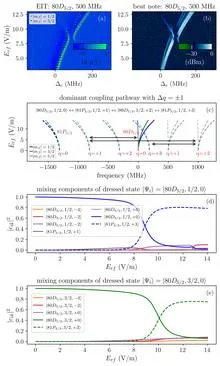
Two roads on a map converge at a single point, but drivers know there is no intersection there: one route passes over the other on a bridge. Energy levels of a Rydberg atom in a varying electric field behave in much the same way. As the field strengthens, the levels draw closer, but instead of merging, they repel and diverge, leaving a gap between them.
Rydberg molecules are like a pair of dancers holding hands at arm's length. One partner is an ion, the other is an atom, and the bond between them is as weak as an invisible thread. Such a pair can exist for only an instant, but that instant stretches into microseconds — an eternity by the standards of the microworld.
Two dancers on stage must move in perfect sync, but if one hesitates, the whole routine is ruined. That's roughly how quantum computers with neutral atoms work: two atoms are entangled by putting them into a Rydberg state (as huge as a balloon compared to an ordinary atom), and then you wait for them to 'dance' their part.
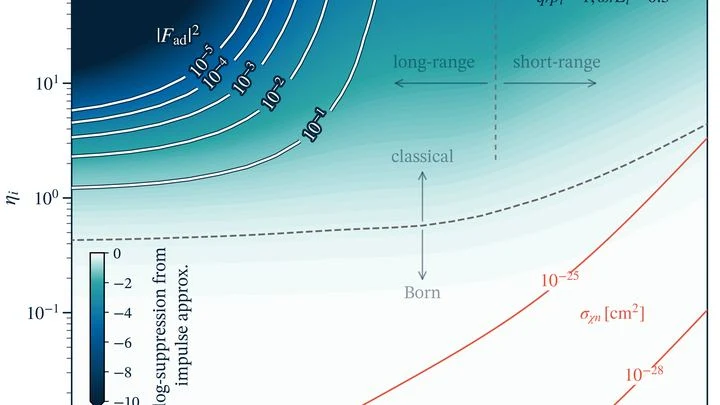
A billiard ball slams into another. Impact, and the balls scatter. But if the push is not sharp but very gentle, the balls just roll together without bouncing. An atom behaves much the same way when hit by a dark matter particle.
If you toss a handful of coins into a box with dividers, each coin lands in its own compartment and stays there forever. Roughly the same happens to atoms in a special optical lattice when excited by a laser. These atoms are called Rydberg atoms: one electron in each is promoted to a very distant orbit, making the atom sensitive to its neighbors.
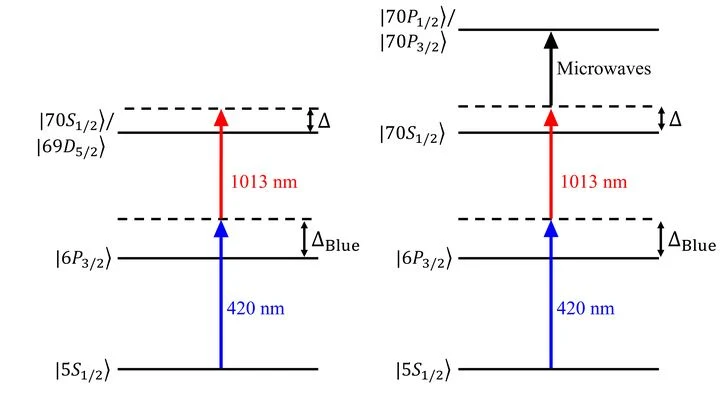
A laser is tuned to a frequency at which a rubidium atom normally does not get excited. But if an excited atom is already nearby, it shifts the energy levels of its neighbor, and the neighbor starts absorbing light. So the pair of atoms acts like a duo: one helps the other light up.
Imagine an orchestra where each musician plays their own part, and the conductor directs everyone at once. In a neutral-atom quantum computer, the laser beam plays the conductor, needing to hit its target precisely without wavering for a split second.
Imagine a tap that doesn't pour a stream but releases water strictly one drop at a time: that's the single-photon source the authors describe. In ordinary light, photons travel in a crowd, like water from an open tap.
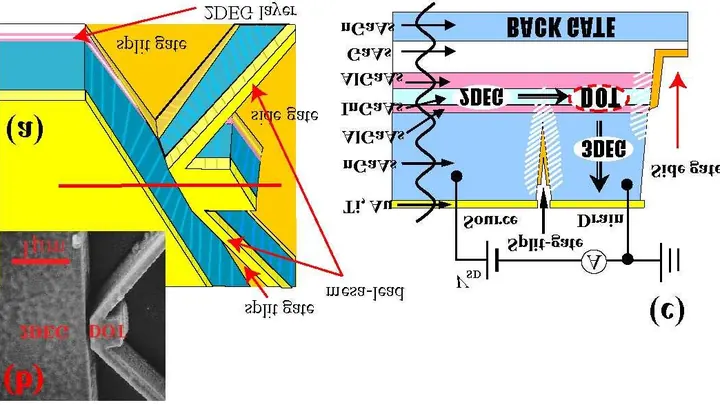
A quantum dot is like a tiny island where one or a few electrons can settle. In this new work, such an island was connected to two 'seas' of electrons: one flat like a pancake, the other bulky like an ocean. Electrons can hop from the island to the seas and back, and this hop depends on the shape of the electron's wave on the island.
In a tokamak, plasma is like a crowd on a narrow street: once someone starts running, everyone takes off at once. In a stellarator with a non-circular cross-section, the street is winding, with dead ends and pockets. The crowd can't gather into a single wave — people get stuck in different corners.
In the world of atoms, any external influence can turn a neat order into chaos. Usually, energy losses only increase entropy — a measure of disorder. But physicists discovered the opposite: sometimes losses help the system maintain stability.