The concept was introduced by William Rowan Hamilton in the 1830s as a reformulation of classical mechanics. It was later adapted into quantum mechanics by Erwin Schrödinger in 1925-1926, who used it to formulate his famous wave equation.
How it works
In quantum mechanics, the Hamiltonian is a mathematical operator that acts on the wavefunction. Its eigenvalues correspond to the possible energy levels of the system, and its eigenvectors are the stationary states. The time evolution of any quantum state is governed by the exponential of the Hamiltonian, which effectively 'rotates' the state in time according to its energy content.
In practice
The Hamiltonian is used in virtually all quantum physics calculations, from modeling atoms and molecules to designing quantum computers and simulating condensed matter systems.
Fun fact
In quantum computing, the Hamiltonian of a system can be engineered to solve optimization problems, a technique known as quantum annealing.
The interpreter in the meeting room hears the shift in tone before it is spoken aloud. They catch subtle changes in breathing, pauses, and intonations, and already know that in a few minutes the conversation will turn heated.
When a fluid flows around an obstacle, it spawns vortices and shock waves. Describing their behavior means solving a nonlinear equation in which the flow velocity depends on itself. Classical supercomputers spend days on this, while quantum computers have barely been used: their native language is linear operations, but fluids are inherently nonlinear.
In the first instants after the Big Bang, the universe expanded faster than light could cross it. Like an inflating balloon, but instead of rubber, it was space itself. On this balloon, ripples inevitably formed — tiny compressions and rarefactions from which all galaxies and stars later grew.
A quantum particle moves in a circle, passing through several stations. At each station, something happens to it — for example, its properties change slightly. After completing a full circle, the particle returns, but its state is no longer exactly what it was at the start.
In the big world, there's a simple rule: energy density can't be negative, and its flow can't outrun light. In a café, that would look like this: a waiter can't deliver orders faster than he can run. Physicists call this restriction the energy dominance condition.
But in the microworld, where quanta rule and spacetime can bend, energy starts acting up.
In a noisy hall, an interpreter tries to catch every word, but rustles and echoes muddle the meaning. That's roughly how conventional computer methods handle complex quantum systems: the more particles and the stronger their correlations, the faster calculations drown in interference.
The quantum world is tricky: sometimes particles confined to a flat layer and pierced by a strong magnetic field start behaving like a liquid made not of whole electrons but of their fractions — fractional charges. This is the fractional quantum Hall effect.
An optical trap holds an atom almost motionless, like a ball on a soft spring. But as soon as acceleration appears, say gravity, the equilibrium shifts. The atom moves within the standing light wave, and this changes the rate at which it exchanges energy with the field. The frequency of this exchange becomes a direct indicator of acceleration.
When a particle carries a large amount of internal energy, like a massive spinning top, its motion can be split into a fast part and a slow part. The fast part is a jitter that barely affects the big picture. Physicists have developed a method to discard this jitter and keep only the slow, meaningful motion. It's like skimming the foam off boiling soup to see the clear broth underneath.
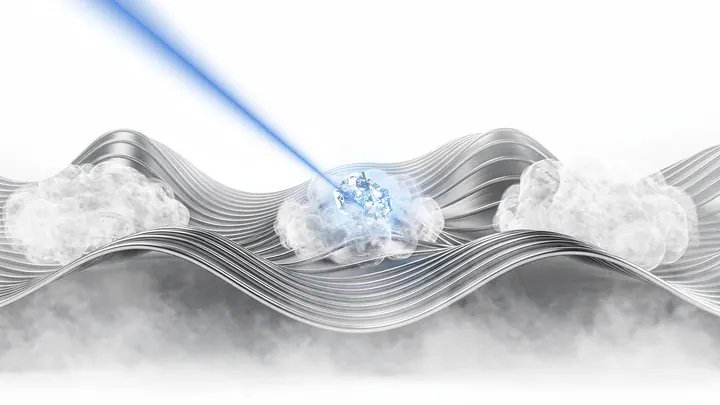
Imagine an old theater in the damp fog. On the stage, a scattering of actors, but only one is caught by the spotlight beam, made to freeze in the bright patch. The rest billow in the dim light, ready to dissolve at any moment.
The classical neuron is a chamber musician, drawing only one note from each string: it takes a weighted sum of inputs, adds a bias, and passes it through a nonlinearity.
Quantum spin chains resemble a line of people passing along a secret handshake: each turns to a neighbor, and how firmly they clasp palms determines how the wave runs through the entire chain. In the ideal Heisenberg chain, quantum magnetism’s bedrock, all handshakes are equal.
Imagine a book being simultaneously copied by trillions of scribes. As long as most of them check against the original, the narrative remains meaningful. But once control weakens, the text accumulates typos, which multiply until the manuscript turns into gibberish.
A regular object moves along a predictable path, like a ball. In the quantum world, a particle is smeared into a probability cloud. To find order in this fog, scientists have recast Schrödinger's equation in the language of flowing water.
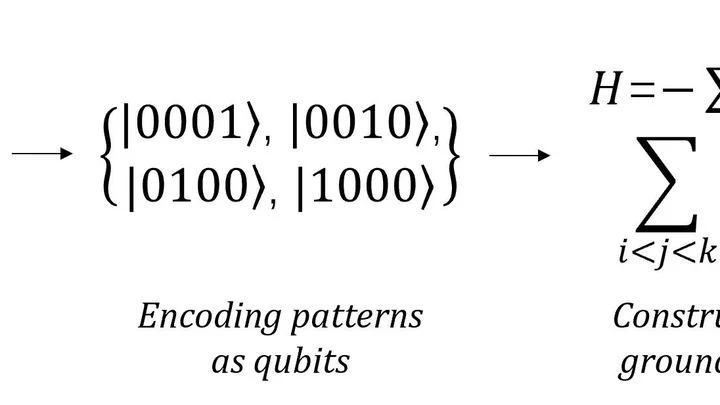
A network of tiny magnets seeks the state with the lowest total energy: that's roughly what the quantum Max Cut problem looks like, one of the toughest in physics. Scientists have been hunting for its solution since the days of Werner Heisenberg.
You can think of a political system as a vast galaxy — a gravitationally bound system of stars, gas, and dust. In this analogy, parties are the stars, radiating the light of public activity, while their supporters are dark matter, the invisible substance that emits no electromagnetic radiation but whose mass holds the whole structure…
A lithium battery is like a tiny city: lithium ions are the residents who move between electrode neighborhoods, generating current. But to understand how much energy the city can deliver, you need to know not only the street layout (the material's structure) but also how residents interact with neighbors, transportation, and even the weather.
In the scorching heart of a dying star, an invisible stream is born — a neutrino gas. The particles race through matter almost without stopping, but when their density is enormous, they start to feel each other. Old calculations described this as a jostle in a crowd: each shove changes direction, but no connection arises between passersby.
Computational studies of material behavior have long suffered from two extremes: either fast but inaccurate models, or accurate but slow physical calculations. Modern programs, trained on data, have nearly resolved this dilemma — now the bottleneck is not computing power, but human routine: setting up simulations and checking results.
Paimon works like an autonomous chef.
A thrown stone follows a smooth arc: its path is easy to predict. But if the stone skips across water, the trajectory becomes jagged and far more interesting. Quantum particles behave much the same way when their state is not a calm wave with fixed energy but a turbulent mix of several waves at once.
An orchestra plays without a conductor, and you hear the tempo speeding up and slowing down. All you have is a recording of the sound, not the score. Can you tell from that recording which string to pluck to make the whole orchestra play more steadily?
A quantum particle traveling around a closed ring leaves two distinct 'records' along its path. The first is like a fingerprint on a doorknob: it remains unchanged no matter how many times you turn the knob, and it only tells you about the shape and material.
Conventional neural networks learn from thousands of examples, burning hours and gigawatts. Physicists have found a quantum workaround. As early as Max Planck showed the discreteness of energy, today this allows generation without training.
Two quantum particles are linked by an invisible thread: one loses energy, the other gains it, but the total remains unchanged. If you watch only the first, its oscillations don't fade — the rhythm is steady, like that of a cosmic pulsar, even though it seems that entropy and chaos are increasing.
A translator gets distracted by every rustle in the hall, and a one-hour meeting stretches into two. That's roughly how ordinary quantum mechanics works: a particle evolves in time, while space serves as the stage. But what if we swapped their roles? Then the particle 'moves' through space, and time becomes a static backdrop.
A quantum bit (qubit) is a delicate thing. Even a little heat destroys it, like a random nudge topples a crystal wine glass. To protect this fragile information, physicists have built a three-dimensional quantum structure resembling a Russian doll.
A quantum battery is not a box of chemicals but a chain of tiny magnets (spins) capable of storing energy. Its main trick: charge many particles at once, using their quantum entanglement. But there's a catch — not all entanglement works.
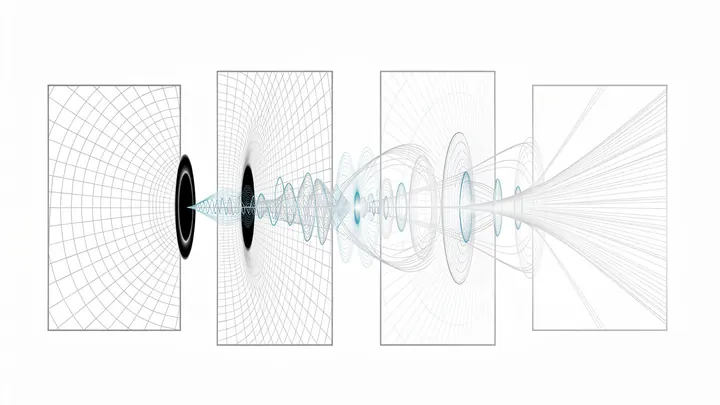
Classical general relativity predicts: a singularity hides inside every black hole. In this region, spacetime curvature skyrockets to infinity, and Einstein's equations lose meaning.
Quantum computers promise to solve problems that regular computers can't. But where is the line? The authors of a new study stumbled upon a surprising case: electrons paired up behave like a well-behaved orchestra. Even if you add a bit of "magic"—a special quantum resource: their behavior remains predictable.
A drop of cream falls into a cup of coffee, and within a minute, the entire drink turns beige. This mixing process can be quantified: how much "stirring" is needed to transform one distribution of particles into another? In mathematics, this approach is called optimal transport, and the measure of effort is the Wasserstein distance.
The authors applied this idea to quantum systems.
Quantum annealing works like a smart way to find a path through a maze: instead of checking every dead end, it uses quantum effects to find the exit faster. But this maze has a quirk: the numbers that describe the walls and corridors must be roughly the same size.
A quantum dot is a trap for electrons, just a few atoms in size, where a particle behaves like a ball in a tiny box. Place two such boxes side by side, and electrons can hop between them, making the system akin to a pair of communicating vessels.
In everyday life, time flows on its own, like a river past its banks. But in quantum gravity, things are different: time does not flow; it emerges from relations between objects, like a pattern in a carpet that is only visible when viewed from a certain spot.
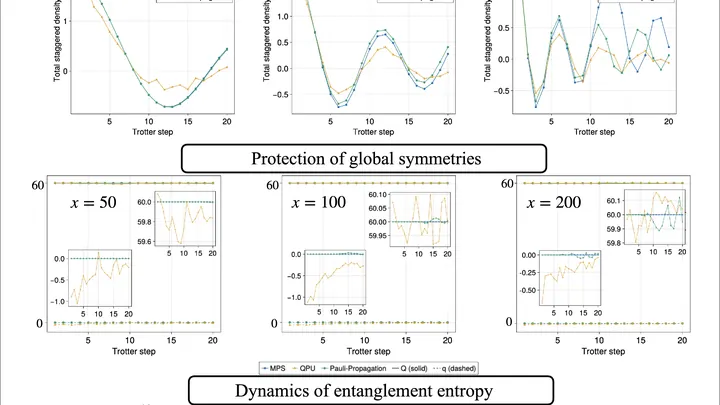
A three-seat swing never stops: one rider is always left hanging. That’s a frustrated magnet — a perpetual dance with no rest. To study it, physicists built a quantum simulator from 256 atoms, meticulously mimicking the crystal TmMgGaO₄.
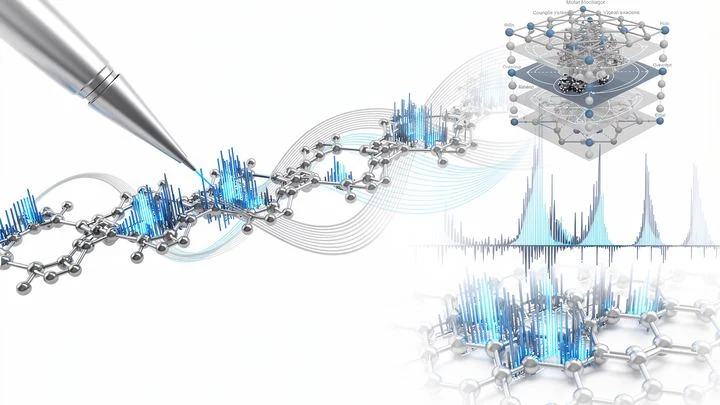
A water molecule resembles a tiny dumbbell: two hydrogen atoms attach to an oxygen atom at an angle. This dumbbell doesn't stay still: it stretches, compresses, and rotates. Each such motion has its own energy, like steps on a ladder.
Inside a proton, quarks are held together by gluons, like springs. Let go of one quark — the spring stretches and snaps, creating a new quark. That's the strong force at work, and simulating it in real time on a regular computer is nearly impossible: there are too many possibilities, all tangled together.
Enter the quantum computer.
Each qubit has its own little ring, freely sliding on the doughnut. All quantum logic boils down to smooth movements: shift, flip, connect. Entanglement, for example, is when two doughnuts stick together, and the rings on them begin to spin synchronously, like figure skaters in pairs skating.
The key insight: the geometry of the surface dictates the rules of the game.
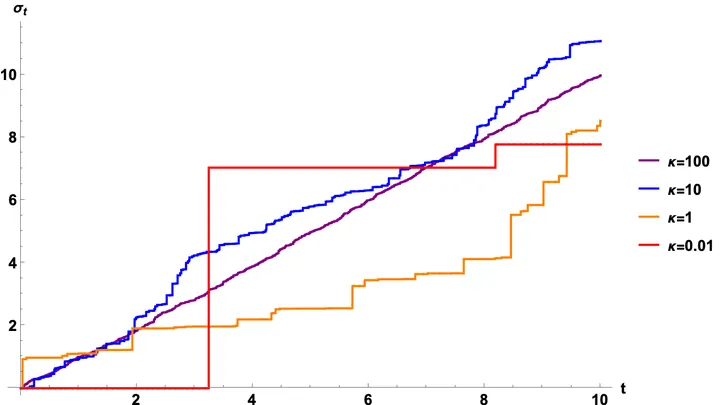
A regular wall clock runs smoothly, but quantum clocks are a different story. They tick at random moments, and each tick can have a different duration. On average, if you watch such a clock for a long time, it will show the correct time. But at any given moment, its hand might jump forward by an unexpected amount.
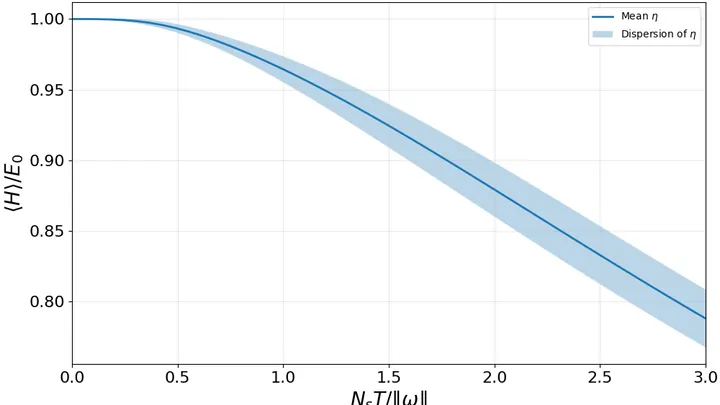
The quantum world is full of surprises: even simply observing a particle changes its behavior. In a new study, physicists showed that continuously measuring energy can make quantum chaos more pronounced. They used a quantity that indicates how long a quantum state remains similar to itself under repeated measurements.