The Hunt for the Galaxy's Fastest Star ✛
Context
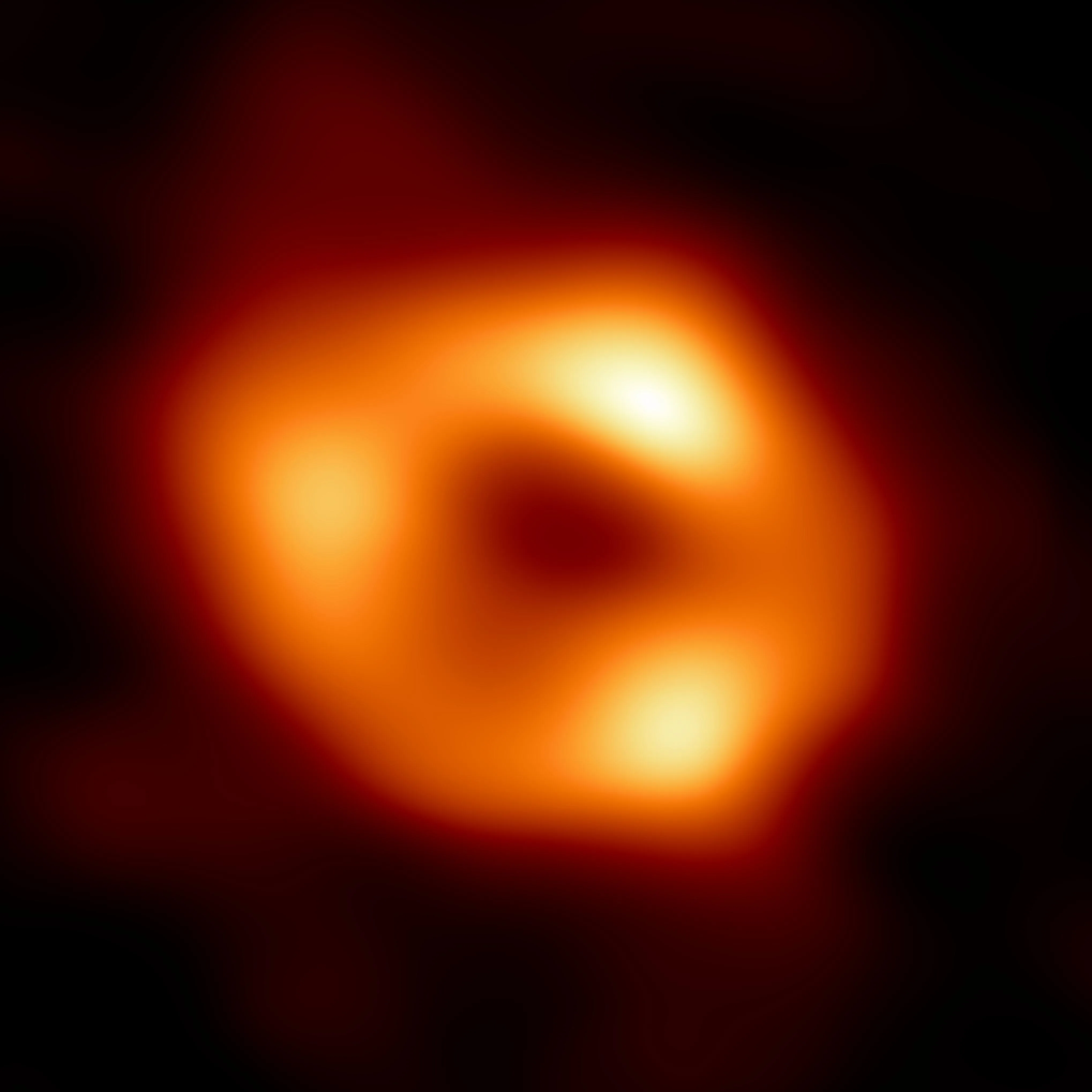
At the center of the Galaxy, dozens of stars orbit the supermassive black hole Sgr A*, and they have enabled the strongest tests of general relativity in a black hole's field to date: the gravitational redshift and the Schwarzschild precession of star S2. However, S2 passes pericenter at about 1400 Schwarzschild radii and has a period of 16 years. The recently discovered star S301 has half the period (8.68 years), is ten times closer to the horizon (136 Schwarzschild radii), and moves at 25,600 km/s at pericenter, making it the fastest known star in the Galaxy. Such an orbit should precess noticeably faster than S2's, but S301 is more than a hundred times fainter, so it can only be tracked with interferometric astrometry on the GRAVITY+ facility. The question is whether astrometry alone can confidently measure the precession over two pericenter passages, given that the first one in 2031 is hidden behind the Sun.
Methods
The authors built the full pipeline needed for a telescope time proposal. They took the published orbital elements of S301 from the GRAVITY Collaboration's 2026 solution, developed a relativistic model of the light curve with the exact Doppler factor and gravitational redshift, and compared four cadence schemes under a fixed budget of 131 epochs. The optimal scheme D reserves 40% of epochs for windows of ±20 days around both pericenters, distributing the remaining epochs via a greedy search based on the Fisher information averaged over orbital element uncertainties. The fit includes seven parameters: six Keplerian elements and the precession rate, with the light travel time from the star accounted for exactly through Newtonian iterations. Systematic errors are modeled in three tiers: terms that can be included in the fit (the Sgr A* reference point, mass, and distance), terms that can be constrained and added as biases (extended mass, gravitational lensing, source confusion), and correlated noises (calibration drifts and the wandering photocentre of Sgr A*), which are estimated from 40 independent realizations.
Results
With white noise at 207 microarcseconds per epoch, as achieved on S301 in the discovery data, the fit recovers the injected precession rate of 0.2307 degrees per year as 0.2324 ± 0.0023 degrees per year, i.e., with a formal significance of 96 sigma. If GRAVITY+ reaches the projected 100 microarcseconds, the precision improves to ±0.0012 degrees per year. However, real noise is not white. Adding calibration drifts of 60 microarcseconds per run and red noise from the Sgr A* photocentre with an amplitude of 50 microarcseconds and a correlation time of half a year increases the scatter by a factor of 2.09. Joint marginalization over the reference point, mass, and distance, adding constrained biases in quadrature, and empirical inflation by sqrt(χ²_red) = 1.47 from real GRAVITY fits yield a final precision of 0.0074 degrees per year, which is 3.2% of the signal and corresponds to a 31-sigma detection. Solar contamination hides the first pericenter for 153 days, but this only degrades the period and epoch of pericenter, not the precession rate. Radial velocities are unattainable at S301's brightness (mK = 19.3), and photometry merely confirms the light-curve model: χ²/N = 1.05.
Implications
This work shows that astrometry with GRAVITY+ alone can provide an independent test of general relativity in the field of a supermassive black hole, without requiring knowledge of its spin. Unlike neighboring studies that either model many stars to extract Lense-Thirring precession or analyze existing S2 data, this is the first time a detailed observing strategy has been developed for a specific, most extreme star, S301, over two future pericenter passages. The main difference from S2 studies is the scale: S301's pericenter is ten times closer, the precession rate is an order of magnitude higher, and thus the demands on systematics are stricter. The authors honestly show that the black hole's spin could shift the measured quantity by 5–6%, so they call the test spin-agnostic, leaving spin measurement to a multi-star approach.
Future development
If the campaign is approved and executed, it will provide the first direct measurement of Schwarzschild precession for a star with a pericenter of only 136 Schwarzschild radii. Looking ahead, adding radial velocities with future instruments such as HARMONI on the Extremely Large Telescope will break the mass–distance degeneracy and further constrain the orbital parameters. The multi-star method developed in parallel work could use S301 as one of the anchors to extract the spin contribution via Lense-Thirring precession. Finally, accumulating epochs after 2041 will turn the observations into a long-term monitoring program that tests the stability of precession over decades.
Impact
The result will influence the planning of GRAVITY+ observing programs and future instruments for the Galactic center, as well as strategies for testing general relativity in the strong-field regime.
Next steps
Submit a proposal for GRAVITY+ observing time for the 2028–2041 campaign with the proposed cadence. In parallel, prepare the spectroscopic channel on ELT/HARMONI for the second pericenter in 2040.
Key open problems
For Galactic center astrophysics, measuring the spin of the supermassive black hole Sgr A* remains a key unsolved problem. This work does not solve it directly but creates the necessary foundation: a validated pipeline for astrometry and error budgeting for the fastest star, which can later be included in a multi-star analysis to extract Lense-Thirring precession. Another open problem is the contribution of extended mass inside S2's orbit, which is constrained here but not completely ruled out.
The knowledge machine's view
This section is addressed to the author of the paper and their colleagues. Neighbouring works were found by meaning-based search across our archive, not by word overlap. We do not review: we show the field around the work.
What the work does
This paper presents an astrometric observation strategy for the star S301 with GRAVITY+ to measure the Schwarzschild precession of its orbit. The authors optimized the observing cadence using the Fisher criterion, built a systematic error budget, and showed that the precession will be detected with high significance.
Where its strength is
The strength of this work lies in the careful design of the observational strategy: it accounts for solar illumination at pericenter, correlated noise, and systematics, making the proposal for observing time nearly ready to submit.
Where it could go next
- The measured precession of S301 could be used to estimate the spin of Sgr A*, provided the contribution from the quadrupole moment can be separated from the Schwarzschild precession. Our archive contains an analysis that specifically considers S301 as a tool for measuring the black hole's spin.based on: The Celestial Compass: S301 and Measuring a Black Hole's Spin arXiv:2607.24931v1
- S301 may share a common origin with other stars in the vicinity of Sgr A*, and its orbit could carry information about the dynamical history of the cluster. Nearby, there is a paper that treats S301 as a 'lost twin' of another star, which might inspire ideas for a joint orbital analysis.based on: Stellar Fossils: S301 — The Lost Twin? arXiv:2607.22517v1
- Additional relativistic effects, such as the precession of the star's spin (Lense–Thirring effect) or the influence of possible extended mass, could be incorporated into the model. The archive includes a quick review of a paper where a spinning star is used to test general relativity, which may suggest ways to extend the analysis.based on: A Spinning Star Puts Gravity to the Test arXiv:2607.26134v1
Worth trying
- Try a joint fit of the S301 and S2 orbits to improve constraints on black hole parameters.
- Include a possible contribution from dark matter near Sgr A* in the model and assess its impact on the precession.
- Investigate how uncertainties in the mass and distance to Sgr A* correlate with the precession measurement and propose ways to reduce them.
Why this may matter
A successful measurement of S301's precession would provide an independent test of general relativity in a stronger gravitational field than that probed by S2, and could pave the way for determining the black hole's spin and studying the mass distribution near it.
Nearby works in our archive
- The Celestial Compass: S301 and Measuring a Black Hole's Spinsimilarity 0.63
- Stellar Fossils: S301 — The Lost Twin?similarity 0.58
- A Spinning Star Puts Gravity to the Testsimilarity 0.57
- A Star's Dance Puts Gravity's Symmetry to the Testsimilarity 0.57
- Star S2 Puts the Black Hole at the Center of the Galaxy to the Testsimilarity 0.54
- Dark Blizzard on the Edge of the Abyss: How Invisible Particles Ignite Starssimilarity 0.54
The closest work in the archive sits at 0.63 by meaning — the usual level for our corpus.
S301 moves at 25,600 km/s at pericenter, more than 14 times faster than the fastest spacecraft ever launched by humans. If such a star needed to travel from Earth to the Moon, it would cover that distance in 15 seconds.
In Greg Egan's novel "The Light of Distant Stars," a civilization lives on a planet near a supermassive black hole, where orbital precession affects the climate. Here, the same physics is at play, but observed from a safe distance.
Key numbers
- pericenter speed: 25,600 km/s (8% of the speed of light)
- pericenter distance: 136 Schwarzschild radii
- precession rate: 0.2307 degrees per year
- final precision: 0.0074 degrees per year (31 sigma)
- duration of solar contamination: 153 days