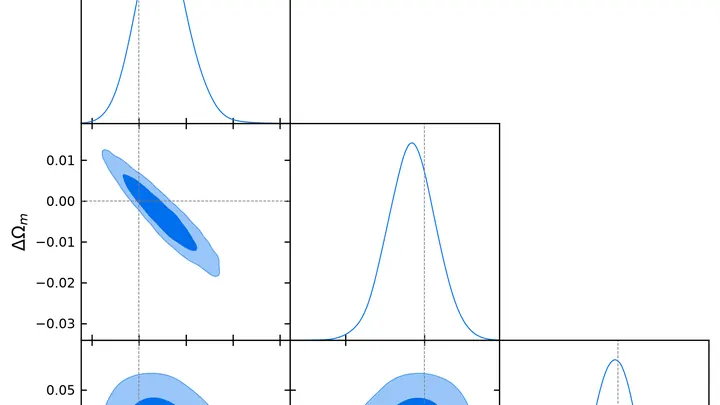
Sigma-8 (σ₈) is a cosmological parameter that measures the amplitude of matterdensity fluctuations on a scale of 8 megaparsecs (about 26 million light-years). It essentially quantifies how 'clumpy' the universe is on that scale — whether matter is distributed relatively smoothly or gathered into dense clusters and filaments. This parameter is crucial for testing our models of cosmic structure formation, as it bridges the early universe's initial conditions (set during inflation) and the large-scale structures we observe today, such as galaxy clusters and voids.
History
The concept of σ₈ was introduced in the 1980s as a convenient normalization for the matter power spectrum, popularized by studies of galaxy clustering and cosmic microwave background anisotropies. It became a standard cosmological parameter in the 1990s with the advent of precision cosmology.
How it works
Cosmologists derive σ₈ from observations of the cosmic microwave background (the relic radiation from the Big Bang), galaxy surveys, and gravitational lensing. The parameter is typically defined as the root-mean-square variance of the matter density field smoothed over spheres of radius 8 Mpc/h. In practice, it's extracted by comparing observed clustering patterns with predictions from cosmological models, often using power spectra. A key tension in modern cosmology is that measurements of σ₈ from early-universe probes (like CMB) tend to be slightly higher than those from late-universe probes (like galaxy clusters), hinting at possible new physics.
In practice
σ₈ is used to constrain dark energy models, test theories of modified gravity, and calibrate large-scale structure surveys like Euclid and the Dark Energy Survey.
Fun fact
The '8' in σ₈ is not arbitrary — it was chosen because on that scale, the density fluctuations are still linear (not yet collapsed into bound structures), making them easier to model theoretically.
Light from a distant galaxy reaches us through its own dust. This dust is not a smooth haze but ragged clouds, like wisps of cotton. Old models treated it as a uniform mist, and then the galaxy didn't add up energetically: too much light disappeared in the ultraviolet and too little came back in the infrared.
Astronomers did what a cook does when they dice a potato instead of tossing it in whole.
The five-hundred-meter FAST radio telescope picked up a signal at the 21-centimeter wavelength — the telltale glow of cold hydrogen. The signal came from a cloud named Cloud-9. It hangs in space near the galaxy M94, but it contains not a single star.
The standard cosmological model ΛCDM (which includes dark energy and cold dark matter) is the score of a cosmic symphony. It describes how space expanded after the big bang. How dark matter clumped together. How galaxies ignited. For a long time, everything played flawlessly.
Cosmology has landed in an interesting pickle. The two main ways to look back into the universe's past, via the early glow (the cosmic microwave background) and via later objects like supernovae, yield different numbers for the expansion rate (the Hubble constant) and for how clumpy matter is distributed.
Light from a distant galaxy travels across the universe, passing through vast clumps of dark and ordinary matter. Their gravity slightly bends the path of the rays, like a river's current flowing around invisible boulders. In images, this shows up as a barely noticeable elongation of galaxy shapes, as if they were stretched on an invisible frame.
The Universe grows like a metropolis: galaxies skyscrapers are erected on an invisible scaffold of dark matter: its gravity pulling in construction material. Meanwhile, dark energy makes the city itself continuously expand.
The Universe resembles a dense forest: up close, individual galaxy-trees are visible, gathered into groves, but from a distance everything merges into a solid green canopy. The boundary beyond which the cosmos becomes homogeneous is called the angular scale of homogeneity: it's the size of a patch of sky from which galaxies are distributed evenly.
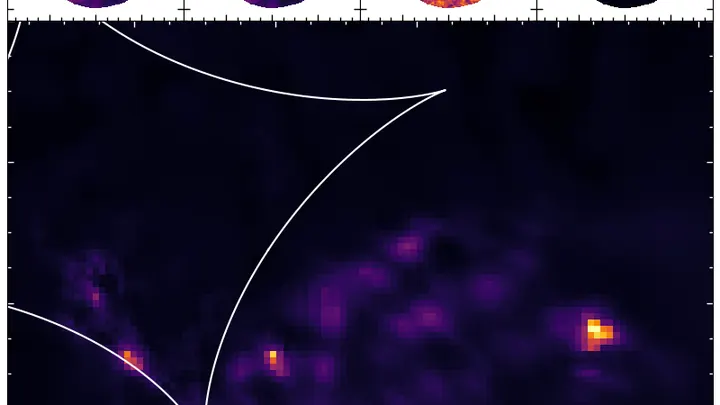
A magnifying glass focuses sunlight into a bright point. If the glass has a tiny flaw, the spot of light becomes distorted. Gravitational lensing works in a similar way: a massive galaxy bends light rays from a more distant source, creating an enlarged and sometimes distorted image.
Two clocks tell different times. One sits on our desk, the other lies far in the past, in the glow left over from the Big Bang. The first, looking at nearby galaxies, ticks off the expansion rate of the universe — about 73 kilometers per second per megaparsec of distance. The second, peering into ancient light, gives a noticeably lower value — roughly 67.
The universe keeps a tally of every newborn star. Over 13.8 billion years, galaxies have ignited so many stars that their 'census' can reveal the nature of the cosmos itself, just as tree rings reveal past climates.
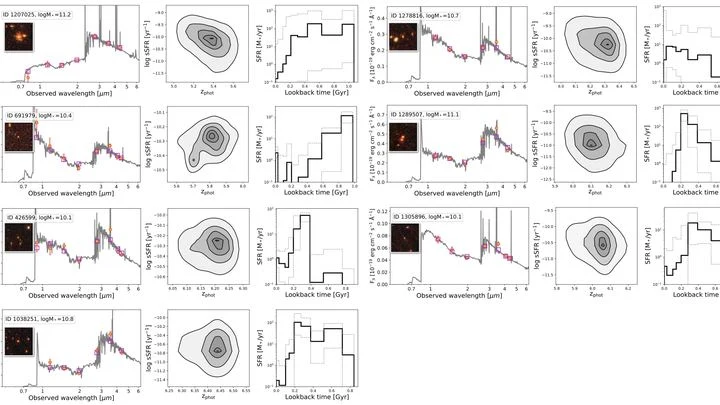
In the first few hundred million years after the Big Bang, the cosmos was like a noisy teen club: galaxies flared up, collided, and churned out stars by the hundreds.
If space is a canvas, then brushstrokes cannot be infinitely thin. There's a tiniest segment, shorter than which there's no point in measuring. This quantum 'graininess' alters the geometry itself: the motion of galaxies and the growth of large-scale structures bear its mark.
Weighing a cloud of hot gas the size of a million galaxies is no easy task. Astronomers observe how this gas bends light passing by, and from that bending they calculate its mass. But the gas in galaxy clusters is not static: it churns like a boiling pot, and some of the pressure goes into turbulence rather than holding the gas against collapse.
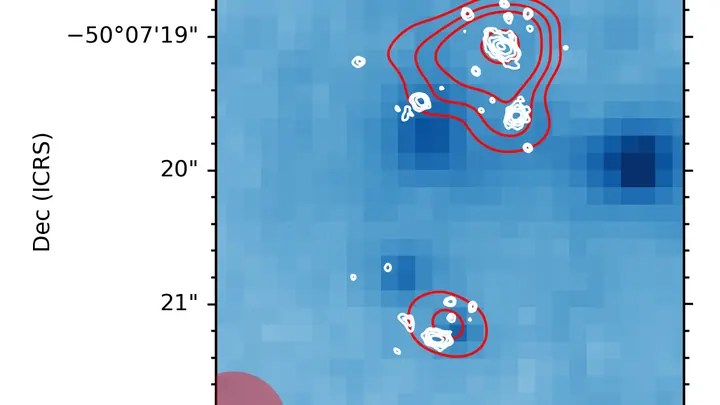
Inside cold clouds of gas and dust where new stars ignite, astronomers have spotted unexpectedly delicate structures. The ALMA telescope, working in the millimeter range, has revealed more than 323 ultra-thin dust filaments within 121 massive clumps.
In the nearly empty regions of space, galaxies spin in unison, like dancers in the same troupe. This dance creates a difference in light from opposite sides: on one side stretching, on the other compression. This optical shift has become a probe of the first moments after the Big Bang.
The merger of two neutron stars is like a strike on a gong: a ripple in space, a gravitational wave, spreads through the universe. Detectors on Earth catch this ripple and, from its strength, calculate the distance to the source.